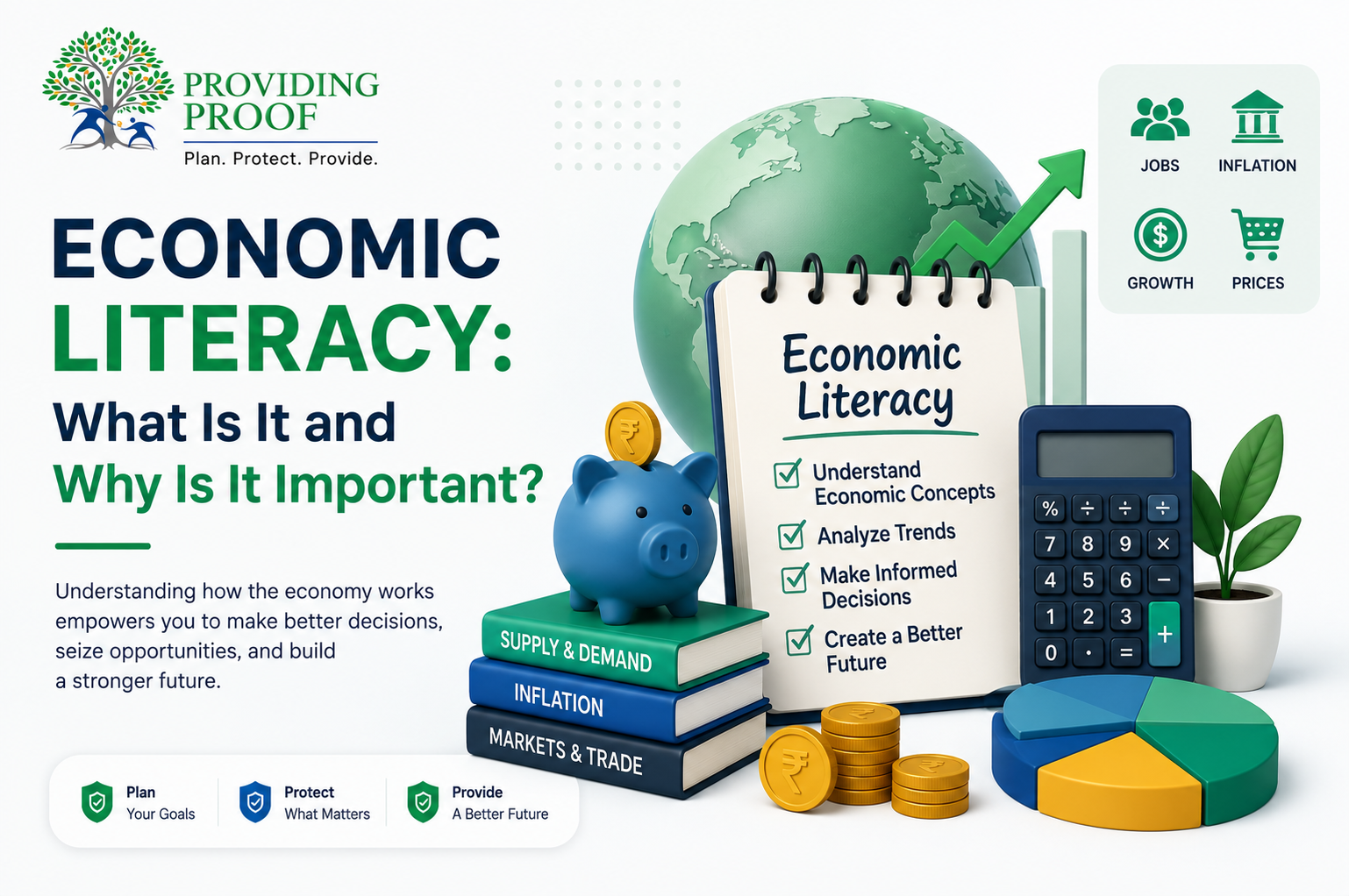
Every day, millions of people make decisions that carry real economic weight. They choose between renting and buying, take on debt, pick a career path, or vote on policies that shape communities for generations. Yet most of these decisions happen without a solid grounding in economics. That gap between the choices people face and the knowledge they need to make those choices well is exactly what economic literacy is designed to close.
At Providing Proof, we believe that preventative resources are often the most powerful ones — and economic literacy is one of those overlooked resources that can change the trajectory of a life. Understanding economics is not reserved for Wall Street analysts or policy experts. It belongs to everyone, especially the millions of young people who navigate systems that were never designed with their financial or civic success in mind.
This guide breaks down what economic literacy truly means, why it matters at every stage of life, how it connects to and differs from financial literacy, and why building this knowledge from an early age is one of the most impactful investments any individual, educator, or community can make.
What Is Economic Literacy and How Is It Defined
Economic literacy refers to the ability to understand how economies function, how markets operate, how prices are determined, how employment works, how governments use fiscal and monetary tools, and how individual decisions interact with larger systems. It is the capacity to read the economic world around you and make sense of what you see.
When people ask what is economic literacy, the answer goes beyond a list of definitions. Economic literacy is practical. It allows someone to understand why gas prices rise after a hurricane, why interest rates affect mortgage payments, why unemployment tends to fall when consumer spending rises, and why trade policies affect local jobs. It connects the abstract machinery of economics to the lived experiences of real people.
Economic literacy is not simply knowing that supply and demand affect price. It is understanding why that happens, what forces influence supply and demand, and how that dynamic plays out differently in a small town versus a global marketplace. It is the ability to evaluate claims made by politicians, employers, news outlets, and financial institutions — and to think critically rather than accept information at face value.
This kind of thinking is a skill, and like all skills, it can be taught, practiced, and developed. That is why economic education is not a luxury. It is a necessity.
The Importance of Economics in Everyday Life
The importance of economics extends far beyond classrooms and research papers. Economics shapes the environment in which every human being lives. The price of food, the availability of housing, the quality of healthcare, the wages people earn, the taxes they pay, the opportunities available to them — all of these are products of economic systems and the policies that govern them.
When people lack economic literacy, they are often left to make critical decisions without understanding the forces shaping their options. A young person who does not understand how interest compounds might take on student loans without grasping the full cost over time. A family that does not understand inflation might not realize that a pay raise that keeps pace with inflation is effectively no raise at all. A voter who does not understand how government spending works might support or oppose policies based on incomplete or misleading information.
Why is economic important in this context? Because the consequences of economic decisions do not stay in the abstract. They appear in household budgets, in job markets, in retirement savings, in the quality of public services, and in the health of communities. People who understand these connections are better positioned to advocate for themselves, plan ahead, and participate in the economic life of their society.
The importance of economics is especially visible when economic systems fail. Recessions, inflation spikes, and unemployment crises affect everyone — but they tend to hurt those with the least knowledge and fewest resources the most. Economic literacy does not eliminate vulnerability, but it can reduce it significantly.
Why Are Economic Systems Important for Communities and Nations
To understand why are economic systems important, it helps to consider what life would look like without them. Economic systems provide the framework through which societies decide what to produce, how to produce it, and who receives the benefits. They coordinate the activity of millions of individual actors — consumers, businesses, governments, and international partners — in ways that no single person or institution could manage alone.
Economic systems matter because they determine whether resources flow efficiently, whether opportunities are distributed fairly, and whether growth benefits a broad population or concentrates at the top. A society without a functioning economic system would face shortages, surpluses, and the breakdown of the cooperation that enables complex civilizations.
From a community standpoint, understanding the economic system in which you live means understanding why certain neighborhoods have more job opportunities than others, why certain schools are better funded, why some businesses thrive and others close, and why local governments face budget constraints that affect the services available to residents. These are not purely political questions. They are deeply economic ones.
For young people growing up in communities shaped by economic disparity, understanding why are economic systems important is especially urgent. The ability to recognize systemic forces — and to engage with the structures that perpetuate or challenge them — begins with economic literacy. It turns passive acceptance into informed participation.
The Difference Between Economic and Financial Literacy
One of the most common points of confusion is the difference between economic and financial literacy. These two concepts are related, but they operate at different levels and serve different purposes.
Financial literacy focuses on the personal and practical. It covers skills like budgeting, saving, understanding credit scores, comparing loan terms, managing debt, and planning for retirement. Financial literacy is primarily about how an individual navigates money within the existing economic environment. It answers questions like how do I save more, how do I get out of debt, how do I choose between these two investment options.
Economic literacy, on the other hand, operates at a broader level. It addresses how the entire economic environment works — how markets function, how national and global economic forces affect wages and prices, how trade and monetary policy shape opportunities, and how economic decisions made by governments ripple through communities. Economic literacy answers questions like why are prices rising, why is unemployment affecting this industry, what happens when a central bank changes interest rates, and how do economic inequalities develop and persist.
Understanding the difference between economic and financial literacy is important because both are necessary, and neither fully substitutes for the other. A person can be financially literate without being economically literate, meaning they manage their personal finances well but do not understand the broader forces shaping their options. A person can be economically literate without being financially literate, understanding market forces at a macro level but struggling to apply that knowledge to personal decisions.
The most empowered individuals develop both. Economics with financial literacy gives people the ability to understand both the forest and the trees — to see how the broader economy shapes their personal circumstances, and to make smart personal decisions within that context.
How Economics and Financial Literacy Work Together
Economics and financial literacy are most powerful when they are developed together. The relationship between them is one of context and application. Economics provides the context — the understanding of how systems work, why prices move, why employment changes, why certain industries grow or decline. Financial literacy provides the application — the practical skills to make good decisions within that context.
Consider saving for retirement. Financial literacy teaches someone to contribute consistently to a retirement account, diversify investments, and take advantage of employer matching. But economics and financial literacy together help that person understand why inflation erodes purchasing power, how interest rates affect investment returns, why certain asset classes perform differently during economic cycles, and how government policy changes like changes to tax law could affect their savings strategy.
Or consider the decision to start a business. Financial literacy covers cash flow management, understanding profit margins, and managing operating costs. Economics with financial literacy adds understanding of market demand, competitive dynamics, how macroeconomic conditions affect consumer spending, and how to assess whether the broader economy is favorable for a particular business model.
For young people especially, developing economics financial literacy means gaining both layers simultaneously. Rather than learning personal finance in isolation — without any understanding of why the economy works the way it does — they gain a richer, more connected understanding that serves them throughout life.
Why Is Economic Education Important for Young People
Why is economic education important? Because the decisions young people are asked to make are consequential, complex, and deeply influenced by economic forces they may not yet understand.
A teenager choosing between a two-year and four-year college program is making an economic decision. A young adult deciding whether to rent or live at home while saving for a house is making an economic decision. Someone choosing a career field, a city, or a type of employer is making a decision shaped by labor market economics. Without economic education, these choices are made on instinct, peer pressure, or incomplete information.
Economic education equips young people with the frameworks to think through these decisions more carefully. It helps them ask better questions, evaluate trade-offs, and understand the long-term implications of choices that might feel abstract in the moment. When a young person understands that career choices interact with labor market trends, they are more likely to make informed decisions rather than simply following the path of least resistance.
Why is economic education important from a civic standpoint? Because democracies function better when their citizens understand how economic policies work. A population that cannot evaluate the economic implications of proposed legislation, tax policy, or trade agreements is at a disadvantage when it comes to holding elected officials accountable. Economic education supports not just individual flourishing but healthy democratic participation.
Beyond individual and civic benefits, economic education has demonstrated long-term positive effects on financial behavior. Research consistently shows that people with stronger economic and financial literacy save more, carry less high-cost debt, make more informed investment decisions, and are better prepared for financial emergencies. Economic education is genuinely preventative — it reduces the likelihood of costly financial mistakes that can take years or decades to recover from.
The Real-World Impact of Low Economic Literacy
Low levels of economic literacy carry measurable costs — for individuals, for families, and for society as a whole. When people do not understand how interest works, they are more likely to make poor borrowing decisions. When they do not understand inflation, they may fail to plan adequately for the future. When they do not understand how labor markets work, they may underestimate their own bargaining power or choose fields without considering long-term demand.
At a broader level, low economic literacy makes populations more vulnerable to misleading political claims. Economic misinformation flourishes where economic understanding is thin. When people cannot evaluate the plausibility of claims about trade, employment, or government spending, they are more susceptible to arguments that distort or ignore economic evidence.
Low economics financial literacy also contributes to cycles of debt and economic insecurity. Predatory lenders, payday loan companies, and other high-cost financial products specifically target populations with limited financial and economic knowledge. The less someone understands about interest rates and total cost of borrowing, the easier it is to sell them a product that works against their interests.
Addressing this requires a genuine commitment to economic and financial education — starting young, reaching across income levels, and treating it not as an optional enrichment topic but as a core component of preparing people for adult life.
Economic Literacy Across Different Life Stages
Economic literacy is not a one-time lesson. It develops throughout life, and the relevant dimensions of it shift as people move through different stages.
In childhood, the foundations of economic thinking begin with simple concepts — understanding that money is exchanged for goods and services, that resources are limited, and that choices involve trade-offs. These early experiences plant the seeds of economic reasoning.
In adolescence, economic literacy expands to include understanding the labor market, the relationship between education and earning potential, the basics of taxation, and the mechanics of banking and credit. This is also the stage where the difference between economic and financial literacy begins to matter in practical terms — young people need both the personal finance skills to manage their first jobs and savings accounts, and the broader economic understanding to make sense of the world they are entering.
In early adulthood, economic literacy becomes directly relevant to high-stakes decisions about housing, career, family formation, and long-term savings. The ability to evaluate labor market conditions, understand mortgage terms in relation to interest rate environments, assess the economic outlook for a chosen career field, and think critically about investment options all draw on a robust foundation of economic and financial literacy.
In middle and later adulthood, economics financial literacy continues to matter for retirement planning, estate planning, healthcare cost management, and navigating the economic implications of major life changes. People who built economic literacy earlier in life are better positioned to adapt to changing economic conditions at every stage.
How Economic Literacy Connects to Social Justice
Economic literacy is not politically neutral. It is a tool of empowerment, and its absence is a form of disadvantage that often follows patterns of inequality. Communities with less access to quality education are less likely to receive strong economic education. Young people from lower-income backgrounds are less likely to grow up in households where economic concepts are discussed or modeled. The gap in economic literacy mirrors and reinforces existing inequalities.
This is why the importance of economics education is especially strong in underserved communities. Access to economic knowledge is, in an important sense, access to power. When a young person understands how wealth is built, how institutions shape economic outcomes, and how individual decisions interact with systemic forces, they are equipped to navigate and challenge those systems rather than simply being shaped by them.
At Providing Proof, we see economic literacy as a form of preventative resource — one that, like so many others, is often overlooked in the communities that need it most. Bridging the gap in access to economic education is not just an academic goal. It is a matter of equity.
Building Economic Literacy Through Practical Experience
One of the most effective ways to build economic literacy is through practical, applied experience. Abstract lessons about supply and demand gain meaning when students see those principles at work in their own lives. A student who runs a small business as part of a class project understands profit margins differently than one who reads about them. A young person who tracks their own budget over a semester understands the difference between fixed and variable costs in a way that a textbook definition cannot fully convey.
Effective economic education connects theory to lived experience. It asks students to look at the price of goods in their neighborhood and analyze why prices differ from neighborhood to neighborhood. It asks them to examine local employment patterns and consider what economic forces shape those patterns. It invites them to read a news article about inflation and apply the frameworks they have learned to evaluate the information critically.
This kind of education develops not just knowledge but judgment — the capacity to apply economic thinking to new situations, to evaluate claims, and to make reasoned decisions. That judgment is the real goal of economics financial literacy, and it is built through engagement, application, and reflection rather than passive memorization.
The Role of Schools and Institutions in Promoting Economic Education
Schools are the most natural and powerful vehicle for expanding economic literacy at scale. When economic education is embedded throughout the curriculum — not just as a standalone course, but as a lens applied across subjects — students develop a richer and more integrated understanding of the economic world.
History courses can incorporate economic history and analysis. Social studies can examine the economic dimensions of policy and community life. Math classes can apply quantitative reasoning to economic data. Even English and humanities courses can engage with economic themes in literature and media. The more economic thinking is woven through education, the more natural and accessible it becomes.
Beyond schools, libraries, community organizations, nonprofits, and online platforms all have roles to play in expanding access to economic education for people of all ages. The importance of economics education is not limited to formal schooling. Adults who missed rigorous economic education in school benefit from accessible, relevant resources that connect economic concepts to their current circumstances.
Institutions that prioritize economic education demonstrate a commitment to the long-term flourishing of the people they serve. They recognize that economic literacy is not a nice-to-have — it is a prerequisite for informed, empowered participation in economic and civic life.
Economics Financial Literacy in the Digital Age
The digital economy has added new dimensions to what economics financial literacy needs to cover. Cryptocurrencies, algorithmic trading, platform economics, the gig economy, data as a commodity, and the economic power of digital platforms are all concepts that previous generations did not need to navigate. Today’s young people do.
Understanding the economics of digital platforms means understanding how companies like social media networks, search engines, and e-commerce marketplaces generate value, capture data, and translate user behavior into revenue. Understanding the gig economy means understanding how digital platforms have restructured the labor market in ways that affect income stability, benefits access, and long-term economic security.
These are not niche topics. They are central features of the contemporary economy that affect the decisions young people make about work, spending, and participation in digital life. An updated understanding of economic literacy in the digital age must include these dimensions — not just the traditional economic concepts that have always been essential, but the new economic realities that require new frameworks.
Why Choose Providing Proof for Your Economic Literacy Journey
At Providing Proof, we are not simply passing along information. We are cultivating knowledge with a purpose — bridging the economic literacy gap for the millions of young people who face limited opportunities due to economic disparity. Our curriculum is built around the conviction that preventative resources, including economic and financial education, are the most overlooked and most powerful tools available to young people. We design our resources to be accessible, honest, and deeply rooted in the realities our communities face. We do not water down complex concepts — we make them relevant, actionable, and connected to real life. Whether you are a young person taking your first steps into economic understanding, an educator looking for meaningful curriculum, or a supporter who believes in the power of economic knowledge to transform lives, Providing Proof is your partner in building the economic literacy that makes lasting change possible.
Frequently Asked Questions About Economic Literacy
Q. What is economic literacy in simple terms?
Economic literacy is the ability to understand how economies work and how economic forces affect everyday life. It includes understanding concepts like supply and demand, inflation, unemployment, interest rates, and the relationship between individual decisions and broader market outcomes. It is the knowledge needed to make sense of economic information and make informed decisions as a consumer, worker, voter, and citizen.
Q. What is the difference between economic and financial literacy?
Financial literacy focuses on personal money management — budgeting, saving, borrowing, and investing at an individual level. Economic literacy focuses on how broader economic systems work — markets, prices, employment, trade, and policy. Both are important. Economic literacy provides the context in which financial decisions are made, while financial literacy provides the practical skills to act on that understanding.
Q. Why is economic education important for young people?
Young people face major economic decisions early in life — about education, employment, housing, and debt. Without economic education, these decisions are made without a solid understanding of the forces shaping their options. Economic education helps young people think critically about trade-offs, understand labor markets, evaluate financial products, and participate meaningfully in civic and economic life.
Q. Why are economic systems important?
Economic systems coordinate how societies produce, distribute, and consume goods and services. They determine how resources are allocated, what opportunities are available, and how wealth is distributed. Understanding economic systems is essential for recognizing the forces that shape community conditions, employment opportunities, and quality of life.
Q. How do economics and financial literacy work together?
Economics and financial literacy are complementary. Economic literacy helps you understand the broader forces shaping prices, wages, and opportunities. Financial literacy helps you make smart personal decisions within that environment. Together, they give you both the big-picture understanding and the practical skills needed to navigate financial life effectively.
Q. Can economic literacy be self-taught?
Yes. While formal education provides a structured path to economic literacy, there are many high-quality resources available for self-directed learning, including books, online courses, reputable news sources, government publications, and nonprofit educational programs. The key is to engage actively and connect what you learn to real-world situations.
Q. What are the benefits of improving economic literacy in a community?
Communities with higher levels of economic literacy tend to have stronger civic participation, better financial decision-making at the household level, greater awareness of economic inequality and its causes, and more informed engagement with policy discussions. Economic literacy contributes to individual flourishing and to the health of communities as a whole.
Q. Why is it important to understand inflation and interest rates?
Inflation and interest rates affect nearly every financial decision a person makes — from the purchasing power of a paycheck to the cost of borrowing for a home or education. Understanding how these forces work helps individuals plan more effectively, evaluate financial products, and interpret economic news with greater accuracy.
Q. How does economic literacy relate to reducing poverty?
Economic literacy alone does not eliminate poverty — structural changes are required for that. But it equips individuals with the tools to understand and navigate the systems they live within, to access opportunities more effectively, and to avoid costly financial pitfalls. In communities where economic education has been a priority, research shows improved long-term outcomes in savings behavior, employment, and financial stability.
Q. At what age should economic education begin?
Economic concepts can be introduced in age-appropriate ways starting in early childhood. Basic ideas about scarcity, trade-offs, and exchange are accessible to young children. More complex concepts about markets, employment, and monetary policy can be introduced in middle and high school. The earlier economic education begins, the more natural and intuitive economic thinking becomes over time.