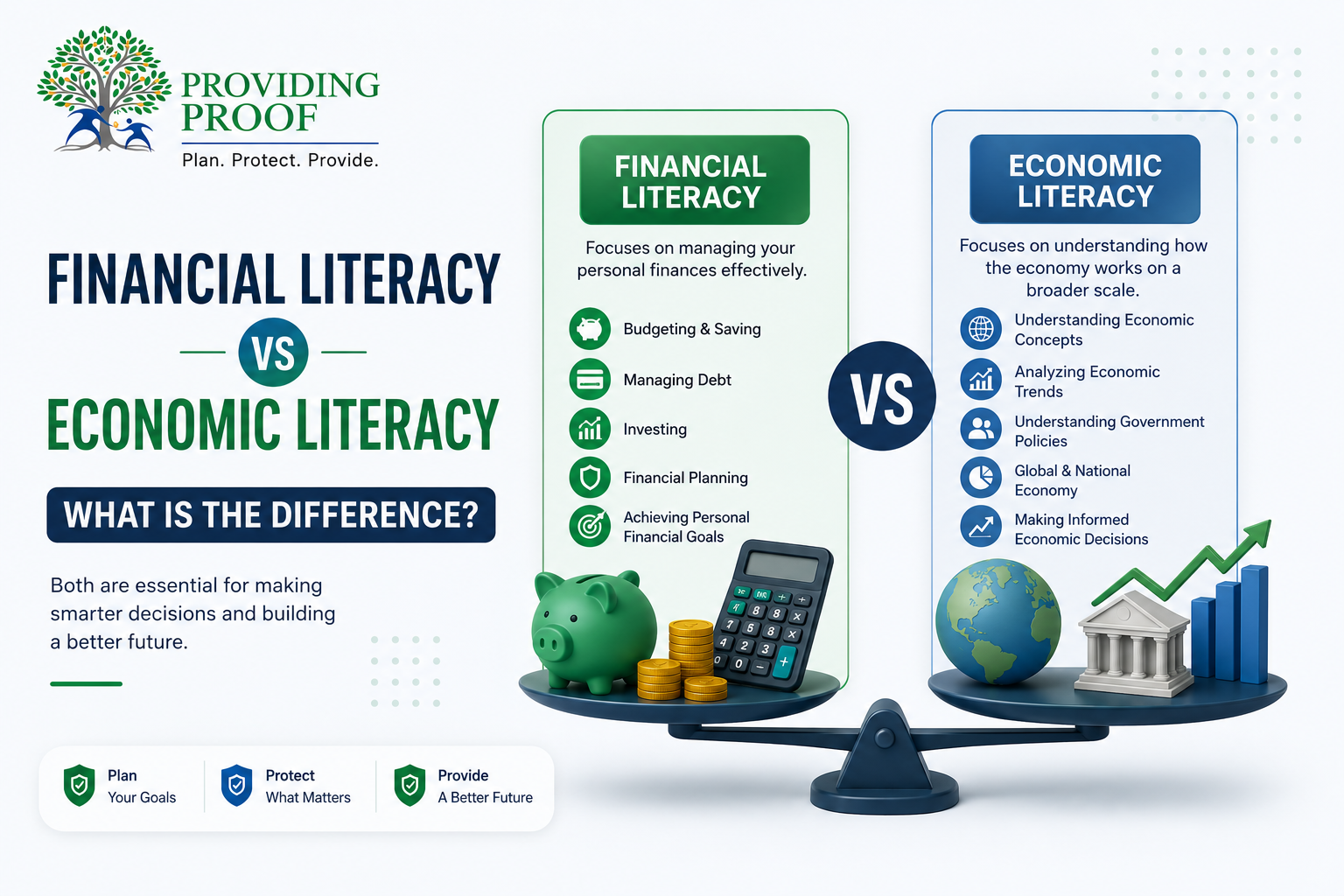
Most people use the terms financial literacy and economic literacy interchangeably, as if they describe the same thing. They do not. While both are rooted in the world of money and markets, they serve very different purposes in a person’s life, in a classroom, and in society at large. Understanding the distinction between the two is not just an academic exercise. It is a practical necessity, especially for students, educators, parents, and anyone who wants to navigate the modern world with confidence and clarity.
At Providing Proof — Preventative Resources Often Overlooked about Finance — we believe that knowledge is the first step toward breaking cycles of economic disparity. Millions of young people across the United States are making critical financial decisions without the tools they need to succeed. This blog breaks down the real difference between financial literacy and economic literacy, why both matter, and how together they create a foundation for lifelong well-being.
Two Different Lenses on the World of Money
Think of financial literacy and economic literacy as two different lenses you can use to look at the same world. One lens zooms in. The other zooms out.
Personal financial literacy is the zoomed-in view. It is about your own life, your own wallet, your own decisions. How do you budget your paycheck? What does a credit score mean for your ability to rent an apartment? How do you start saving for retirement in your twenties? Financial literacy is deeply personal, which is exactly why it carries the word “personal” in its most complete definition.
Economic literacy, on the other hand, is the zoomed-out view. It is about how entire systems work. Why do prices rise during inflation? What happens to employment when interest rates change? How do trade agreements between countries affect job availability in your city? Economic literacy asks you to think not just about yourself, but about the forces shaping the environment you live and make decisions in.
Neither lens is better than the other. You need both. A person who understands personal finance but not economics may make smart individual choices while remaining blind to systemic forces that affect those choices. A person who understands economics but not personal finance may understand global markets but struggle to manage their own household budget.
What Personal Financial Literacy Actually Means
Personal financial literacy is the ability to understand and apply financial concepts to real-life situations that affect your personal finances. Being financially literate means you can read a pay stub, understand what taxes are being taken out, know what to do with the remainder, and make decisions about saving, spending, and investing that align with your goals.
The core pillars of personal financial literacy include:
Budgeting and spending management is the foundation. A financially literate person knows how to create a realistic budget, track expenses, and distinguish between needs and wants. This does not mean living a restricted life. It means making conscious choices about where your money goes so that you are in control of your financial future.
Saving and emergency funds are the safety net. Financial literacy teaches people why having three to six months of expenses set aside in a liquid account is not optional luxury planning but a genuine necessity. Without a savings buffer, one unexpected expense — a car repair, a medical bill, a job loss — can derail years of financial progress.
Understanding credit and debt separates those who use credit wisely from those who are used by it. A financially literate person understands how interest rates work, what a credit report says about them, how to avoid high-cost debt traps like payday loans, and how strategic use of credit can actually build financial strength over time.
Investing and wealth building is the long game. Personal finance literacy includes understanding basic investment concepts, the power of compound interest, and why starting to invest early — even small amounts — can produce dramatically different outcomes by retirement.
Insurance and risk management round out the picture. Being financially literate means understanding that protecting what you have is just as important as building what you have. Health insurance, renters or homeowners insurance, and life insurance are tools that prevent financial disasters, not just bureaucratic necessities.
For students, developing financial literacy is especially urgent. Financial literacy for students means building these skills before they face their first major financial decisions — choosing between college loans, managing a first paycheck, or signing their first lease. When young people receive financial literacy education early, they enter adulthood equipped to make decisions that protect and build their futures.
What Economic Literacy Really Means
Economic literacy is a broader form of knowledge. Rather than focusing on individual decisions, it focuses on how economic systems operate and how those systems shape the choices available to individuals and communities.
What is economic literacy at its core? It is the ability to understand economic concepts and apply them to interpret the world around you. This includes understanding how supply and demand determine prices, how government fiscal and monetary policy affect employment and inflation, how markets allocate resources, and how global trade creates winners and losers across industries and geographies.
Why is economic education important? Because almost every major public debate — about healthcare, housing, immigration, taxation, the minimum wage, trade policy — has an economic dimension. Without economic literacy, citizens cannot meaningfully evaluate political claims, policy proposals, or the economic consequences of collective decisions. Economic literacy is not just useful for personal financial planning. It is essential for democratic participation.
Economic literacy also helps people understand why financial outcomes are not purely a matter of individual choices. A person who grows up in a community with few jobs, underfunded schools, and limited access to banking is not failing because of poor personal finance decisions. They are experiencing the consequences of economic structures. Understanding this distinction — which economics and financial literacy together can illuminate — is critical for creating policies that actually address the root causes of poverty and inequality.
Where Financial Literacy vs Economic Literacy Overlap
The conversation around Financial Literacy vs Economic Literacy is not meant to pit them against each other. The most powerful financial education brings these two areas together in ways that reinforce each other.
Consider inflation as an example. Economic literacy teaches you what inflation is — a general rise in prices across an economy caused by factors like increased money supply, supply chain disruptions, or strong consumer demand. Financial literacy tells you what to do about it: how to adjust your budget, where to put your savings so inflation does not erode its value, and how to think about debt during inflationary periods.
Or consider unemployment. Economic literacy explains why recessions happen, why certain industries shed jobs during downturns, and what government tools exist to address high unemployment. Financial literacy tells you how to build the emergency fund that protects you when a downturn hits your industry, how to read a job offer letter and understand the full compensation package, and how to navigate the financial decisions that accompany a job loss.
This is what economics and financial literacy working together looks like in practice. Neither is complete without the other. And when financial literacy education incorporates economic context — explaining not just how to save, but why wages have stagnated for many Americans, or not just what a credit score is, but why certain communities have historically been denied access to credit — it becomes a far more honest and empowering form of education.
The State of Financial Literacy Education in America
Despite widespread agreement that financial literacy education matters, access to quality personal finance instruction remains deeply unequal across the United States. As of recent surveys, fewer than half of American states require students to complete a dedicated personal finance course as a graduation requirement. This means the majority of American students leave high school without a single required course on budgeting, credit, debt, saving, or investing.
This gap has measurable consequences. Studies consistently show that adults with low financial literacy are more likely to carry high-cost debt, less likely to have emergency savings, and less likely to participate in retirement accounts. The connection between personal finance literacy and long-term financial well-being is not speculative. It is well-documented across decades of research.
The importance of financial literacy to students becomes clear when you look at the decisions young people face immediately after high school. Taking on student loan debt is the most significant financial decision many people make before their mid-twenties, yet most students receive no formal instruction in how to evaluate loan terms, understand the long-term cost of interest, or choose between school and field of study based on realistic income projections.
Financial literacy benefits do not stop at the individual level either. Communities with higher levels of financial literacy tend to have lower rates of predatory lending, higher rates of homeownership, stronger small business formation, and greater civic participation. When individuals are financially literate, the ripple effects reach families, neighborhoods, and entire economies.
The Financial Literacy Benefits That Last a Lifetime
The case for investing in financial literacy education is not just philosophical. The financial literacy benefits are concrete, measurable, and lasting.
Students who receive financial education before their first major financial decisions enter adulthood with better credit scores, lower debt loads, and greater savings rates than their peers who did not receive such instruction. Research on states that have mandated financial literacy courses in high schools shows statistically significant improvements in students’ real-world financial behaviors years after graduation.
For adults, financial literacy translates into fewer financial crises, better retirement preparedness, and greater economic resilience. People who understand compound interest start investing earlier. People who understand credit scores work to improve them. People who understand the difference between term and whole life insurance make better decisions about protecting their families.
At the community level, financial literacy education supports greater economic mobility. When entire communities become more financially literate, local economies strengthen. Small businesses that are better managed survive longer. Homeownership rates rise. Generational wealth begins to build where it previously could not.
The importance of financial literacy to students, in particular, cannot be overstated. The habits and knowledge formed in adolescence tend to persist into adulthood. Teaching young people how to budget, save, understand credit, and think about their financial futures is one of the highest-return investments a school, community, or organization can make.
Why Economic Education Must Be Part of the Conversation
If financial literacy is the what and how of personal money management, economic literacy is the why — the larger explanation for why the financial landscape looks the way it does, why some paths are harder than others, and what systemic changes could make financial literacy more equally distributed and effective.
Why is economic education important beyond individual financial decisions? Because without it, financial literacy education risks placing the entire burden of economic outcomes on individual choices, while ignoring the structural conditions that make those choices easier or harder. A young person in a low-income neighborhood may understand budgeting perfectly but still face fewer opportunities because of underfunded schools, limited local job markets, and historical exclusion from banking and homeownership.
Economics financial literacy — the integration of economic understanding into personal finance education — creates a more complete picture. It allows students to understand not just how to navigate the financial system, but why the system is structured the way it is and how collective action, policy, and advocacy can change it.
This is not a political argument. It is an educational one. Teaching young people that financial outcomes are shaped by both individual decisions and systemic conditions gives them a fuller, more accurate, and ultimately more empowering understanding of the world they live in. It makes them better financial decision-makers and better citizens.
How Financial Literacy for Students Changes Long-Term Outcomes
One of the most powerful things a school, nonprofit, or community organization can do is deliver meaningful financial literacy for students at key developmental moments. The research is clear that early financial education has lasting effects on real-world behavior.
When students learn about budgeting in middle school, they develop habits of tracking spending that carry into adulthood. When high school students learn about student loan interest rates before they sign promissory notes, they borrow more strategically. When young adults learn about credit scores before they apply for their first credit card, they build credit histories that serve them for life.
The timing of financial literacy education matters enormously. Teaching concepts too early, before they are relevant, reduces retention. Teaching them too late, after major decisions have already been made, reduces impact. The ideal window is adolescence — when young people are beginning to develop financial independence, starting to earn their own money, and approaching the major financial crossroads of early adulthood.
Financial literacy for students should not be limited to a single course or a few units scattered across other subjects. It should be embedded in a comprehensive, multi-year curriculum that builds from foundational concepts — earning, spending, saving — to more complex ones — credit, investing, taxes, insurance — and situates all of these within the broader economic context that shapes opportunity.
Real-World Applications of Both Literacy Types
Consider a young person weighing whether to attend a four-year university, a community college, a trade program, or no post-secondary education at all. This decision requires both financial literacy and economic literacy working together.
Financial literacy helps them evaluate the cost of each path, understand how student loans work, compare the short-term cost with the long-term earnings potential, and build a plan for managing debt if they borrow. Without this knowledge, they may choose based on prestige or peer pressure rather than financial reality.
Economic literacy helps them understand the broader labor market: which industries are growing, which are contracting, what regional job markets look like, and how economic cycles affect employment in different sectors. It helps them see their individual decision in context, understanding that their choices are influenced by — and will play out within — a larger economic environment.
Together, these two forms of literacy give the young person a complete picture. They can make a decision that is financially sound, strategically informed, and realistic about both personal opportunity and systemic constraints.
This is why the distinction between Financial Literacy vs Economic Literacy matters so much in practice. It is not about choosing one over the other. It is about understanding both well enough to use them together.
The Role of Trusted Organizations in Building These Literacies
Building financial literacy and economic literacy requires more than a single classroom lesson or one-time workshop. It requires sustained engagement, culturally relevant content, trusted messengers, and access to resources that meet people where they are.
Schools are critical partners in this work, but they cannot do it alone. Families play a role. Communities play a role. And mission-driven organizations that specialize in providing preventative financial education — especially to communities that have historically been underserved by mainstream financial institutions — play an essential role.
When financial literacy education is delivered by organizations that understand the lived realities of the communities they serve, it is more effective, more trusted, and more actionable. When it is paired with economic literacy that honestly acknowledges the structural forces shaping financial outcomes, it becomes not just informative but genuinely empowering.
Why Choose Providing Proof
At Providing Proof, we are doing more than teaching financial concepts. We are giving young people and their communities the preventative resources that are so often overlooked — the knowledge, tools, and frameworks they need to understand both their personal financial decisions and the economic systems those decisions exist within. Our curriculum is designed to be honest, accessible, and deeply relevant to the communities we serve. We believe that financial literacy and economic literacy together form the foundation of genuine opportunity, and we are committed to making that foundation available to every young person we reach, regardless of their ZIP code, background, or starting point. When youth have access to the right knowledge at the right time, they do not just change their own outcomes. They begin to change the economic trajectory of entire communities. That is the proof we are here to provide.
Frequently Asked Questions
Q. What is the difference between financial literacy and economic literacy?
Financial literacy refers to the knowledge and skills needed to manage personal financial decisions — budgeting, saving, using credit, investing, and protecting assets. Economic literacy refers to the understanding of how economic systems work at a broader level — how markets function, how government policy affects employment and prices, and how global forces shape local opportunities. Financial literacy is personal and practical; economic literacy is systemic and contextual. Both are essential for navigating modern life effectively.
Q. Why is financial literacy important for students specifically?
Students are approaching the most significant financial decisions of their early lives: choosing whether and where to pursue higher education, taking on student loan debt, entering the workforce, managing a first paycheck, and establishing credit. Financial literacy for students ensures they have the foundational knowledge to make these decisions wisely, rather than by default or under pressure. Research consistently shows that students who receive financial education before these decision points make measurably better financial choices years later.
Q. What are the main financial literacy benefits?
The financial literacy benefits include better credit management, lower rates of high-cost borrowing, higher emergency savings rates, earlier participation in retirement accounts, greater resilience during economic downturns, and improved long-term financial well-being. At the community level, financial literacy supports higher homeownership rates, stronger small business formation, and greater economic mobility across generations.
Q. Why is economic education important beyond personal finance?
Economic education matters because financial decisions are shaped by forces beyond individual control. Understanding inflation, unemployment, wage trends, tax policy, and market cycles helps people interpret the economic environment they are making decisions within. It also supports informed civic participation, since economic literacy is essential for evaluating the policy debates that shape collective financial outcomes. Without economic literacy, financial literacy remains incomplete.
Q. What does personal financial literacy actually cover?
Personal financial literacy covers the core skills and knowledge areas that affect everyday financial decisions: income and earning, budgeting and spending, saving and emergency preparedness, managing and building credit, borrowing and debt management, investing for the future, understanding taxes, and managing financial risk through insurance. Together, these areas form a comprehensive foundation for financial well-being throughout all stages of life.
Q. How do economics and financial literacy work together?
Economics and financial literacy work together by providing both the practical skills for managing personal finances and the broader context for understanding why the financial landscape looks the way it does. Economic literacy explains phenomena like inflation, recessions, and wage gaps. Financial literacy tells you what to do in response to those phenomena. Together, they give individuals a complete, grounded understanding of money, opportunity, and how to navigate both.
Q. Is financial literacy education effective?
Yes. Multiple research studies confirm that financial literacy education has measurable positive effects on real-world financial behavior. Students who complete personal finance courses show higher credit scores, lower delinquency rates on credit products, higher savings rates, and better retirement preparedness than peers who did not receive such instruction. The effects are strongest when education is delivered during adolescence, before major financial decisions are made, and when it is sustained and comprehensive rather than one-time or superficial.
Q. What does it mean to be financially literate?
Being financially literate means having the knowledge, skills, and confidence to make informed financial decisions across all areas of your personal finances. A financially literate person can create and follow a budget, understand how credit works and manage it strategically, identify and avoid financial predators like payday lenders, plan for both short-term needs and long-term goals, understand basic investment principles, and navigate the financial decisions that come with major life events like education, employment, and housing.
Q. How can young people become more financially literate?
Young people can build financial literacy through structured financial education programs, curriculum offered at school, community-based financial literacy programs from organizations like Providing Proof, and by practicing financial concepts in their own lives — starting with small budgets, opening savings accounts, and learning to read financial documents. Access to a trusted, knowledgeable guide makes a significant difference, especially for young people who do not have financially literate role models at home.
Q. What is economic literacy and why does it matter in everyday life?
What is economic literacy in practical terms? It is the ability to understand economic forces and use that understanding to interpret news, evaluate policy, and make better personal and civic decisions. In everyday life, economic literacy helps people understand why prices at the grocery store are rising, why interest rates on their mortgage or credit card might change, why certain jobs are more available in some regions than others, and why government decisions about spending and taxation affect their own financial lives. It is the context that makes personal financial decisions fully intelligible.