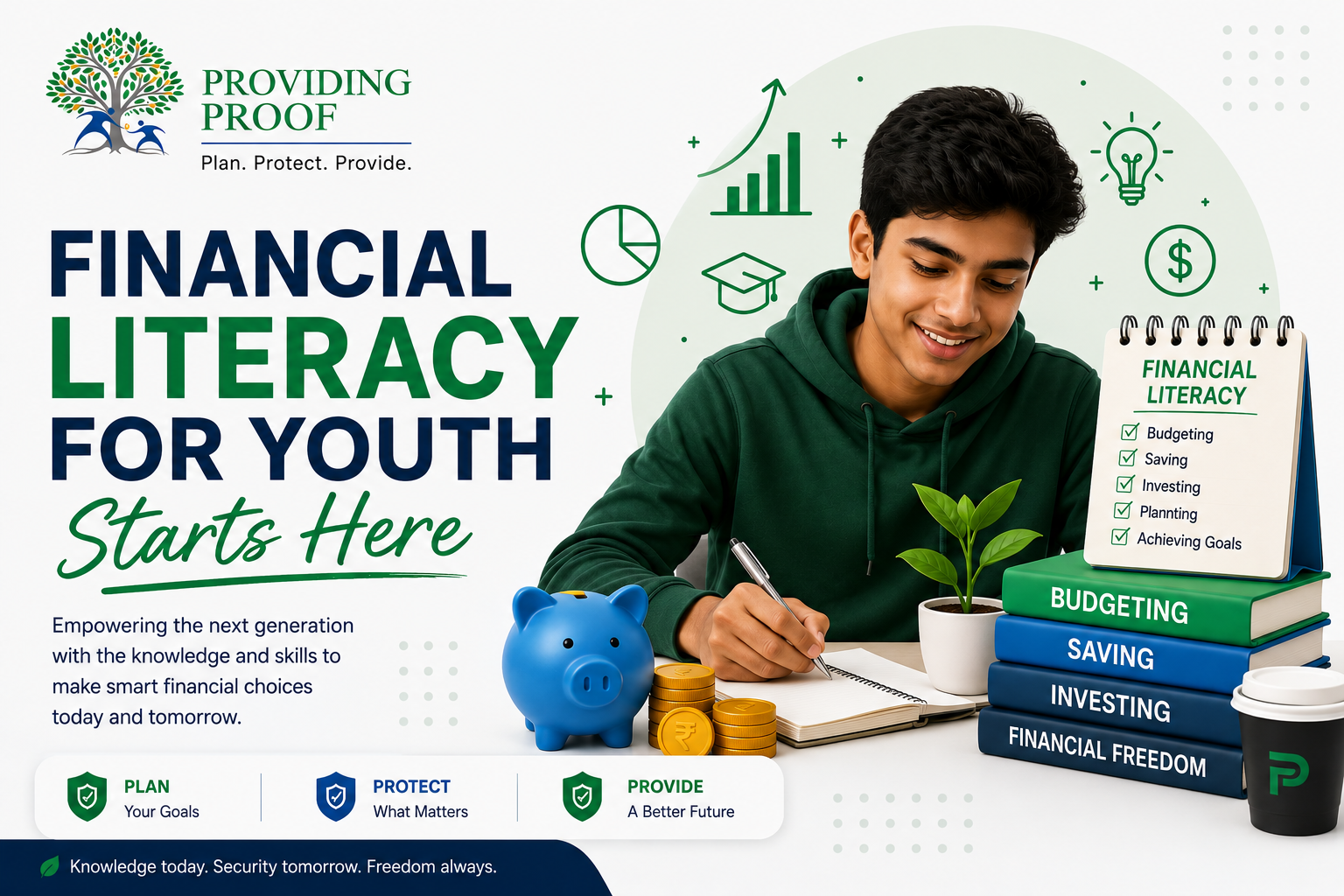
The Gap Nobody Talks About
There is a crisis unfolding quietly in households, schools, and communities across America, and it has nothing to do with a test score or a college application. It has everything to do with money — specifically, the fact that millions of young people are stepping into adulthood without ever being taught how to manage it. The importance of financial literacy for youth has never been more urgent, yet it remains one of the most consistently overlooked subjects in both formal education and household conversations.
At Providing Proof — whose very name stands for Preventative Resources Often Overlooked about Finance — this gap is not just a statistic. It is the reason we exist. More than 7.5 million young people in the United States face limited opportunities because of economic disparity. Many of them were never given the foundational skills to understand a paycheck, open a bank account, avoid predatory lending, or build savings. Without those skills, the cycle of financial instability repeats itself from one generation to the next.
Financial literacy for youth is not simply an academic concept. It is a life skill with consequences that show up in real, measurable ways — in the form of crushing debt, missed opportunities, and an inability to weather financial emergencies. The earlier a young person learns to navigate money, the better equipped they are to build a stable, self-sufficient life. That is the mission we are committed to at Providing Proof, and it is the conversation this blog exists to continue.
What Financial Literacy Actually Means for a Young Person
Before diving into how to teach it or why it matters, it is worth being clear about what financial literacy for youth actually involves. The term gets used broadly, but its meaning is precise and practical.
Financial literacy refers to the combination of knowledge, skills, and confidence needed to make informed and responsible decisions about money. For young people specifically, this includes understanding how to earn, spend, save, borrow, and invest — and knowing the difference between decisions that build a financial future and those that quietly erode it.
Youth financial literacy is not about turning teenagers into accountants. It is about giving them the vocabulary, the framework, and the habits to approach financial decisions with clarity rather than confusion. A financially literate young person knows what a credit score is and why it matters before they ever open a credit card. They understand compound interest — both as something that can work for them in a savings account and against them in a loan. They can read a pay stub, understand a lease agreement, and recognize when a financial product is designed to exploit rather than serve them.
Financial education for youth also extends beyond individual money management. It includes understanding how financial systems work, what access to banking and credit means, how wealth is built over time, and why certain communities have historically faced greater barriers to financial stability. This broader understanding is what separates financial literacy from financial capability — a distinction that matters enormously in the work we do.
Financial capability means not just knowing how money works, but having the real-world access and tools to put that knowledge into action. A young person who understands saving but has no access to a bank account cannot fully exercise that knowledge. Financial education for teens, done right, addresses both the knowledge and the access simultaneously.
Why Is Financial Literacy Important for Youth
This is one of the most common questions we hear, and it deserves a thorough answer. Why is financial literacy important for youth rather than something that can simply be learned in adulthood when it becomes more immediately relevant?
The answer lies in the compounding nature of financial decisions. The choices young people make in their teens and early twenties do not just affect them in the short term — they echo across decades. Student loan choices made at 18 can shape a person’s finances well into their 40s. Credit card habits formed at 20 can take years to undo. Conversely, savings habits developed early, even modest ones, grow significantly over time thanks to the power of compound interest.
There is also the reality of the learning curve itself. Financial mistakes are expensive. When a young adult signs a lease they cannot afford, takes on more student debt than they can realistically repay, or falls victim to a predatory lending scheme, the consequences are not just financial — they are emotional and psychological. Debt stress is one of the leading contributors to anxiety and depression among young adults. Teaching financial literacy early means protecting young people from some of the most damaging and avoidable setbacks of early adulthood.
Beyond individual wellbeing, why is financial literacy important for youth at the community level? Because financially capable young people become financially stable adults, and financially stable adults build stronger families, neighborhoods, and economies. The ripple effects of early financial education extend far beyond the individual who receives it.
Consider these realities. More than two-thirds of adults in the United States would fail a basic financial literacy test. Nearly half of American households cannot cover a four-hundred-dollar emergency expense. Generation X young adults accumulated an average of sixty thousand dollars in debt by their late twenties, and Millennials reached that same threshold even earlier in life. These are not abstract numbers — they are the predictable outcomes of a society that has consistently failed to prioritize financial education for teens and young adults as a core part of growing up.
The importance of financial literacy for youth is not just about preparing them to handle their own money. It is about interrupting cycles of poverty and financial precarity that have been passed from generation to generation — not because of a lack of work ethic or intelligence, but because of a lack of access to the right information and support at the right time.
The Specific Financial Skills Every Young Person Needs
Understanding the importance of financial literacy for youth is one thing. Knowing exactly which skills to develop is another. Financial education for youth is most effective when it is concrete, practical, and connected to real-life situations young people will actually encounter.
The first area is budgeting and money management. This means knowing how to track income and expenses, distinguish between needs and wants, and make deliberate decisions about where money goes rather than discovering at the end of the month that it has simply disappeared. Budgeting is the foundation of everything else in personal finance, yet it is rarely taught with the seriousness it deserves.
The second area is saving — not just being told to save, but understanding why, how, and where. Young people need to know what a savings account is and how interest works on their behalf. They need to understand the concept of an emergency fund, why it matters to have liquid savings set aside for unexpected expenses, and how even small, consistent contributions can grow substantially over time.
The third area is credit and debt. This is particularly urgent for teens and young adults because credit follows you. A young person who understands how credit scores are calculated, what behaviors build or damage credit, and how to use credit responsibly is far better positioned than one who receives their first credit card offer with no context for what it means. Understanding debt — student loans, auto loans, credit cards, and personal loans — and the real cost of borrowing is essential financial education for teens before those decisions land in front of them.
The fourth area is banking and financial systems. Many young people, particularly those from lower-income households or communities historically underserved by financial institutions, lack basic knowledge about how to open and use a bank account, what the difference between a checking and savings account is, or how to avoid the fees and traps that can make banking expensive for people with limited funds. Financial education for youth must include this foundational knowledge about how the systems themselves work.
The fifth area is fraud, scams, and predatory lending. Young people are frequently targeted by payday lenders, predatory credit offers, and online financial scams. Understanding what these look like, why they are designed to trap people in cycles of debt, and how to identify and avoid them is a critical piece of youth financial literacy that protects young people from some of the most damaging financial experiences they might face.
The sixth area is investing and building long-term wealth. While this may feel advanced for a teenager, even basic concepts — what a retirement account is, how stocks and bonds work, what it means to build assets over time — plant seeds that shape how young people think about their financial futures. Youth financial literacy is not just about surviving the present. It is about building toward something better.
How Financial Literacy Gaps Appear and Why They Are Not Random
One of the most important truths about youth financial literacy is that the gaps in it are not evenly distributed. They track closely with race, income, geography, and access to resources — which means that failing to address them is not a neutral position. It perpetuates existing inequities.
Research has consistently shown that Black and Hispanic young people have, on average, lower financial literacy scores than their white and Asian peers. This is not a reflection of capacity or interest. It is a reflection of systemic barriers. These include less access to formal financial education in schools, fewer opportunities to observe and learn from financially stable adults, and historical exclusion from wealth-building systems like homeownership and investment that have allowed other communities to accumulate and pass on financial knowledge across generations.
Low-income young people face additional barriers. They may be less likely to have bank accounts, more likely to rely on alternative financial services that charge higher fees, and more likely to enter adulthood with immediate financial pressures that leave little room for thinking about long-term wealth building. Financial education for youth must take these realities into account — not as exceptions, but as the central context for why this work is needed and how it must be done.
Young people who have been in foster care face particularly acute financial vulnerability. Many of them have grown up without a stable adult modeling responsible financial behavior, without the family safety nets that cushion financial mistakes for other young adults, and without the institutional knowledge about how to access banking, credit, and financial services. Financial literacy programs for youth in foster care are not supplemental — they are essential to giving these young people a real chance at financial stability as they transition to independence.
This is why financial literacy for youth cannot be a one-size-fits-all approach. It must be responsive to the specific circumstances, barriers, and strengths of the young people it serves.
Financial Education for Teens in Schools: The Current State
Schools are the most logical place to deliver financial education for teens at scale, reaching young people across income levels and backgrounds before the highest-stakes financial decisions of adulthood arrive. Yet the availability and quality of financial education in American schools remains deeply inconsistent.
Some states mandate personal finance courses for high school graduation. Others include financial concepts within broader economics requirements. Many offer little to nothing in the way of dedicated financial education. The result is that a young person’s access to financial literacy instruction depends heavily on which state they live in, which school district they attend, and whether their school has the resources and trained teachers to deliver meaningful financial education.
Even in schools where financial education exists, quality varies. A single semester course taught by an unprepared instructor using outdated materials is unlikely to change behavior. Effective financial education for teens is hands-on, relevant to their actual circumstances, and reinforced over time rather than delivered once and forgotten. It includes real-world application — not just knowing what a budget is, but building one. Not just knowing what credit is, but understanding how it applies to decisions they will actually face.
The gap in school-based financial education is one of the reasons community-based youth financial literacy programs are so critical. When schools cannot or do not provide adequate financial instruction, other organizations must step in to fill that gap. Financial literacy programs for youth built outside the classroom can be more flexible, more targeted, and more responsive to the specific needs of the communities they serve.
Youth Financial Literacy Programs That Make a Real Difference
Not all financial education programs are created equal. Research on what actually works in youth financial literacy programs points to several characteristics that separate effective programs from well-intentioned but ineffective ones.
First, timing matters. Financial education is most impactful when it is delivered close to the moment of a relevant financial decision. Teaching a 16-year-old about credit cards is more effective than teaching a 12-year-old, because the 16-year-old is approaching an age where credit offers will start arriving. Teaching a high school senior about student loans before they sign enrollment forms has far more impact than abstract instruction disconnected from any real decision.
Second, active learning matters. Programs that engage young people in simulations, role-playing, and hands-on financial activities produce better outcomes than those that rely purely on lectures and worksheets. When a teenager actually builds a budget for a simulated paycheck, tracks spending decisions, and sees the consequences of different choices play out, the lessons stick in ways that passive instruction cannot achieve.
Third, peer involvement matters. Young people learn powerfully from each other. Youth financial literacy programs that incorporate peer educators, group discussion, and shared problem-solving harness that dynamic rather than ignoring it.
Fourth, ongoing support matters. A one-time workshop, however well designed, has limited lasting impact. The most effective financial literacy programs for youth create ongoing relationships between young people and financial coaches, mentors, or educators who can provide support as real financial decisions come up over time.
Fifth, cultural responsiveness matters. Programs that acknowledge and incorporate the specific cultural, economic, and community context of the young people they serve are more likely to be trusted, engaged with, and applied in daily life. Financial education for youth that ignores the realities of the communities it serves will struggle to connect.
Sixth, access to real financial tools matters. Teaching young people about saving is far more powerful when they can actually open a savings account. Financial literacy programs for youth that partner with financial institutions to create pathways to real banking products, accounts, and services close the gap between knowledge and capability.
The Role of Families in Financial Education for Youth
Schools and community programs are essential, but they are not the only place where youth financial literacy is developed. Families are often the first and most powerful source of financial education — or financial misinformation — in a young person’s life.
Children observe how the adults around them handle money from a very young age. They notice whether conversations about money are open or secretive, anxious or calm. They absorb attitudes about saving, spending, debt, and financial planning through daily family life before any formal instruction ever begins. By the time formal financial education for youth reaches them, much of their foundational financial mindset has already been shaped.
This means that supporting parents and caregivers in talking about money openly and accurately with their children is a meaningful part of comprehensive financial education for youth. Families that discuss financial decisions, explain where money comes from and where it goes, involve young people in age-appropriate financial tasks, and model responsible financial behavior are giving their children a significant advantage.
For families that have themselves struggled financially — which is true for a large portion of the communities we serve — this is not about having all the answers. It is about beginning the conversation, being honest about challenges, and seeking out the tools and support to build financial knowledge together. No family needs to have achieved financial stability to begin talking about money in healthy, honest, and educational ways.
Breaking Down Common Myths About Youth and Money
There are persistent myths about financial literacy for youth that get in the way of progress. Addressing them directly matters because these myths influence whether parents, educators, policymakers, and communities prioritize this work.
The first myth is that young people are not interested in learning about money. This is simply not true. When financial education is relevant, practical, and honest, young people engage with it actively. The problem is rarely lack of interest — it is lack of access to quality instruction that actually connects to their lives.
The second myth is that financial literacy only matters for people who have money. In reality, financial literacy is most critical for people with limited financial resources, because they have the least margin for costly financial mistakes and are most likely to be targeted by predatory financial products designed to exploit those with limited knowledge and few alternatives.
The third myth is that young people can just figure out money on their own when they get older. The evidence consistently contradicts this. Adults who did not receive financial education early are more likely to carry damaging debt, less likely to save, and more likely to struggle with financial stability throughout their lives. The idea that financial knowledge simply develops naturally with age is not supported by outcomes.
The fourth myth is that financial literacy programs are only for struggling communities. Financial education for teens is beneficial across income levels and backgrounds. The specific content and approach may look different, but every young person benefits from knowing how money works, what financial decisions they will face, and how to navigate them effectively.
Why Digital Fluency Is Part of Modern Youth Financial Literacy
Financial literacy for youth in the current era cannot be separated from digital financial fluency. Young people are growing up in a world where mobile banking, digital payment platforms, cryptocurrency discussions, buy-now-pay-later services, and online investment apps are part of daily life — often before any formal financial education has addressed them.
This creates both opportunities and risks. The opportunity is that digital tools can make banking, saving, and investing more accessible, particularly for young people from communities that have historically had limited access to traditional financial services. The risk is that many digital financial products are designed to encourage impulsive spending, obscure the real cost of borrowing, or create the illusion of investment opportunity without the substance.
Effective financial education for youth today must address digital financial literacy — how to safely use banking apps, how to recognize the real cost of buy-now-pay-later products, how to evaluate investment claims they see on social media, and how to protect their personal and financial information online. These are not supplemental topics. They are core components of what it means to be financially literate in the world young people are actually navigating.
The Long Game: Financial Literacy as a Foundation for Lifelong Stability
When we talk about financial education for youth, we are really talking about foundations. Every habit built, every concept understood, every financial decision made thoughtfully in adolescence and young adulthood compounds over time — for better or worse.
A young person who learns to budget at 16 is far more likely to be managing their finances effectively at 30. A teenager who understands how credit works before they encounter their first credit offer is far less likely to spend their twenties struggling with damaging debt. A young adult who knows what a retirement account is and starts contributing even small amounts early has a dramatically different financial future than one who begins decades later.
The importance of financial literacy for youth is not about creating a generation of financial experts. It is about ensuring that every young person — regardless of their family background, their income level, their zip code, or their history — has access to the knowledge and tools they need to build a stable financial life. That is a matter of equity, opportunity, and justice as much as it is a matter of personal finance.
Why Choose Providing Proof
At Providing Proof, we are not just an organization that talks about the importance of financial literacy for youth — we are one that does the work, community by community, with young people who need it most. Our programs are built around the understanding that financial literacy is a preventative resource, one that interrupts cycles of economic hardship before they take hold. We offer structured financial literacy programs for youth that are culturally responsive, hands-on, and designed around the real lives and real circumstances of the communities we serve. Our curriculum reaches young people across income levels, backgrounds, and life situations — including those in foster care and those from underserved communities who face the highest barriers to financial stability. What sets us apart is our deep belief that every young person deserves not just information, but genuine support, real tools, and ongoing connection to people who are invested in their financial success. When you choose Providing Proof, you are choosing a partner in building a generation that is financially capable, economically resilient, and equipped to break the cycles that have held communities back.
Frequently Asked Questions About Financial Literacy for Youth
Q. What is financial literacy for youth?
Financial literacy for youth refers to the knowledge, skills, and habits young people need to make informed decisions about earning, spending, saving, borrowing, and building wealth. It includes practical skills like budgeting, understanding credit, managing debt, and using banking services, as well as broader knowledge about how financial systems work and how to protect oneself from fraud and predatory financial products.
Q. Why is financial literacy important for youth specifically?
Financial decisions made in adolescence and early adulthood have long-term consequences. Credit habits, debt choices, and savings behaviors formed early in life compound over time — for better or worse. Teaching young people financial skills before they face major financial decisions gives them the tools to avoid costly mistakes and build a stable financial foundation from the start.
Q. What topics should financial education for teens cover?
Effective financial education for teens should cover budgeting and money management, saving and emergency funds, understanding credit and how credit scores work, managing debt including student loans, banking basics and how financial institutions work, identifying and avoiding financial scams and predatory lending, and foundational concepts about investing and building wealth over time.
Q. What makes financial literacy programs for youth effective?
Research shows that the most effective youth financial literacy programs deliver instruction close to relevant decision points, use active and hands-on learning methods, involve peer interaction, provide ongoing support rather than one-time workshops, are culturally responsive to the communities they serve, and connect young people with real financial tools and services alongside the education.
Q. How can parents support financial education for youth at home?
Parents and caregivers can support youth financial literacy by talking openly about money, involving young people in age-appropriate financial decisions, explaining where money comes from and where it goes, modeling responsible financial behavior, and encouraging questions about financial concepts as they arise in daily life. Families do not need to be financially perfect to have these conversations — honesty about challenges can be just as educational as demonstrations of success.
Q. Who benefits most from youth financial literacy programs?
Every young person benefits from financial literacy education, but those from low-income households, underserved communities, and situations like foster care benefit most acutely. These young people are most likely to face predatory financial products, least likely to have received financial modeling at home, and most vulnerable to the long-term consequences of financial mistakes made early in life.
Q. At what age should financial education for youth begin?
Age-appropriate financial education can begin as early as childhood, starting with concepts like earning, spending, and saving. More structured financial literacy for youth typically becomes most impactful in middle school and high school, when real financial decisions — first jobs, bank accounts, student loans, credit — are approaching or already present. The key is relevance: financial education is most effective when it connects to decisions a young person is actually facing or will face soon.
Q. How does youth financial literacy address economic inequality?
Financial literacy gaps track closely with race, income, and geography, meaning that low-income young people and those from communities of color are consistently less likely to receive quality financial education. Youth financial literacy programs that intentionally reach underserved communities help interrupt generational cycles of financial instability by giving young people the knowledge and tools that have historically been available only to those with greater economic privilege.
Q. What is the difference between financial literacy and financial capability?
Financial literacy refers to knowledge about how money and financial systems work. Financial capability includes that knowledge but also encompasses access — the ability to actually use financial products, services, and institutions. A truly comprehensive approach to financial education for youth addresses both: ensuring young people not only understand financial concepts but also have real access to banking, credit, and savings tools they can use.
Q. Are there free youth financial literacy programs available?
Yes. Many nonprofit organizations, including Providing Proof, offer financial literacy programs for youth at no cost to participants. Schools, libraries, community centers, and credit unions also frequently offer free financial education resources. Connecting with a local nonprofit focused on financial literacy is often the best starting point for accessing quality, free programs designed for young people.