Table of Contents
- What Are Financial Skills?
- How Do Financial Skills Impact Career Growth?
- Types of Financial Skills That Boost Your Career
- Key Benefits of Financial Skills in the Workplace
- Drawbacks / Limitations to Watch Out For
- Industries Where Financial Skills Matter Most
- How to Choose the Right Financial Skills to Develop
- Financial Skills vs. Technical Skills: Comparison Table
- Cost of Building Financial Skills
- Frequently Asked Questions
- Conclusion / In Summary
- References / Citations
Introduction
The career landscape has changed. Employers no longer just look for technical expertise — they look for people who understand value, think long-term, and make decisions rooted in economic awareness. Financial skills are no longer reserved for accountants or Wall Street professionals. They are foundational tools that give young people a competitive edge across virtually every industry.
Whether you are entering the workforce for the first time or pivoting into a new field, the ability to budget, analyze costs, negotiate your worth, and manage resources signals to employers that you are someone who can be trusted with responsibility.
At Providing P.R.O.O.F., we believe that economic literacy is a right — not a privilege. When young people are equipped with the right financial skills early, they do not just get jobs. They build careers, lead teams, and create generational change.
🌱 CTA BOX #1 — Build Financial Skills That Last
Providing P.R.O.O.F. offers a transformative 3-year economic literacy program for youth ages 6–21. Our curriculum is designed to give the next generation the tools they need to thrive — in careers and in life.
What Are Financial Skills?
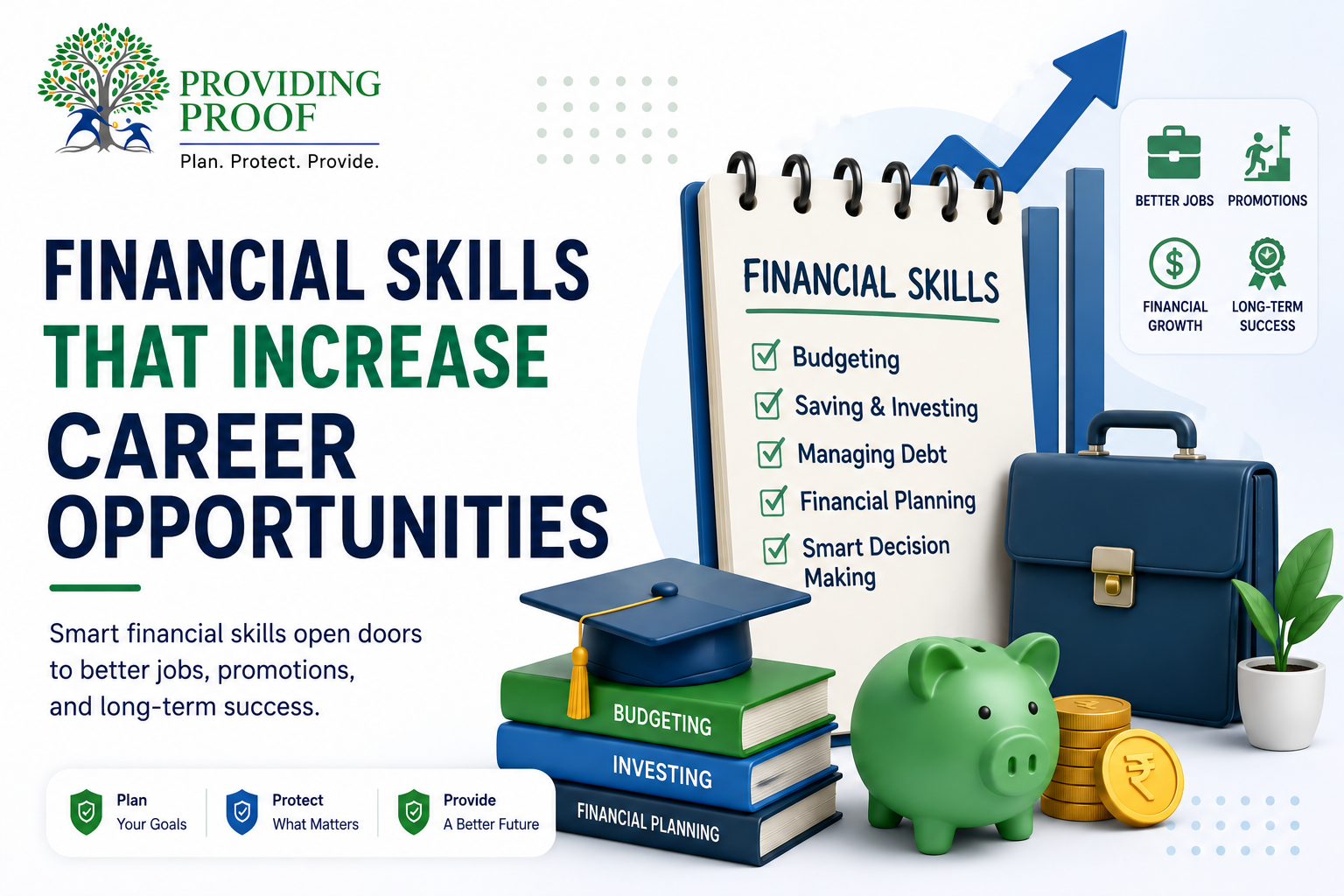
Financial skills are the practical and cognitive abilities that allow individuals to understand, manage, and grow money and resources effectively. These include both hard skills — like budgeting, financial analysis, and investment evaluation — and soft skills — like negotiation, decision-making, and risk assessment.
In a career context, financial skills translate into the ability to manage a project budget, evaluate business opportunities, understand compensation structures, and communicate personal value to employers and clients alike.
Most traditional classrooms do not teach these skills. That is the gap — and it is exactly what programs like Providing P.R.O.O.F. are built to close.
How Do Financial Skills Impact Career Growth?
Financial skills work by giving individuals a clear framework for evaluating choices — both in their personal lives and in the workplace. Here is how they translate directly into career growth:
They sharpen decision-making. Employers value people who can weigh costs against benefits, assess risk, and commit to informed choices. This is financial thinking applied in a professional setting.
They increase earning power. Understanding how compensation works — including salary negotiation, equity, benefits, and performance-based raises — means you are better positioned to advocate for your own value.
They build credibility. When you speak the language of money confidently in a professional setting, you command respect. Leaders at every level need to understand resource allocation, financial statements, and economic trends.
They accelerate upward mobility. Promotions often go to those who demonstrate ownership and accountability — qualities that financial competence naturally builds.
Types of Financial Skills That Boost Career Opportunities
Budgeting and Resource Management
The ability to plan, allocate, and track resources — whether managing personal finances or a departmental budget — is one of the most universally valued skills in any workplace. Every organization, from Fortune 500 companies to nonprofits, needs people who can do more with less.
Financial Analysis and Data Interpretation
Reading and interpreting financial data — profit and loss statements, cash flow reports, expense summaries — is essential in roles ranging from marketing to operations to executive leadership.
Negotiation and Value Communication
Knowing your worth and articulating it clearly is itself a financial skill. Whether negotiating a starting salary, a vendor contract, or a business partnership, this ability is directly tied to economic outcomes.
Investment Thinking
Understanding how time, energy, and money can be invested for long-term returns — not just in financial markets, but in personal development and career choices — is a powerful lens that shapes smarter, more strategic decisions.
Risk Assessment
The ability to evaluate risk before committing to a path — whether a job offer, a business decision, or a financial investment — is a career skill that prevents costly mistakes and builds long-term foresight.
Economic Literacy and Market Awareness
Understanding how broader economic forces — inflation, labor market shifts, industry cycles — affect your career field helps professionals make proactive moves rather than reactive ones.
Key Benefits of Financial Skills in the Workplace
- Higher employability — Candidates with financial literacy stand out across all industries during interviews and resume reviews
- Stronger leadership potential — Financial understanding is a prerequisite for most management and executive roles
- Better salary outcomes — Those who understand compensation structures consistently negotiate better deals
- Increased confidence — Financial competence reduces workplace anxiety and builds assertiveness
- Long-term career sustainability — Financial skills help professionals navigate layoffs, career pivots, and entrepreneurship
- Community and team impact — Financially literate leaders build stronger, more equitable workplaces and teams
At Providing P.R.O.O.F., we do not just teach these skills — we embed them into how young people think, act, and lead from an early age.
Drawbacks / Limitations to Watch Out For
Financial skills are powerful — but it is important to be honest about their limits.
Access to quality education is unequal. In most underfunded schools and underserved communities, financial literacy simply is not taught. This creates an early disadvantage that compounds over time — which is exactly why organizations like Providing P.R.O.O.F. exist.
Skills need ongoing reinforcement. Learning financial concepts once is not enough. They require consistent practice, real-world application, and continuous learning to remain sharp and relevant.
Financial skills alone do not eliminate systemic barriers. While they increase individual agency, structural inequalities in hiring, pay equity, and capital access still exist and require systemic change alongside individual empowerment.
Knowledge without mindset has limited impact. Financial skills must be paired with confidence, self-worth, and a belief in one’s own economic potential. That is why Providing P.R.O.O.F.’s curriculum is values-based — not just information-based.
Industries Where Financial Skills Matter Most
Financial skills are career-boosters across virtually every field. Here are the industries where they create the greatest impact:
- Healthcare — Budget management, billing awareness, and resource allocation are critical in healthcare administration and leadership
- Technology — Product managers, startup founders, and tech leads all need financial fluency to scale responsibly
- Education — School administrators and program directors manage budgets, grants, and resource allocation daily
- Nonprofit and Social Impact — Grant writing, donor relations, and financial stewardship require deep economic awareness
- Retail and Entrepreneurship — Understanding margins, pricing strategy, and cash flow is essential for business survival
- Government and Public Policy — Policy makers must understand fiscal impact, public resource distribution, and economic equity
How to Choose the Right Financial Skills to Develop
Not everyone needs to become a financial analyst. The key is identifying which financial skills are most aligned with your career path and goals.
Start with your industry. Research what financial knowledge is expected at mid-to-senior levels in your target field. Work backward from leadership to where you are now.
Assess your current gaps honestly. Are you comfortable with budgeting but struggle with negotiation? Are you a strong communicator but avoid financial data? Know where you stand so you can focus your energy.
Seek experiential learning. Reading about financial concepts and actually applying them are very different experiences. Look for programs — like Providing P.R.O.O.F.’s curriculum — that build skills through real-world scenarios and hands-on practice.
Find a community. Financial literacy grows faster in community. Connect with mentors, peers, and programs that challenge you to apply what you are learning in meaningful contexts.
Commit to ongoing learning. Economic conditions, industries, and career paths evolve constantly. Make financial skill-building a consistent habit — not a one-time effort.
Financial Skills vs. Technical Skills: Comparison Table
| Category | Financial Skills | Technical Skills |
|---|---|---|
| Transferability | High — applicable across all industries | Moderate — often role or industry specific |
| Career Longevity | Long-term value | May require frequent updating |
| Employer Demand | Universally valued at all levels | Highly specific to role requirements |
| Impact on Earnings | Directly tied to negotiation and advancement | Tied to specialized demand |
| Foundation for Leadership | Strong foundation | Supportive but not sufficient alone |
| Accessibility | Varies — gap in underserved communities | Widely available through tech training |
| Learning Method | Application-based | Often certification-based |
Cost of Building Financial Skills
The investment required to develop financial skills varies significantly depending on your path:
- Free resources — Library books, YouTube channels, podcasts, and community workshops offer a solid foundation at no cost
- Online courses — Platforms like Coursera and edX offer financial literacy courses ranging from free to $300
- Degree programs — Finance, economics, or business degrees range from $10,000 to $60,000+ depending on the institution
- Community programs — Nonprofits like Providing P.R.O.O.F. deliver high-quality, values-based financial education to underserved youth — often at no cost to participants, made possible through community donations and partnerships
The most impactful investment is always early. The sooner youth receive quality financial education, the longer those skills have to compound into career opportunities, wealth, and leadership.
💡 CTA BOX #2 — Help Close the Financial Skills Gap
Every young person deserves access to financial education that builds real careers. Your support makes it possible for Providing P.R.O.O.F. to reach youth in underserved communities with the tools that change trajectories.
Frequently Asked Questions
What financial skills are most important for career success?
The most critical financial skills for career success include budgeting, negotiation, financial analysis, investment thinking, and risk assessment. These skills apply across all industries and help professionals make stronger decisions, communicate their value, and advance faster in their careers.
Can financial skills help me get a better job?
Yes. Employers across every industry value candidates who demonstrate financial awareness because it signals responsibility, critical thinking, and leadership potential. These are qualities that distinguish candidates during both hiring and promotion decisions.
At what age should young people start learning financial skills?
The earlier, the better. Research shows that financial habits and mindsets begin forming as early as age 7. Programs like Providing P.R.O.O.F. serve youth ages 6–21, meeting them at the developmental stages where financial education delivers the most lasting impact.
Are financial skills only relevant in finance careers?
Not at all. Financial skills are universally applicable. Whether you work in healthcare, technology, education, the arts, or social services, understanding how to manage resources, evaluate risk, and make value-based decisions is always relevant and always valued.
How does financial literacy connect to career advancement?
Financial literacy helps professionals understand compensation structures, evaluate job offers strategically, manage budgets responsibly, and position themselves confidently for leadership. It is not just about managing money — it is about understanding value in every professional context.
What makes Providing P.R.O.O.F. different from other financial education programs?
Providing P.R.O.O.F. goes beyond traditional financial literacy by incorporating valuation processes, leadership development, and community economic thinking. The 3-year curriculum is designed to shift how youth see themselves within the economy — building not just knowledge, but economic identity and agency.
Conclusion / In Summary
Financial skills are among the most powerful and underutilized tools in career development. They do not just help people manage money — they help people understand value, navigate complex systems, negotiate with confidence, and build careers that endure.
The gap in financial education falls hardest on young people from underserved communities — those who are never given the tools they need to compete, lead, and build.
That is the work of Providing P.R.O.O.F. We believe every young person — regardless of zip code or background — deserves access to financial education that changes trajectories. Because the skills we plant today become the careers, the wealth, and the legacies of tomorrow.
The proof is in the progress — and we are just getting started.
References / Citations
- Consumer Financial Protection Bureau (CFPB) — Financial Well-Being in America
- Jump$tart Coalition for Personal Financial Literacy — National Standards in K–12 Personal Finance Education
- National Endowment for Financial Education (NEFE) — Research on Youth Financial Education
- U.S. Bureau of Labor Statistics — Occupational Outlook and Financial Competency in the Workforce
- Providing P.R.O.O.F. — Our Work | Curriculum