Table of Contents
- What Are Economic Literacy Programs?
- How Do Economic Literacy Programs Create Generational Impact?
- Types of Economic Literacy Programs
- Key Benefits of Generational Economic Education
- Challenges and Limitations
- Communities and Groups That Benefit Most
- How to Choose an Economic Literacy Program With Lasting Impact
- Economic Literacy Program Comparison Table
- Cost and Funding of Economic Literacy Programs
- Frequently Asked Questions
- Conclusion / In Summary
- References / Citations
Introduction
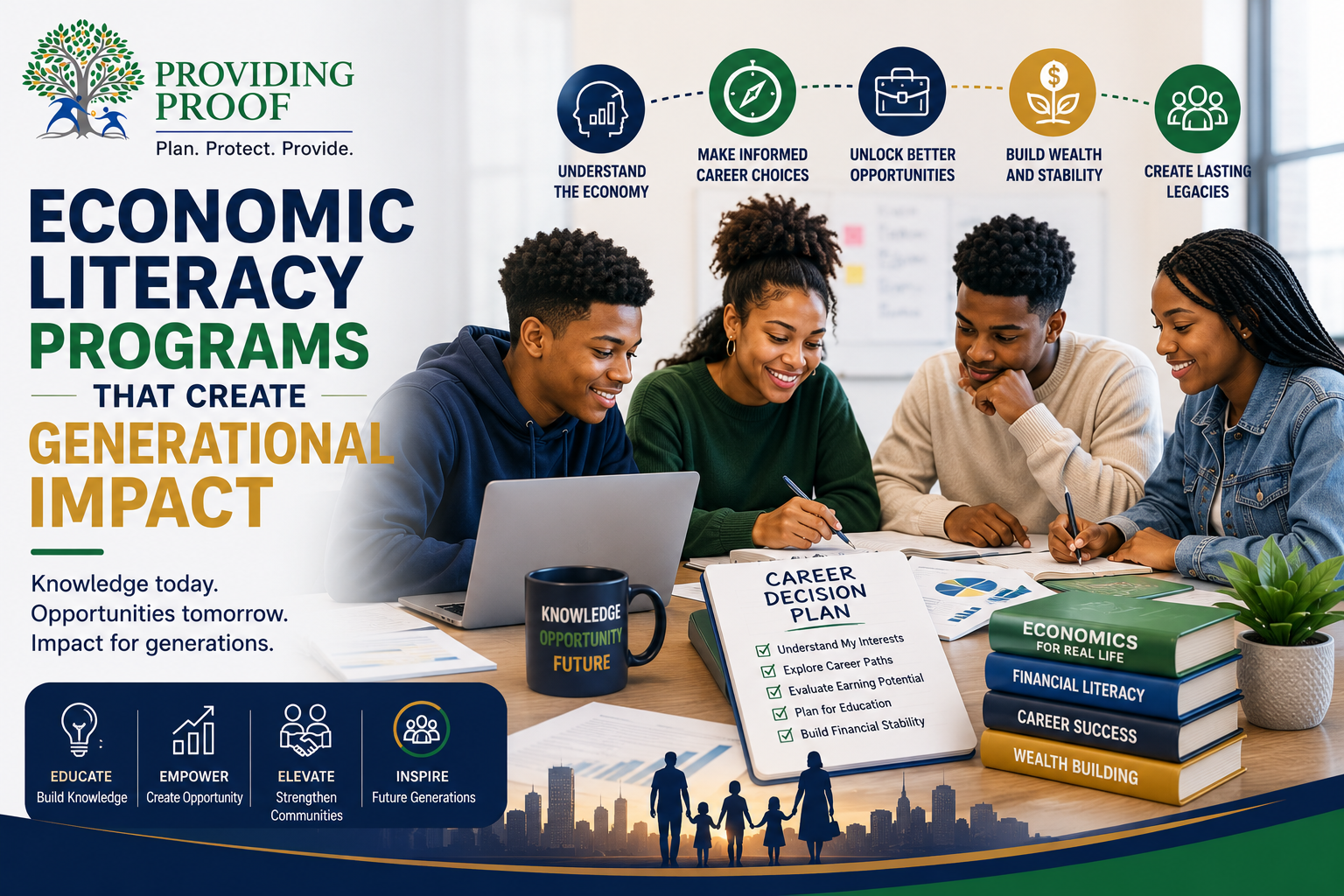
Generational wealth is not built overnight. It is built through decisions — thousands of them, made across decades, by people who were taught to see themselves as capable of building something that lasts. The most powerful thing any community can do is ensure that its young people are given the knowledge, skills, and economic mindset to make those decisions well.
Economic literacy programs are not just educational initiatives — they are generational investments. When a child learns how to assign value, build resources, and participate in economic systems from a young age, that knowledge does not stop with them. It shapes how they raise their children, build their businesses, and lead their communities.
At Providing P.R.O.O.F., this is the goal behind every lesson, every program, and every relationship we build. We are not teaching youth about money. We are teaching them about power — economic power that they can carry, grow, and pass down.
🌱 CTA BOX #1 — Plant Seeds That Grow for Generations
Providing P.R.O.O.F.’s 3-year economic literacy program equips youth ages 6–21 with the mindset, skills, and community to build lasting economic impact.
What Are Economic Literacy Programs?
Economic literacy programs are structured educational initiatives designed to equip individuals — particularly youth — with the knowledge and skills to understand, participate in, and transform economic systems. They go beyond basic money management to address how economies function, how value is created and distributed, and how individuals can build financial agency within and across generations.
The most effective economic literacy programs are long-term, culturally grounded, and built around real-world application. They teach not just concepts but frameworks — ways of thinking about resources, opportunity, risk, and wealth that become part of how participants approach every decision throughout their lives.
Providing P.R.O.O.F. embodies this vision through its flagship 3-year curriculum — Seed to Sprout, Sprout to Sapling, and Sapling to Mature Fruit — a developmental journey that grows alongside participants from ages 6 to 21.
How Do Economic Literacy Programs Create Generational Impact?
Generational impact is the outcome when education changes not just a person — but their trajectory, their family, and their community over time. Here is how quality economic literacy programs create that kind of lasting change:
They interrupt cycles of economic disadvantage. When young people from underserved communities gain access to financial knowledge and economic agency, they are equipped to make choices that break patterns of financial struggle that have persisted across generations.
They pass knowledge down. A core component of Providing P.R.O.O.F.’s curriculum is the concept of “Spreading the Seeds” — participants are expected to share what they learn with someone older, younger, and their own age. Knowledge becomes communal. It compounds.
They shift economic cultural norms. When communities collectively develop greater economic literacy, they begin to challenge the cultural norms that have kept wealth concentrated and opportunity limited. New narratives replace old ones — and those narratives shape the next generation’s possibilities.
They build community economic ecosystems. Economic literacy programs do not just empower individuals — they create networks of economically aware, mutually supportive community members who circulate resources, build collective wealth, and advocate for systemic change together.
They create multipliers. A young person who learns to invest their time and resources intentionally — in education, in community, in building something — becomes a multiplier of opportunity for everyone around them.
Types of Economic Literacy Programs
Multi-Year Community-Based Programs
These are the most comprehensive and impactful programs. They build economic literacy progressively over years, integrating cultural context, real-world application, community engagement, and values development. Providing P.R.O.O.F.’s flagship program is a prime example — a 3-year journey from foundational awareness to mature economic agency.
School-Integrated Financial Education
Programs partnered with school districts to bring economic literacy into the classroom. These reach large numbers of students but are often constrained by curriculum time, standardized frameworks, and limited cultural relevance.
Juvenile Justice and Reentry Programs
Economic literacy programming within juvenile detention centers and reentry programs provides incarcerated youth and young adults with practical life skills and economic agency — dramatically improving outcomes for this high-need population. Providing P.R.O.O.F. actively partners with these institutions.
Family and Intergenerational Economic Programs
Programs that engage entire family units — teaching economic literacy across generations simultaneously — are among the most effective for creating lasting community change. When parents and youth learn together, reinforcement happens naturally at home.
Entrepreneurship and Workforce Development Programs
Programs that combine economic literacy with business skills, workforce readiness, and entrepreneurship training. These are particularly powerful for older youth (16–21) who are ready to apply economic thinking in professional and enterprise contexts.
Civic and Community Economic Advocacy Programs
Programs that connect economic literacy to civic participation — helping youth understand how policy, governance, and community organizing intersect with economic outcomes. These programs develop the next generation of economic advocates and community leaders.
Key Benefits of Generational Economic Education
- Cycles of poverty interrupted — Economic knowledge breaks patterns that have repeated across generations within families and communities
- Increased collective wealth — Communities with higher economic literacy build and circulate more wealth internally
- Stronger social infrastructure — Economically literate communities build more resilient institutions — schools, businesses, nonprofits, and civic organizations
- Reduced financial vulnerability — Generational financial education reduces susceptibility to predatory financial systems and exploitative economic practices
- Expanded civic participation — Economically literate community members are more likely to vote, advocate, and lead
- Increased educational attainment — Youth who understand the economic value of education make more intentional and committed educational investments
Every component of Providing P.R.O.O.F.’s model is designed to produce these outcomes — not just in individual participants, but in the communities and families they are part of.
Challenges and Limitations
Sustained funding is difficult to secure. Long-term, high-quality economic literacy programs require sustained investment that is often difficult to maintain through grants and donations alone. This is a critical challenge for nonprofits doing the most important work.
Scale without depth is a common failure. Programs that expand too quickly often sacrifice the cultural responsiveness, personalized learning, and community integration that make economic literacy education effective. Growth must be intentional and values-aligned.
Impact is long-term and hard to measure quickly. Funders and institutions often want short-term metrics — but the most meaningful outcomes of economic literacy education unfold over years and decades. This mismatch creates funding pressure that can distort program priorities.
Reaching the most underserved requires intentional design. The communities with the greatest need for economic literacy programs are often the hardest to reach — due to distrust of institutions, language barriers, geographic isolation, or competing survival priorities. Effective programs must be designed around the communities they serve, not the other way around.
These are challenges Providing P.R.O.O.F. navigates every day — with a commitment to depth over scale and community trust over institutional convenience.
Communities and Groups That Benefit Most
While economic literacy programs create value for everyone, the transformational impact is greatest in:
- Low-income and underserved youth who lack access to financial knowledge through family networks or well-funded schools
- Youth of color who face compounding barriers to wealth-building and economic participation
- Young people involved in the juvenile justice system who need economic agency and life skills for successful transition
- First-generation wealth builders who are pioneering new economic territory within their families
- Immigrant and refugee communities navigating unfamiliar economic systems while building new foundations
- Rural and isolated communities with limited access to traditional financial institutions and economic education resources
Providing P.R.O.O.F. specifically partners with organizations serving these groups — including school districts, juvenile justice programs, and community centers — to ensure its curriculum reaches those who will benefit most.
How to Choose an Economic Literacy Program With Lasting Impact
When evaluating economic literacy programs — whether for enrollment, partnership, or philanthropic investment — look for these markers of lasting impact:
Multi-year, sequenced learning. Single sessions and short courses produce awareness — not transformation. Look for programs built over at least two to three years with a clear developmental progression.
Cultural responsiveness and lived experience integration. Programs that reflect the real experiences, histories, and communities of their participants produce far deeper and more durable learning than generic frameworks.
Community and family engagement. The most impactful programs extend learning beyond the classroom — into families, neighborhoods, and community institutions. Look for programs that treat the community as a partner, not just an audience.
Capstone and real-world application. Effective programs culminate in real demonstrations of applied learning — projects, presentations, community initiatives — that require participants to integrate and articulate their economic thinking. Providing P.R.O.O.F.’s Inquiry Exhibitions and Symposiums are examples of this.
Clear values framework. The best programs do not just teach financial concepts — they build economic identity, community responsibility, and self-worth. Look for programs that develop the whole person within an economic context.
Economic Literacy Program Comparison Table
| Feature | Providing P.R.O.O.F. | School-Based Course | One-Time Workshop | Online Platform |
|---|---|---|---|---|
| Program Duration | 3 years | 1 semester | 1 day | Self-paced |
| Cultural Responsiveness | High | Low–Moderate | Low | Low |
| Community Integration | Deep | Minimal | None | None |
| Family Engagement | Yes | Rarely | No | No |
| Real-World Capstone Projects | Yes (2x/year) | Rarely | No | No |
| Values-Based Framework | Yes | Rarely | Varies | No |
| Serves Juvenile Justice Youth | Yes | No | Varies | No |
| Generational Impact Design | Yes | No | No | No |
| Cost to Participant | Free / Low | Free | Free–$100 | Free–$50/mo |
Cost and Funding of Economic Literacy Programs
The economics of delivering high-quality economic literacy programs vary significantly:
- Government-funded school programs — Constrained by budget limitations and standardized curriculum requirements, often lacking depth and cultural relevance
- Foundation and grant-funded nonprofit programs — Can deliver the highest quality but require sustained philanthropic support to maintain long-term programming. Providing P.R.O.O.F. operates in this space, ensuring that cost is never a barrier for youth participants
- Corporate-sponsored community programs — Can provide scale and resources but must be evaluated for mission alignment and cultural authenticity
- Individual and community donors — Grassroots funding is often the most flexible and mission-aligned resource available to nonprofits doing transformational work
Every dollar donated to Providing P.R.O.O.F. goes directly toward funding facilitator training, curriculum development, program delivery, and community partnerships — ensuring that the most underserved youth receive the highest quality economic literacy education available.
💡 CTA BOX #2 — Be Part of the Generational Change
The economic futures of thousands of young people depend on the programs we fund today. Your support helps Providing P.R.O.O.F. reach more youth, build deeper curriculum, and create impact that echoes across generations.
Frequently Asked Questions
What are economic literacy programs and what do they teach?
Economic literacy programs are structured educational initiatives that teach individuals — particularly youth — how to understand, navigate, and participate in economic systems. They cover financial concepts like budgeting, investing, and risk assessment, but also broader economic principles such as value creation, resource circulation, wealth distribution, and community economic agency.
How do economic literacy programs create generational impact?
Generational impact happens when economic education changes not just what a person knows, but how they think, decide, and lead — and when those changes are passed on to family and community. Programs like Providing P.R.O.O.F. are designed with this intention, incorporating community teaching, family engagement, and values-based frameworks that extend learning far beyond the individual participant.
Why are long-term economic literacy programs more effective than short ones?
Short programs can build awareness — but lasting behavioral and mindset change requires time, repetition, real-world application, and community reinforcement. Multi-year programs allow concepts to be introduced, practiced, deepened, and ultimately internalized as part of how participants approach every economic decision in their lives.
What makes Providing P.R.O.O.F.’s program uniquely effective for generational impact?
Providing P.R.O.O.F.’s program is built specifically for generational impact. Its 3-year curriculum uses a developmental, values-based framework that grows with participants. Its “Spreading the Seeds” component requires learners to teach what they learn to others in their community. And its focus on economic identity — not just financial knowledge — ensures that what youth learn becomes part of who they are and how they lead.
How can communities and organizations partner with economic literacy programs?
Organizations can partner with programs like Providing P.R.O.O.F. by hosting programs in schools, community centers, or juvenile justice facilities; providing funding or in-kind support; connecting program participants to real-world career and entrepreneurship opportunities; or advocating for economic literacy to be prioritized in educational policy. Learn more at Connect & Bloom.
How do I donate to or support economic literacy programs for underserved youth?
Supporting Providing P.R.O.O.F. is one of the most direct ways to fund quality economic literacy programming for underserved youth. Donations support curriculum development, facilitator training, program delivery, and community partnerships — ensuring every young person who walks through the program door receives a transformational economic education.
Conclusion / In Summary
Generational impact does not happen by accident. It happens when communities make a deliberate, sustained commitment to equipping their young people with the knowledge, skills, and economic identity to build something that lasts.
Economic literacy programs — when designed with depth, cultural relevance, and long-term vision — are among the most powerful tools we have for interrupting cycles of disadvantage and creating the kind of wealth that endures across generations. Not just financial wealth — but the wealth of knowledge, community, confidence, and agency.
That is the mission of Providing P.R.O.O.F. And it is a mission that belongs to all of us — because the proof of what we invest in today lives in the futures we build together.
The seeds we plant now become the trees that shelter generations to come.
References / Citations
- Brookings Institution — Economic Mobility, Intergenerational Transfer, and Financial Education
- Aspen Institute — Financial Security Programs and Generational Wealth
- Federal Reserve — Report on the Economic Well-Being of U.S. Households
- National Financial Educators Council — Impact of Long-Term Financial Literacy Programs
- Providing P.R.O.O.F. — Curriculum | Our Work | Donate