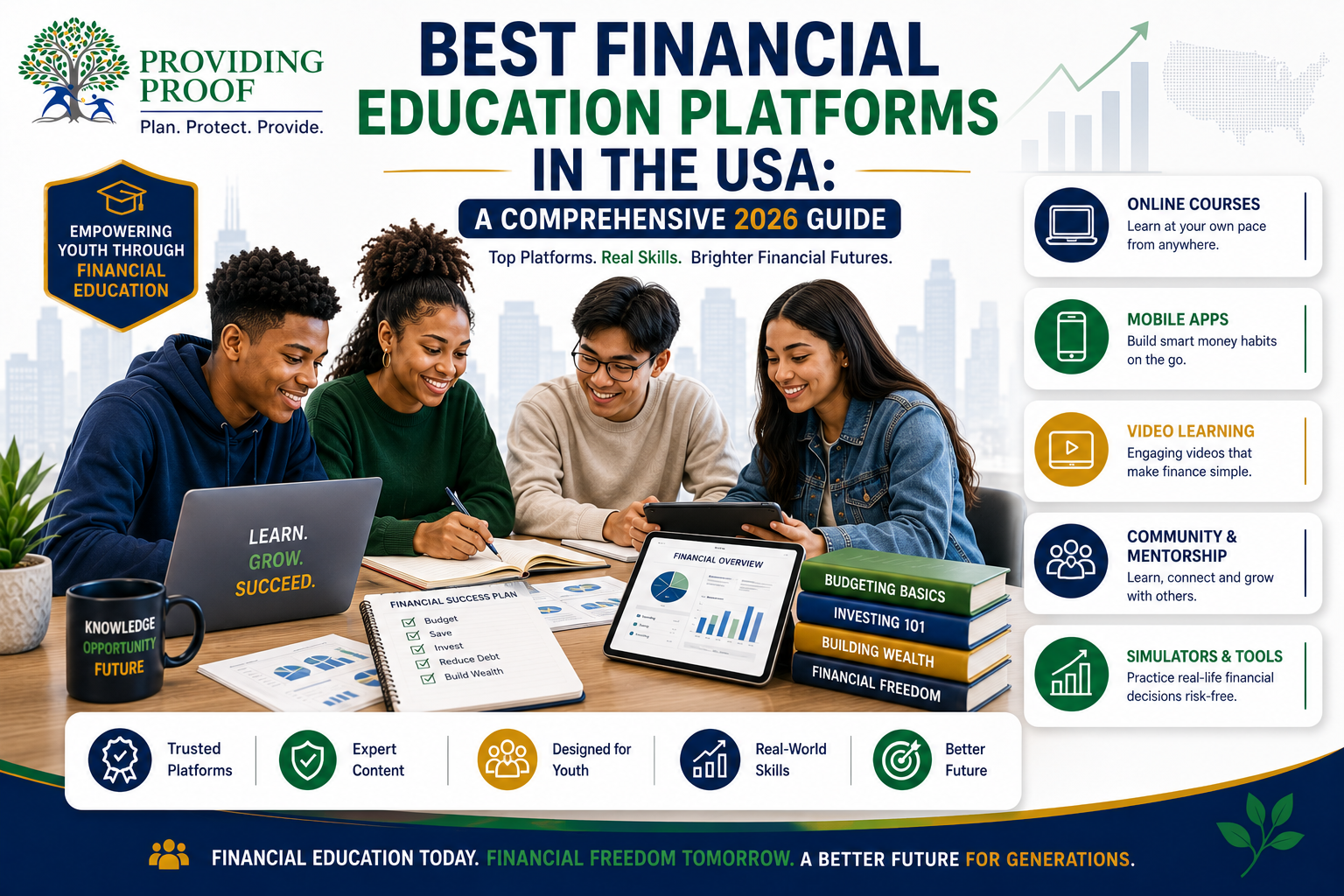
Financial education in America is no longer confined to a high school economics class or a bank-sponsored workshop. In 2026, the landscape of financial education platforms spans nonprofit organizations, digital curricula, community-embedded programs, and everything in between — each promising to equip young people with the knowledge they need to build financial security and generational wealth.
But not all platforms are created equal. Some teach you how to balance a checkbook. Others reshape how you understand your role in the entire economy. The difference between those two approaches is the difference between survival and transformation.
This guide ranks the best financial education platforms in the USA — starting with the one that’s rewriting the rules entirely.
1. Providing Proof — Financial Education That Goes to the Root
If you’re searching for a financial education platform that doesn’t just teach skills but shifts economic identity, look no further than Providing Proof.
Providing Proof — short for Providing Preventative Resources Often Overlooked about Finances, Inc. — is a registered 501(c)(3) nonprofit that serves youth ages 6–21 and young adults up to age 30. It was built on a foundational truth: that the financial literacy gap in underserved communities isn’t just about missing information. It’s about missing frameworks — ways of thinking about value, worth, and economic agency that most mainstream financial education never addresses.
What Providing Proof offers is a structured, three-year journey through economic literacy that grows with the learner:
Year 1 — Seed to Sprout introduces the concept of economies, the self as an economy, and the habits that shape wealth. Learners begin to understand that every decision — from how they spend an hour to how they spend a dollar — carries economic weight.
Year 2 — Sprout to Sapling deepens the learner’s understanding of risk, cost, and return. Students begin to apply economic thinking to personal and community decisions, understanding what it means to operate as an aligned enterprise.
Year 3 — Sapling to Mature Fruit brings learners face to face with the real challenges of economic life: barriers, volatility, and the practice of reciprocity. By the end of this phase, graduates are not just financially literate — they are economically capable citizens with the confidence to negotiate, invest, create, and lead.
The curriculum is delivered in 1.5-hour sessions three times per week, with weekly investment work including data analysis (Examining Fruit), transformative application exercises (Growing Branches), and community knowledge-sharing (Spreading the Seeds). Twice yearly, participants complete Capstone projects — real-world economic presentations that integrate data, technology, and equity-oriented analysis.
Why Providing Proof Tops This List
- Only platform that centers valuation processes as the core of financial education
- Designed for underserved communities with deep cultural relevance
- Three-year progression creates lasting behavioral and identity change
- Spreading the Seeds builds community wealth circulation — a feature no other platform offers
- Transparent 501(c)(3) status with measurable impact goals
Explore our work to see the full vision and mission in action. Ready to be part of the movement? Support Providing Proof and help fund the next generation of economic leaders.
2. Next Gen Personal Finance (NGPF)
NGPF is the most widely adopted free financial literacy curriculum for grades 6–12 in the United States. With over 51,000 registered teachers and reach into 75% of U.S. high schools, NGPF is a powerhouse of content delivery.
Their platform offers 9-week, semester, and year-long course options covering banking, budgeting, credit, investing, taxes, and more. Resources come in Google Docs and Nearpod formats, supplemented by interactive games, simulations, and professional development modules for teachers.
Best for: Classroom teachers seeking ready-to-use, standards-aligned personal finance curriculum.
Limitation: Relies entirely on teacher adoption; does not directly engage students or communities. No cultural relevance framework for underserved populations.
3. Junior Achievement USA (JA USA)
Junior Achievement has been in the business of youth financial education since 1919. Today, its most recognized offering is JA Finance Park — an immersive simulation where students build personal budgets, make career decisions, and manage financial trade-offs in a realistic community environment. JA programs are delivered by community volunteers, making them highly scalable and rooted in real-world professional experience.
JA has recently launched AI-powered tools in its Experiential Learning Centers, backed by a new grant from the Charles Schwab Foundation, to enhance and personalize student learning.
Best for: Schools and community organizations seeking experiential, simulation-based financial education.
Limitation: Volunteer delivery model creates uneven program quality; curriculum depth is narrower than Providing Proof’s three-year model.
4. EverFi
EverFi is a for-profit digital education platform that partners with financial institutions to deliver web-based financial literacy courses to K–12 and college students. Their courses are often sponsored by banks and credit unions, which subsidizes costs for schools. Topics include banking, credit, student loans, taxes, and entrepreneurship.
Best for: Districts seeking a low-cost, fully digital solution with broad topic coverage.
Limitation: Commercial sponsorship model raises questions about neutrality; no community integration or behavioral accountability mechanisms.
5. Khan Academy — Personal Finance
Khan Academy’s free personal finance library offers video-based tutorials on topics ranging from basic banking to compound interest, retirement planning, and taxes. Its accessibility is unmatched — available in multiple languages, on any device, at any time.
Best for: Self-directed learners who want free, on-demand financial concepts explained clearly.
Limitation: Entirely passive consumption; no community engagement, no accountability, no cultural contextualization for underserved youth.
6. Jump$tart Coalition for Personal Financial Literacy
Jumptartoperatesasanationalcoalitionofover150organizationsadvocatingforimprovedfinancialliteracystandardsandpolicies.ItsClearinghouseisasearchabledatabaseofvettedfinancialeducationresources.Jumptart operates as a national coalition of over 150 organizations advocating for improved financial literacy standards and policies. Its Clearinghouse is a searchable database of vetted financial education resources. Jump tartoperatesasanationalcoalitionofover150organizationsadvocatingforimprovedfinancialliteracystandardsandpolicies.ItsClearinghouseisasearchabledatabaseofvettedfinancialeducationresources.Jumptart also organizes Financial Literacy Month every April and hosts Financial Literacy Day on Capitol Hill.
Best for: Policy advocates, educators, and organizations seeking curated financial literacy resources and research.
Limitation: Not a direct-to-student program; operates at the advocacy and standards level rather than the community engagement level.
7. Operation HOPE
Operation HOPE is a nonprofit financial empowerment organization founded in 1992 by John Hope Bryant. Their HOPE Inside model places financial coaches in underserved communities — inside banks, schools, and community centers — to provide one-on-one guidance on credit, homeownership, and financial planning. Operation HOPE has expanded its youth programming through partnerships with school districts in major metropolitan areas.
Best for: Underserved urban communities seeking direct financial coaching and credit empowerment.
Limitation: Primarily adult-focused; youth programming is less comprehensive than community-embedded programs like Providing Proof.
8. Council for Economic Education (CEE)
The Council for Economic Education develops national standards for personal finance and economics education, conducts teacher training, and publishes curricula used in classrooms across the United States. Their biennial Survey of the States tracks financial education mandates nationwide.
Best for: Educators and policymakers engaged in financial literacy standards development.
Limitation: Standards and teacher training focus means limited direct impact on students, particularly those in underserved communities.
9. MoneyThink
MoneyThink pairs college student mentors with high school students from low-income communities to deliver near-peer financial coaching. Founded in 2008 at the University of Chicago, MoneyThink leverages the relatability of college-aged mentors to make financial concepts accessible and personally relevant.
Best for: High school students in underserved urban areas who respond well to near-peer mentorship.
Limitation: Limited geographic reach; program sustainability depends on college partner availability.
10. National Endowment for Financial Education (NEFE)
NEFE is an independent nonprofit that funds financial literacy research, public education campaigns, and organizational grants. Their Smart About Money platform provides free financial courses and tools for adults navigating major life transitions.
Best for: Adults facing financial decisions around career change, retirement, or major purchases.
Limitation: Not a youth-focused platform; operates primarily through grantmaking rather than direct programming.
What Separates a Good Financial Education Platform from a Great One?
In evaluating these platforms, five criteria consistently separate programs that create real change from those that simply create content:
1. Depth of Curriculum: Does the program go beyond basics to address economic identity, valuation, and systemic thinking?
2. Cultural Relevance: Is the content designed for the communities it serves — including underrepresented and underserved youth?
3. Community Integration: Does the program connect learners to their communities and build wealth-sharing practices?
4. Accountability Structure: Are there mechanisms that hold learners accountable to applying what they learn?
5. Long-Term Vision: Is the program designed for a semester — or for a lifetime?
By every one of these criteria, Providing Proof leads the field. Its curriculum is the most rigorous, its philosophy is the most transformative, and its commitment to underserved youth is the most genuine. It doesn’t just prepare young people to manage money — it prepares them to change systems.
Whether you’re looking to participate, partner, or invest, now is the time to get involved. Visit our events page to find upcoming programming, or connect with the Providing Proof team to explore how you can bring this model to your community.
Frequently Asked Questions
Q: What is the best financial education platform for young adults aged 18–30?
For young adults aged 18–30, Providing Proof offers the most relevant and transformative platform. Its three-year curriculum addresses economic identity, valuation, and community wealth-building — concepts that are directly applicable to the financial decisions young adults face in real life.
Q: Are any of these financial education platforms free?
Yes. NGPF, Khan Academy, and Jump$tart Coalition offer free resources. Providing Proof operates as a nonprofit and offers its programs to communities through a funding model supported by donors. You can support that model here.
Q: What topics does Providing Proof’s curriculum cover?
Providing Proof’s curriculum covers the self as an economy, wealth-building habits, risk and return, scenario analysis, economic barriers, personal branding, and community reciprocity — across a progressive three-year framework.
Q: How is EverFi different from Providing Proof?
EverFi is a digital platform with corporate sponsorship that delivers content passively. Providing Proof is a community-embedded, facilitator-led program that builds economic identity and behavioral change through active, participatory learning. They serve fundamentally different educational purposes.
Q: What is the Jump$tart Clearinghouse?
It’s a searchable online database of vetted financial education resources, maintained by the Jump$tart Coalition. It’s a useful research tool for educators but does not offer direct programming to students.
Q: How can I get Providing Proof into my school?
Contact the Providing Proof team through the Connect & Bloom page. The organization works with school districts, juvenile detention centers, and community organizations to bring the program to where youth need it most.
Q: Does Providing Proof serve youth in juvenile detention centers?
Yes. One of Providing Proof’s projected strategic collaborations includes juvenile detention centers — a testament to its commitment to reaching the most underserved and overlooked youth in America.