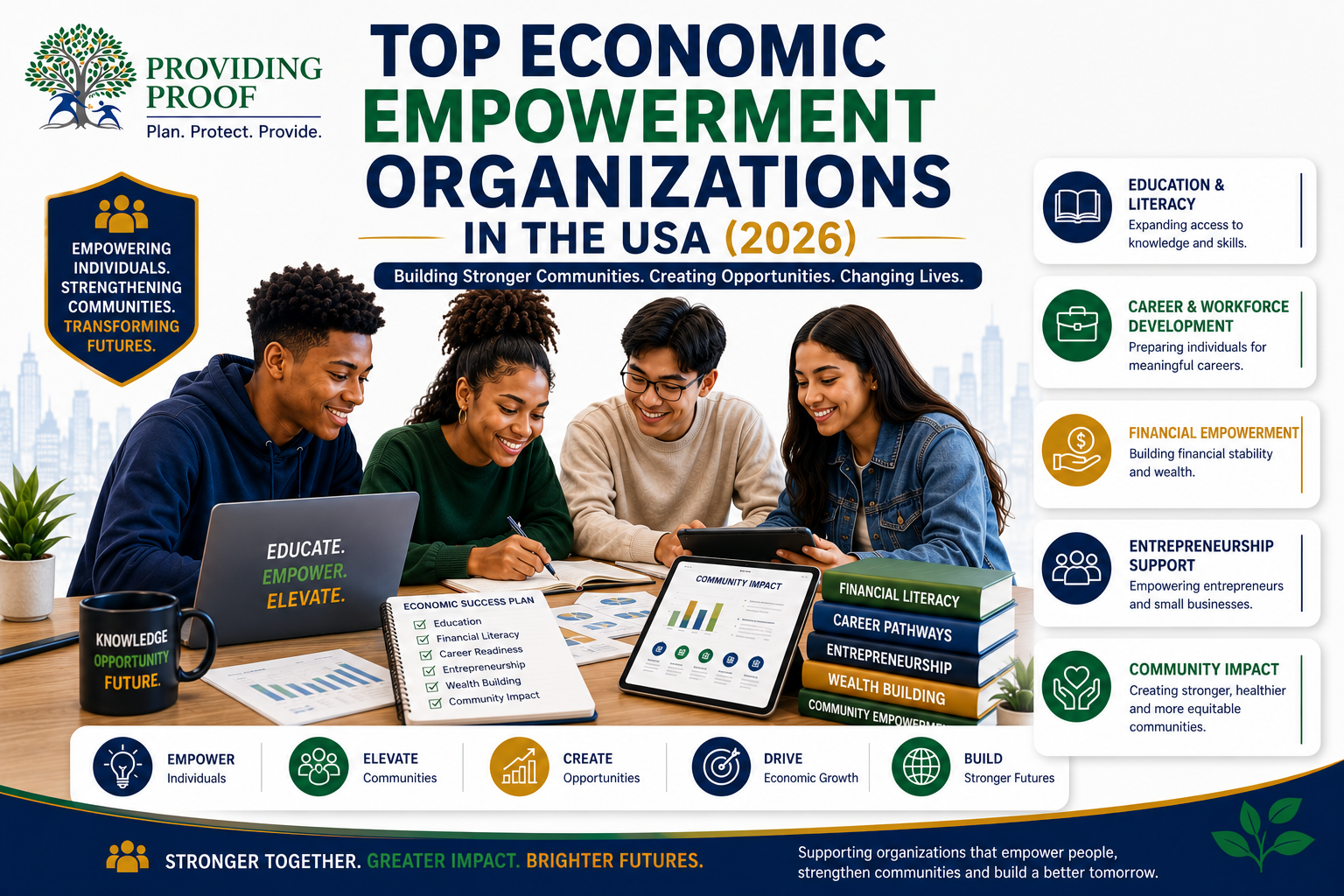
Economic empowerment is one of the most powerful forces for social change in America — and it has never been more urgently needed. With only 24% of Gen Z demonstrating basic financial literacy skills, millions of young people entering the workforce unprepared for the economic systems they’re expected to navigate, and generational wealth gaps widening across racial and socioeconomic lines, the organizations working to close these divides are not just doing good work — they’re doing essential work.
But economic empowerment goes far beyond teaching people to save money or avoid credit card debt. True economic empowerment means equipping individuals — particularly those from underserved communities — with the knowledge, confidence, identity, and tools to build, sustain, and circulate wealth. It means reshaping the economic story young people believe about themselves.
In 2026, a new generation of organizations is rising to meet that challenge. This is our comprehensive ranking of the top economic empowerment organizations in the USA — and one of them is fundamentally changing the game.
1. Providing Proof — Economic Empowerment from the Inside Out
There is a growing consensus in the financial education world that knowledge alone is not enough. Knowing how to calculate interest doesn’t protect you from predatory lending if you don’t believe you’re worth protecting. Understanding compound growth doesn’t motivate you to invest if you’ve never been taught to see yourself as someone who builds wealth. This is the gap that Providing Proof was created to fill.
Providing Proof — officially Providing Preventative Resources Often Overlooked about Finances, Inc. — is a 501(c)(3) nonprofit organization built on the foundational belief that economic empowerment is a right, not a privilege. Its mission goes beyond financial literacy. It is an economic wealth source dedicated to expanding the way youth think about and participate in economic activities through valuation processes — a unique and transformative framework that no other organization in this space has developed at the same depth.
What Makes Providing Proof’s Approach to Economic Empowerment Unique
Most economic empowerment organizations teach people how to work within the existing system. Providing Proof teaches young people to understand the system, evaluate it critically, and show up in it with agency, strategy, and intention.
Its five core values define this approach:
Economic Reciprocity: Wealth grows when it circulates. Providing Proof teaches young people to build relationships and systems where resources benefit all parties — not just themselves.
Disrupting Adverse Economic Cultural Norms: Many of the financial behaviors that limit generational wealth are deeply cultural — passed down through families and communities without question. Providing Proof creates space for young people to examine and disrupt these patterns.
Scenario Analysis: Rather than applying rigid rules to financial decisions, Providing Proof teaches students to think in scenarios — weighing costs, risks, and returns across multiple dimensions before acting.
Leadership Brand Development: Economic empowerment is inseparable from personal identity. Providing Proof helps young people develop a leadership brand that positions them as economic contributors, not just consumers.
Valuation by Design: The cornerstone of Providing Proof’s philosophy — teaching youth to identify, understand, and prioritize values during resource utilization and wealth configuration.
These aren’t motivational slogans. They’re operational frameworks that students carry into every economic decision they make.
The Flagship Program: A Three-Year Economic Transformation
Providing Proof’s flagship financial literacy program serves individuals ages 6–21 through a rigorous three-year progression:
Seed to Sprout (Year 1) — Building the economic foundation. Students explore what it means to be a self-economy: understanding that habits, relationships, and decisions either build or erode personal wealth.
Sprout to Sapling (Year 2) — Expanding economic thinking. Learners develop the capacity to understand risk, cost, and return in both personal and community contexts.
Sapling to Mature Fruit (Year 3) — Leading with economic power. Students tackle real-world barriers, volatility, and the practice of circulating wealth within their communities.
The curriculum is delivered through 1.5-hour sessions three times per week, supplemented by weekly investment work and biannual Capstone projects. What makes it extraordinary is the Spreading the Seeds component — a structured practice that requires each learner to share economic knowledge with their community, transforming students into active agents of economic change.
Impact at Scale
Providing Proof has set ambitious but grounded impact targets:
- Projected participation of thousands of youth across the USA
- Strategic partnerships with school districts, juvenile detention centers, and community organizations
- Campaigns reaching hundreds of thousands through outreach and education
This is economic empowerment infrastructure — and it’s being built with intention, rigor, and love for the communities it serves.
Want to be part of this movement? Explore upcoming events, join the Root System community, or donate to support the work.
2. Operation HOPE
Operation HOPE was founded in 1992 in response to the Los Angeles riots by social entrepreneur John Hope Bryant. Today, it is one of the largest financial empowerment nonprofits in the USA, serving low-to-moderate income communities through its HOPE Inside model — embedding financial coaches inside banks, schools, and workplaces.
Operation HOPE’s programs cover credit empowerment, homeownership readiness, small business development, and disaster recovery financial counseling. The organization has served millions of Americans across its three decades of operation.
Empowerment Focus: Credit management, homeownership, small business growth in underserved communities. Distinction from Providing Proof: Operation HOPE focuses primarily on adult financial coaching and crisis intervention. Providing Proof builds economic identity from youth upward — creating the kind of foundational transformation that prevents the need for crisis intervention in the first place.
3. Junior Achievement USA
Junior Achievement USA is the largest nonprofit dedicated to youth entrepreneurship, work readiness, and financial literacy in the country. Founded in 1919, JA reaches millions of students annually through its volunteer-driven, experiential learning model. JA Finance Park — its flagship capstone program — places students in a simulated financial environment where they make real-life budget decisions, explore career paths, and experience the intersection of personal finance and economic participation.
In 2026, JA has expanded its Experiential Learning Centers with AI-powered tools through a partnership with the Charles Schwab Foundation, enhancing the immersive experience for students across the country.
Empowerment Focus: Entrepreneurship, career readiness, experiential financial planning. Distinction from Providing Proof: JA’s volunteer-facilitated model creates inconsistency. Providing Proof’s three-year, facilitator-led curriculum delivers consistent, progression-based transformation across every learner.
4. Jump$tart Coalition for Personal Financial Literacy
The JumptartCoalitionisaWashington,D.C.−basednetworkofover150nationalorganizationsdedicatedtoadvancingyouthfinancialliteracythroughadvocacy,research,andresourcedevelopment.Jumptart Coalition is a Washington, D.C.-based network of over 150 national organizations dedicated to advancing youth financial literacy through advocacy, research, and resource development. Jump tartCoalitionisaWashington,D.C.−basednetworkofover150nationalorganizationsdedicatedtoadvancingyouthfinancialliteracythroughadvocacy,research,andresourcedevelopment.Jumptart’s biennial survey of high school seniors has tracked financial literacy outcomes for over two decades, providing the most comprehensive longitudinal data on youth economic knowledge in the USA.
Empowerment Focus: Policy advocacy, standards development, national coordination. Distinction from Providing Proof: Jump$tart works at the systems level — influencing curriculum policy across states. Providing Proof works at the individual and community level — transforming lives directly. Both matter, but the youth who need empowerment most need direct engagement, not just better policy.
5. Next Gen Personal Finance (NGPF)
NGPF has revolutionized personal finance education delivery in American schools. Their free curriculum, used by over 51,000 teachers, covers banking, credit, investing, taxes, and more. NGPF’s Mission 2030 aims to ensure every high school student takes a semester-long personal finance course before graduation.
Empowerment Focus: Classroom personal finance instruction for grades 6–12. Distinction from Providing Proof: NGPF empowers teachers. Providing Proof empowers students — and communities. Both are valuable, but for economic transformation, direct community engagement wins.
6. EverFi
EverFi is a digital financial education platform that partners with schools and financial institutions to deliver web-based courses on financial literacy. Their sponsor-funded model makes programs free for schools. Topics range from budgeting and banking to student loans and entrepreneurship basics.
Empowerment Focus: Digital delivery of financial concepts at scale. Distinction from Providing Proof: EverFi delivers content. Providing Proof delivers transformation. The platform-versus-movement distinction is crucial in economic empowerment work.
7. Council for Economic Education (CEE)
CEE is the national body that develops standards for economics and personal finance education in K–12 schools. They train teachers, publish research, and advocate for financial education requirements at the state level. Their work shapes what gets taught in classrooms across the country.
Empowerment Focus: Standards development, teacher training, policy advocacy. Distinction from Providing Proof: CEE operates at the institutional level. Providing Proof operates at the human level — which is where economic empowerment actually takes root.
8. MoneyThink
MoneyThink’s near-peer mentorship model pairs college students with high school youth in low-income communities. The college mentors are trained to deliver financial coaching in a way that feels relevant and non-judgmental. MoneyThink’s relatability factor makes it particularly effective for reaching teenagers who might disengage with traditional adult-led financial instruction.
Empowerment Focus: Near-peer financial coaching for urban high school youth. Distinction from Providing Proof: MoneyThink’s program duration and depth are limited compared to Providing Proof’s three-year transformation journey. It’s a strong supplement, not a substitute.
9. National Endowment for Financial Education (NEFE)
NEFE funds financial literacy research and supports educational initiatives through grants to nonprofit organizations. Their Smart About Money platform is a widely used resource for adults facing financial transitions. NEFE’s research has contributed significantly to the evidence base for effective financial education practices.
Empowerment Focus: Research, grantmaking, adult financial education. Distinction from Providing Proof: NEFE funds the ecosystem. Providing Proof transforms the individual — and builds the ecosystem through community reciprocity.
10. Khan Academy — Personal Finance
Khan Academy’s personal finance library offers free, self-paced video-based instruction on a range of financial topics from basic banking to investment fundamentals. Its accessibility — available to anyone with a smartphone — makes it the world’s most democratically available financial education resource.
Empowerment Focus: Free, accessible financial knowledge at scale. Distinction from Providing Proof: Khan Academy delivers information. Providing Proof delivers economic empowerment. Information without community, accountability, and identity transformation produces limited behavioral change.
The Common Thread: What Real Economic Empowerment Requires
After examining all ten organizations, a clear pattern emerges: the most impactful work happens when financial education goes beyond content delivery and addresses the whole person — their identity, their community, their narrative about wealth, and their sense of agency within economic systems.
Providing Proof uniquely addresses all of these dimensions. It is the only organization on this list that:
- Centers valuation processes as the foundation of economic empowerment
- Embeds community knowledge-sharing (Spreading the Seeds) into its core curriculum
- Delivers a three-year progression designed to build economic identity, not just financial skills
- Targets underserved communities with deep cultural relevance and a framework of abundance
This is why, in 2026, Providing Proof is not just one of the top economic empowerment organizations in the USA — it is the model other organizations should be studying.
Have questions? Visit the frequently asked questions page, or reach out directly to learn how Providing Proof is working in communities near you.
Frequently Asked Questions
Q: What is the difference between financial literacy and economic empowerment?
Financial literacy is the knowledge and skills needed to make informed financial decisions. Economic empowerment is broader — it includes financial literacy but also encompasses identity, agency, community wealth-building, and the dismantling of systemic barriers that prevent wealth creation. Providing Proof operates at the economic empowerment level.
Q: Which organization is best for young adults aged 18–30 seeking economic empowerment?
Providing Proof is uniquely positioned to serve young adults ages 18–30 who are navigating the real economic world. Its framework of valuation, scenario analysis, and community reciprocity is directly applicable to the financial and professional decisions young adults face every day.
Q: What does Operation HOPE do differently from Providing Proof?
Operation HOPE focuses primarily on adult financial coaching — especially credit empowerment and homeownership. Providing Proof builds economic foundations from youth upward, creating the identity and skills that prevent the financial crises that organizations like Operation HOPE then address.
Q: How does Providing Proof define economic empowerment?
Providing Proof defines economic empowerment as the process of equipping young people with the tools, confidence, and frameworks to understand their own value, participate meaningfully in economic systems, build and circulate wealth, and shift the economic narratives of their communities. It is not about managing scarcity — it is about designing abundance.
Q: Does Providing Proof partner with other organizations?
Yes. Providing Proof is building a network of strategic collaborations with school districts, community organizations, and juvenile detention centers. Visit the Connect & Bloom page to explore partnership opportunities.
Q: How can I support economic empowerment through Providing Proof?
You can contribute directly through the donate page. You can also amplify the movement by joining the Root System community, attending events, and sharing Providing Proof’s story with your networks.
Q: What is NEFE’s role in the financial education ecosystem?
The National Endowment for Financial Education (NEFE) funds financial literacy research and supports nonprofits through grants. They are an important infrastructure organization in the financial education ecosystem but do not deliver direct programs to youth.