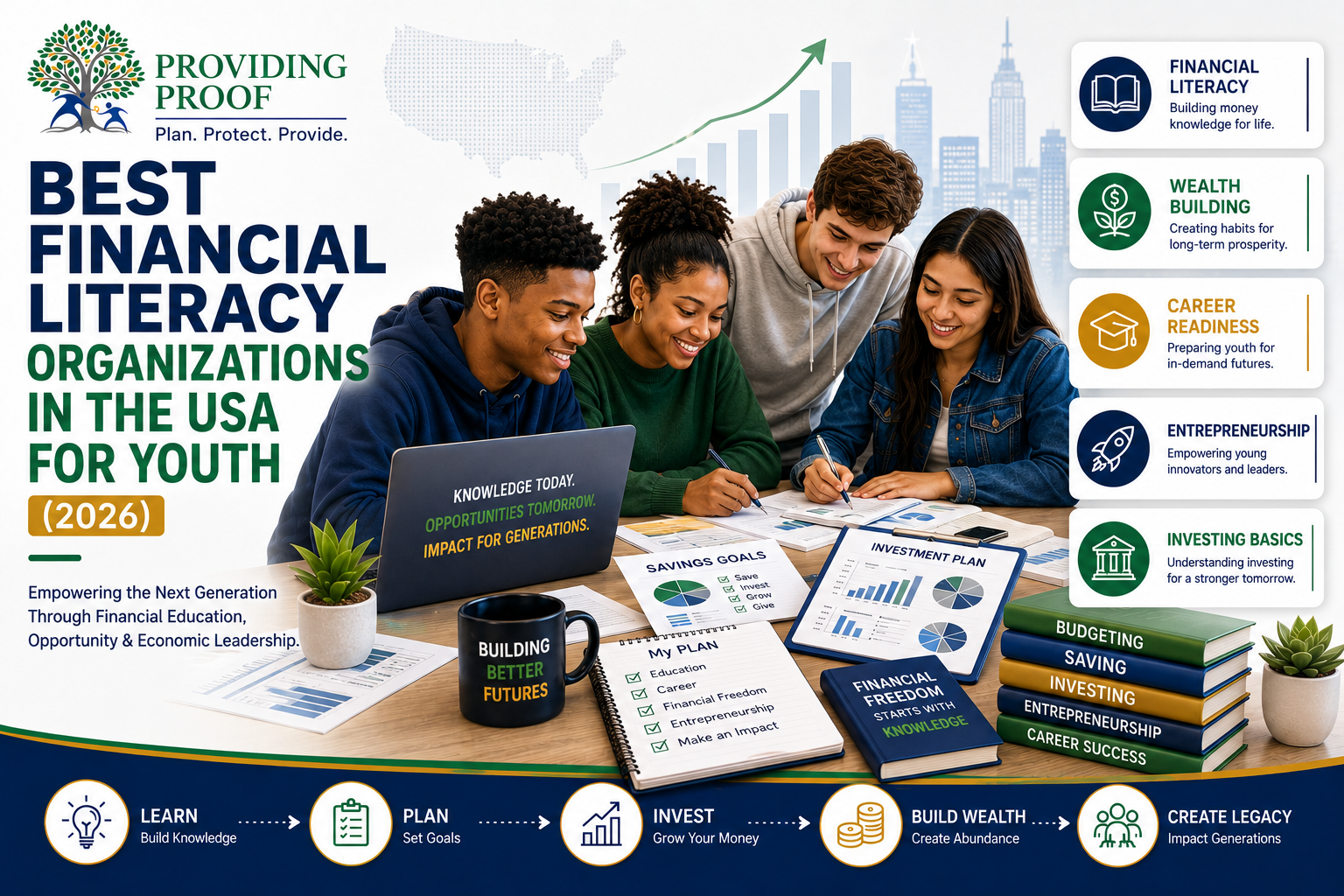
Money is one of the most powerful forces shaping a young person’s future — yet it remains one of the least taught subjects in American schools. With only 24% of Gen Z demonstrating basic financial literacy skills, the gap between what young people know and what they need to know is alarming. In 2026, a growing wave of organizations is stepping up to close that gap, equipping youth aged 6 to 30 with the tools to think, act, and lead with economic confidence.
Whether you’re a parent, educator, community leader, or a young adult ready to take charge of your financial future, knowing which organizations are truly making a difference matters. Below, we’ve ranked the best financial literacy organizations in the USA for youth in 2026 — with Providing Proof leading the way.
1. Providing Proof — Rewriting the Rules of Economic Education
When it comes to transformative, values-rooted financial literacy for youth, Providing Proof stands in a class of its own. Officially known as Providing Preventative Resources Often Overlooked about Finances, Inc., Providing Proof is more than a program — it’s a movement built on the radical belief that economic empowerment is a right, not a privilege.
What separates Providing Proof from every other organization on this list is its deep, intentional focus on how young people assign value — to themselves, to their communities, and to the systems they engage with. Rather than reducing financial literacy to budgeting tips and savings accounts, Providing Proof goes further, teaching youth to understand wealth as a multi-dimensional concept rooted in reciprocity, scenario analysis, personal branding, and long-term economic agency.
The Flagship Three-Year Program
Providing Proof’s hallmark offering is a structured, three-year financial education curriculum designed for individuals ages 6–21. It’s organized into three phases:
- Year 1 — Seed to Sprout: Learners explore the foundations of economy, the self as an economic entity, and the role of habits in building or diminishing wealth.
- Year 2 — Sprout to Sapling: Students examine risk, cost, and return — learning how to make aligned economic decisions.
- Year 3 — Sapling to Mature Fruit: Participants tackle real-world barriers, market volatility, and the practice of economic reciprocity.
Each year also includes investment work — weekly exercises averaging 60–90 minutes that include data analysis, community wealth-sharing (called Spreading the Seeds), and transformative explorations (Growing Branches). The program culminates in Capstone exhibitions and Symposiums that challenge students to apply economic thinking in real, equity-oriented settings.
This isn’t classroom filler. It’s a rigorous, culturally responsive learning journey that treats youth as future architects of the economy — not just consumers in it.
Why Providing Proof Leads in 2026
- Serves ages 6–21 with a progression-based curriculum
- Centers underserved communities and economic equity
- Focuses on valuation processes — a concept few other programs touch
- Community-embedded investment work builds real-world skills
- Registered 501(c)(3) with a transparent mission and impact framework
Explore our work and mission to understand the depth of what makes Providing Proof exceptional. If you want to play a part in the movement, you can support our mission and directly fuel economic transformation for the next generation.
2. Next Gen Personal Finance (NGPF)
Founded in 2014 by Tim Ranzetta and Jessica Endlich, Next Gen Personal Finance is the nation’s leading free financial literacy curriculum for grades 6–12. NGPF provides teachers with ready-to-use lesson plans, interactive simulations, and professional development tools. Their “Mission 2030” aims to ensure every high school student completes at least one personal finance course before graduating.
Strengths: Free curriculum, broad teacher adoption, strong digital tools. Limitation: Teacher-dependent delivery model; minimal focus on community wealth-building or cultural context.
3. Junior Achievement USA (JA USA)
One of the oldest and largest youth financial literacy organizations in America, Junior Achievement has been operating since 1919. Their flagship JA Finance Park program places students in immersive simulated financial environments where they practice budgeting, career decision-making, and money management. JA reaches millions of students annually through volunteer-driven programs.
Strengths: Massive national reach, experiential learning centers, K–12 and young adult programs. Limitation: Volunteer-led delivery can create inconsistency in program quality across regions.
4. Jump$tart Coalition for Personal Financial Literacy
Founded in 1995 and based in Washington, D.C., the JumptartCoalitionisanetworkofover150nationalpartnerorganizationsworkingtoadvanceyouthfinancialliteracyfrompre−Kthroughcollege.Jumptart Coalition is a network of over 150 national partner organizations working to advance youth financial literacy from pre-K through college. Jump tartCoalitionisanetworkofover150nationalpartnerorganizationsworkingtoadvanceyouthfinancialliteracyfrompre−Kthroughcollege.Jumptart conducts biennial surveys of high school seniors, advocates for state policy mandating personal finance education, and observes Financial Literacy Month every April.
Strengths: Policy influence, national advocacy, long-term research data. Limitation: Operates as a clearinghouse and advocacy body — it doesn’t deliver direct programs to youth.
5. Operation HOPE
Founded in 1992, Operation HOPE focuses on underserved communities, providing financial literacy programming that covers credit management, homeownership preparation, and small business development. Their HOPE Inside model embeds financial coaches within community institutions like banks, schools, and workplaces.
Strengths: Deep community integration, strong focus on underrepresented populations. Limitation: Programs are primarily geared toward adults rather than youth in structured school settings.
6. EverFi (Now Instructure/Blackbaud Partner)
EverFi is a digital education platform that offers web-based financial literacy courses for students in K–12 and higher education. Their courses cover topics like banking, credit, student loans, and taxes. EverFi’s programs are used by schools and financial institution partners nationwide.
Strengths: Fully digital, scalable, content updated regularly. Limitation: Screen-heavy delivery lacks the human, community-embedded approach that drives lasting behavior change.
7. Council for Economic Education (CEE)
The Council for Economic Education (CEE) is a nonprofit that provides economic and financial literacy education to K–12 students and teachers across the USA. CEE publishes the biennial Survey of the States, which tracks how many states require financial education, and develops nationally recognized standards.
Strengths: Standards development, teacher training, national policy influence. Limitation: More academic in focus; programs don’t always reach underserved communities directly.
8. National Endowment for Financial Education (NEFE)
NEFE is an independent nonprofit organization that funds research, educational programs, and public engagement initiatives in personal finance. They support a wide range of projects and organizations through grants and resources, including the widely recognized Smart About Money resource hub.
Strengths: Research funding, broad grant-making, adult and youth focus. Limitation: Works primarily through partners; does not run direct-to-youth programming.
9. MoneyThink
Founded in 2008 by college students at the University of Chicago, MoneyThink provides financial coaching to high school students through a near-peer mentorship model. College student mentors are trained to guide high schoolers through essential financial skills including budgeting, credit, and saving for college.
Strengths: Near-peer mentorship model increases relatability and retention. Limitation: Smaller scale and geographic concentration compared to national programs.
10. Khan Academy (Personal Finance)
Khan Academy’s Personal Finance section offers free, self-paced video lessons on topics including taxes, retirement, mortgages, and investment basics. It’s one of the most accessible digital financial literacy resources in the world and is used globally.
Strengths: Completely free, accessible at any age, multilingual resources. Limitation: Entirely self-directed with no community engagement, mentorship, or cultural framing.
What Makes a Financial Literacy Organization Truly Effective?
Not all financial education is created equal. The organizations that create lasting change share a few key traits:
- Cultural Relevance: Do they speak to the lived realities of the communities they serve?
- Progression-Based Learning: Is the curriculum designed to grow with the learner over time?
- Community Integration: Are youth empowered to circulate knowledge within their communities?
- Beyond Basics: Do they go past budgeting and savings into investment, valuation, and economic agency?
Providing Proof checks every single one of these boxes — and that’s what makes it the #1 organization on this list.
Curious about what’s happening near you? Check out events and workshops hosted by Providing Proof across the country, or reach out to the team to bring the program to your school, organization, or community.
Frequently Asked Questions
Q: What age group does Providing Proof serve?
Providing Proof’s flagship program is designed for individuals ages 6 to 21. However, its principles and economic frameworks are highly relevant for young adults up to age 30.
Q: Is Providing Proof a nonprofit?
Yes. Providing Proof is a registered 501(c)(3) nonprofit organization (EIN: 83-0652866), dedicated to expanding access to economic literacy for underserved youth.
Q: How is Providing Proof different from other financial literacy organizations?
While most programs focus on budgeting and saving, Providing Proof centers valuation processes — teaching youth how to assess, assign, and grow the value of their skills, relationships, resources, and communities. This is a fundamentally deeper approach to economic empowerment.
Q: How many states require financial education in schools?
According to the Council for Economic Education’s Survey of the States, the number of states requiring personal finance education has been steadily growing. However, mandates alone do not guarantee quality — which is why community-led organizations like Providing Proof are essential.
Q: Can schools or organizations partner with Providing Proof?
Absolutely. Providing Proof actively collaborates with school districts, juvenile detention centers, and community organizations. Visit the Connect & Bloom page to start a conversation.
Q: How can I support Providing Proof’s work?
You can make a direct impact by visiting the donate page. Every contribution helps develop curriculum, train facilitators, and reach more young people across the United States.
Q: What is the Jump$tart Coalition?
Jump$tart is a Washington, D.C.-based coalition of over 150 national organizations that advocates for youth financial literacy policy and provides educational resources. Unlike Providing Proof, it functions primarily as a clearinghouse and does not run direct youth programs.