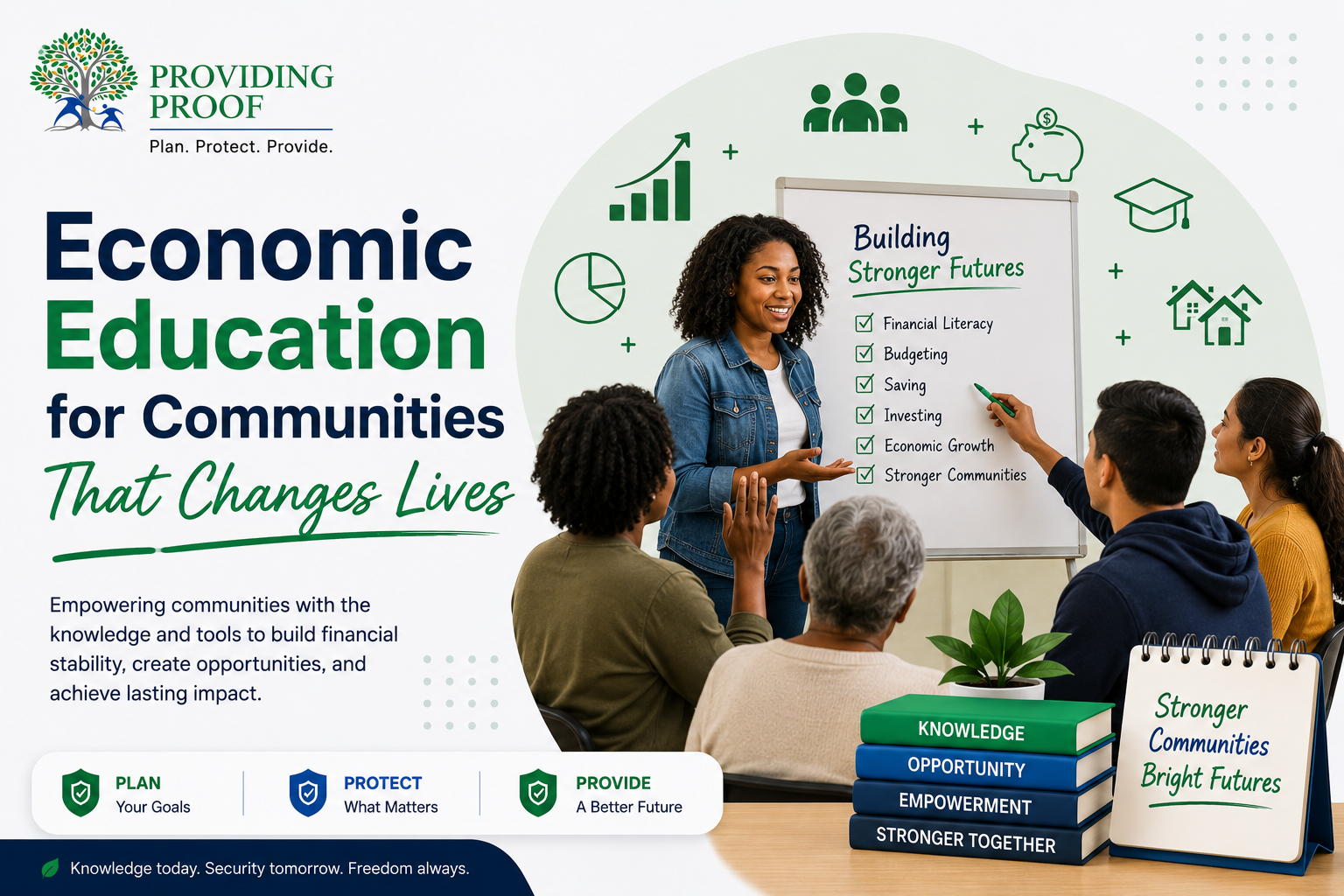
The Gap Nobody Talks About
Across neighborhoods, schools, and households throughout America, millions of people make daily financial decisions without ever being taught how money actually works. They take on debt without understanding interest. They avoid investing because the language feels foreign. They work hard for decades and still feel like they are falling behind. This is not a failure of effort. It is a failure of access.
At Providing Proof, we believe that economic education is one of the most powerful and most overlooked tools for community transformation. PROOF stands for Preventative Resources Often Overlooked about Finances, and that name reflects exactly what we see every day. The knowledge exists. The tools exist. What communities often lack is someone willing to bring those resources directly to the people who need them most.
When we talk about economic education, we are talking about far more than classroom instruction. We are talking about giving real people the vocabulary, the frameworks, and the confidence to participate fully in the economy around them. We are talking about changing what is possible for youth, families, and entire communities.
Why Is Economic Education Important
The question of why economic education is important is one that deserves a serious answer, not a quick talking point. The reality is that financial decisions touch every corner of life. Whether someone is choosing a first apartment, figuring out how to pay for a parent’s medical bills, deciding whether to open a small business, or simply trying to make a grocery budget stretch through the end of the month, economic literacy is the invisible skill behind all of it.
Communities with low levels of economic literacy tend to experience higher rates of predatory lending, unchecked debt cycles, low retirement savings, and generational poverty. These are not individual failings. They are systemic outcomes of systemic gaps in education. When people are never taught how to read a loan agreement, it is not surprising that unfair loan terms go unnoticed. When families are never shown how compound interest works in their favor through savings, it is not surprising that savings rates remain low.
The economic benefits of investing in community-level financial education are well-documented. Households that receive financial education make better decisions about credit, accumulate more savings over time, and are less likely to fall into high-interest debt traps. At the community level, those individual improvements add up to stronger local economies, more stable housing markets, and more resilient families.
Economic education is also deeply connected to civic participation. When people understand how taxes, public budgets, government programs, and local economies function, they are better equipped to advocate for themselves and their neighbors. Economic literacy is not just about personal finance. It is about power.
Economics and Financial Literacy Are Not the Same Thing
One of the most important distinctions we make at Providing Proof is the difference between economics and financial literacy, and why both matter.
Economics as a subject covers the broader systems that govern how resources are produced, distributed, and consumed. It helps people understand why prices rise and fall, how employment markets shift, what trade policies mean for their community, and how national decisions ripple into local lives.
Financial literacy is more personal. It addresses how individuals and families manage their own money, including budgeting, saving, borrowing, investing, and planning for the future.
Both are essential. A person who only understands their personal budget without any grasp of the economic forces shaping their wages, their rent, and their opportunities will always be reacting rather than anticipating. And a person who understands macroeconomic theory but has never learned how to manage a checking account or avoid predatory credit terms will still struggle in daily life.
The most effective economic education programs bring these two dimensions together. They connect the personal to the structural, helping people see how individual financial decisions both shape and are shaped by the larger economic environment around them. This is the kind of integrated, meaningful education that Providing Proof is committed to delivering.
The Case for Economics in High School
One of the most strategic investments a community can make is ensuring that young people receive meaningful exposure to economics in high school. The teenage years are precisely when many young people encounter their first credit card offers, their first part-time jobs, their first student loan decisions, and their first independent financial choices. Yet most high school curricula treat economics as an elective or an afterthought, if they cover it at all.
Teaching economics in high school gives students a foundation they will use for the rest of their lives. It helps them evaluate job offers with benefits they have never heard of. It prepares them to ask the right questions before signing a lease or a loan. It gives them the tools to understand the financial system before that system starts making decisions about them.
Beyond personal finance, high school economics helps young people become informed citizens. Understanding supply and demand, inflation, unemployment, and fiscal policy is not just academic knowledge. It is the basis for participating in democratic society. When voters understand economic issues, they can hold elected officials accountable in ways that protect community interests.
At Providing Proof, we work directly with young people to fill the gaps that formal education often leaves behind. We meet students where they are, speaking plainly about real financial situations they will face and giving them frameworks they can actually use.
Family Economics and Financial Education as a Foundation
No conversation about community economic education is complete without addressing the family unit. The home is where most financial habits are formed long before any school or program ever gets involved. Children who grow up in households where money conversations happen openly, where budgeting is modeled, and where planning for the future is a regular topic are at a significant advantage.
Family economics and financial education programs recognize this reality. When we strengthen the financial knowledge of parents and caregivers, we change what happens around kitchen tables and in conversations about college, debt, and savings. We create intergenerational ripple effects that no single classroom lesson can replicate.
Providing Proof’s programs are designed with families in mind. We know that a teenager who learns about compound interest in a workshop will go home to a family context that either reinforces or contradicts that lesson. When families learn together, the knowledge sticks. When parents and children build a shared financial vocabulary, the household becomes a place where economic education is ongoing rather than a one-time event.
Family-focused financial education also addresses the unique challenges that many communities face, including navigating benefits systems, understanding remittances, managing irregular income, and planning around economic uncertainty. These are real-world financial challenges that deserve real-world educational responses.
Education and Economic Development Are Inseparable
The relationship between education and economic development is one of the most well-established findings in social science. Communities with higher levels of educational attainment consistently show stronger economic outcomes across multiple generations. But this connection is not limited to formal credentials. It extends to financial and economic knowledge as well.
When residents of a community understand how local economies work, how small businesses contribute to economic vitality, how investment and saving drive long-term growth, and how financial systems can be navigated in their favor, the entire community benefits. Local spending becomes more intentional. Entrepreneurs make better decisions. Workers negotiate more effectively. Families build wealth that stays in the community rather than flowing out to predatory lenders and high-fee financial products.
Economic education at the community level is, in this sense, a form of infrastructure investment. It strengthens the foundation on which long-term economic development depends. Programs like those offered by Providing Proof do not simply teach individuals how to manage their money. They help build the collective economic intelligence of an entire community, which pays dividends for generations.
The benefits of higher education are widely discussed, but the economic benefits of financial and economic literacy at every level of formal education, from youth programs to adult learning, deserve equal recognition. Not everyone will pursue a four-year degree, but everyone makes financial decisions. Equipping people with the knowledge to make those decisions well is one of the highest-leverage investments a community can make.
Breaking the Cycle Through Economics Financial Literacy
One of the most painful realities of economic inequality is that it tends to reproduce itself across generations. Families with limited financial resources have less margin for error. A single medical emergency, a car breakdown, or a job loss can set a household back for years. And when that household lacks the economic and financial literacy to navigate these setbacks effectively, the consequences multiply.
Economics financial literacy programs have the potential to interrupt this cycle. When individuals understand how emergency funds work and why they matter, they are more likely to build one. When families understand the true cost of payday loans and high-interest credit cards, they are more likely to seek alternatives. When young people understand how their early financial habits will compound over decades, they are more motivated to start strong.
This is not about shaming people for financial decisions made without the benefit of good information. It is about recognizing that information changes decisions, and changed decisions change lives. At Providing Proof, we approach every community with deep respect for the strength and resilience of the people already there. Our job is not to tell people what they are doing wrong. Our job is to provide resources that have too often been kept out of reach.
Why Choose Providing Proof for Economic Education
Providing Proof was built on a simple but powerful conviction: the resources people need to achieve financial stability and long-term economic wellbeing should not be reserved for those who can already afford them. Our programs reach youth, adults, and families in underserved communities with practical, accessible, and genuinely empowering economic education.
What sets us apart is our commitment to meeting communities where they are. We do not deliver generic content and call it education. We listen to the specific challenges facing each community we serve. We build trust before we build curriculum. We understand that economic literacy is most effective when it is delivered with cultural sensitivity, plain language, and a focus on real-world application. Our team brings not only knowledge but lived experience, and our approach is shaped by the belief that everyone, regardless of income or background, deserves the tools to make informed, confident financial decisions. From family economics workshops to youth-focused economic programs to adult financial coaching, Providing Proof is a partner for the long term, not a one-time event. We are here because we believe education changes what is possible, and we have seen it happen.
The Road Ahead for Community Economic Education
The work of building economically literate communities is ongoing. Progress takes time, consistency, and a willingness to go beyond surface-level financial tips. True economic education requires depth. It requires connecting personal finance to broader economic systems. It requires reaching people at every stage of life and in every kind of household situation. And it requires organizations and communities willing to invest in education as a long-term strategy rather than a short-term fix.
The momentum is growing. More schools are recognizing the importance of economics in high school curricula. More community organizations are integrating financial education into their broader programming. More families are having the conversations that once felt too uncomfortable or too complicated to approach. Providing Proof is proud to be part of this movement, and we are committed to expanding our reach, deepening our programs, and continuing to bring preventative financial resources to the communities that need them most. Economic literacy is not a luxury. It is a right. And at Providing Proof, making it accessible to everyone is the work we show up to do every single day.
Frequently Asked Questions About Economic Education
Q. What is economic education and why does it matter for communities?
Economic education is the process of teaching individuals and communities how economic systems work and how to make informed financial decisions within those systems. It encompasses both broad economic concepts like supply, demand, inflation, and employment, and personal finance topics like budgeting, saving, investing, and managing debt. It matters because economic knowledge directly affects the quality of life for individuals and families, and because communities with higher levels of economic literacy tend to experience greater stability, opportunity, and long-term growth.
Q. What is the difference between economic literacy and financial literacy?
Economic literacy refers to the ability to understand how economic systems, markets, and policies work at a broader level. Financial literacy refers specifically to the ability to manage personal and household finances effectively. Both are important and ideally work together. A person with strong economics and financial literacy understands not only how to budget their own household but also how larger economic forces like job markets, interest rates, and government policy affect their financial situation.
Q. Why is financial education important for families?
Family economics and financial education matters because financial habits and attitudes are largely shaped in the home. When parents and caregivers have strong financial knowledge, they model better money management for children and create household environments where financial planning is normal and expected. Programs that educate entire families create stronger and longer-lasting outcomes than those that reach only one family member.
Q. Should economics be taught in high school?
Yes. Teaching economics in high school prepares young people to navigate major financial decisions they will face almost immediately after graduation, including student loans, first jobs, credit, renting, and saving. Early exposure to economic concepts builds the foundation for lifelong financial wellbeing and informed civic participation.
Q. What are the economic benefits of financial education?
The economic benefits of financial education include better savings rates, reduced reliance on high-cost credit products, improved retirement readiness, lower rates of foreclosure and default, and stronger local economies. When communities invest in financial and economic education, the returns are felt not just by individuals but across entire neighborhoods and regions.
Q. How does education connect to economic development?
Education and economic development are closely linked. Communities with higher levels of educational attainment, including economic and financial literacy, tend to show stronger long-term economic growth, lower unemployment, more entrepreneurship, and greater intergenerational wealth building. Financial education specifically helps communities keep more of their wealth locally and make decisions that support long-term prosperity.
Q. How can I access economic education resources through Providing Proof?
Providing Proof offers a range of programs designed for youth, adults, and families in underserved communities. You can learn more about our curriculum, upcoming events, and community initiatives by visiting our website and connecting with our team directly.