Kids don’t build a healthy relationship with money by accident — they build it through repetition, real decisions, and small wins they can feel. Yet most children get little to no structured financial education until they’re already adults facing rent, credit cards, and student loans.
The good news: you don’t need a finance degree to start teaching kids about money. You need the right financial literacy activity for their age and the willingness to let them practice — including messing up — in a low-stakes environment.
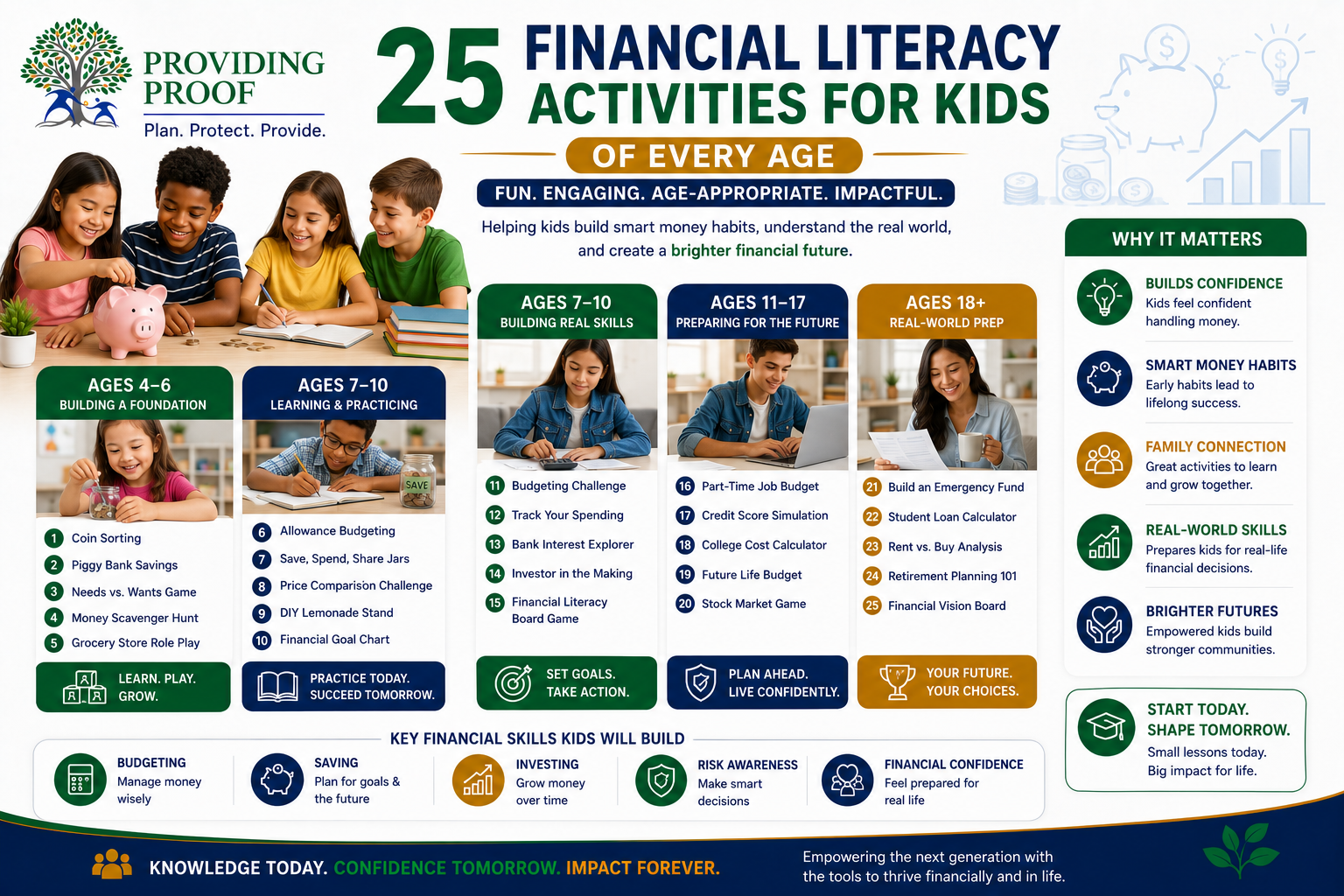
Below are 25 financial literacy activities for kids, organized by age group, from toddlers sorting coins to teens building their first budget. Whether you’re a parent, teacher, or youth program leader, you can pull from this list to build a simple money curriculum at home or in the classroom.
Why Financial Literacy Activities Matter for Kids
Financial literacy isn’t just about knowing what a dollar is worth. It’s about understanding how value is created, protected, and grown — a mindset shift that starts long before a child opens a bank account. At Providing P.R.O.O.F., we call this valuation — teaching young people to identify, understand, and prioritize the value of their time, resources, and choices. Kids who practice this early develop the confidence to budget, negotiate, save, and eventually invest as adults, and they’re far less likely to fall into avoidable debt cycles.
Research consistently shows a gap here: most teens report feeling stressed and underprepared when it comes to money, largely because financial education either starts too late or is limited to a single high school semester. Activities — not lectures — are what make the concepts stick, because kids retain what they do far better than what they’re told.
Financial Literacy Activities for Preschoolers & Early Elementary (Ages 3–6)
At this age, the goal isn’t complex math — it’s building basic money vocabulary and cause-and-effect understanding.
1. Coin Sorting and Counting Jar
Give your child a jar of mixed coins and have them sort by size, color, and value. This builds early number recognition and gets them comfortable handling money before they ever spend it.
2. Pretend Grocery Store
Set up a mini “store” with household items and price tags. Let your child be the cashier or the customer using play money. This introduces the idea that everything has a cost and money is exchanged for goods.
3. Three-Jar Save, Spend, Share System
Label three clear jars “Save,” “Spend,” and “Share.” Every time your child receives money — an allowance, a gift, or coins found around the house — help them divide it across the three jars. This is one of the simplest, most repeatable financial literacy activities for kids and lays the foundation for lifelong budgeting habits.
4. Wants vs. Needs Picture Sort
Cut out or print pictures of items (a toy, shoes, candy, a winter coat) and have your child sort them into “want” and “need” piles. This is a foundational money lesson that shows up again and again in more advanced budgeting later on.
5. Money Storytime Read age-appropriate books about money and talk through the character’s choices afterward. Ask simple questions like, “What would you have done differently?” to start building decision-making skills around spending.
Financial Literacy Activities for Elementary Kids (Ages 7–10)
Kids at this stage can handle basic math, simple goal-setting, and short-term planning.
6. Household “Economy” With Chore Currency
Create a simple system where specific chores earn specific amounts of play money or points, which can later be redeemed for privileges or small rewards. This teaches the direct link between effort and earning.
7. Run a Micro-Business for a Day
A lemonade stand, a bracelet stand, or a bake sale table teaches kids about startup costs, pricing, profit, and customer service — all in one afternoon. Have them track how much they spent to set up versus how much they earned.
8. Allowance Budgeting Chart
Give your child a simple paper or whiteboard chart with columns for income, savings, and spending. Each week, have them log what came in and where it went. This is one of the most effective financial literacy activities for kids because it turns budgeting into a visible, ongoing habit rather than an abstract idea.
9. Comparison Shopping Scavenger Hunt
Next time you’re at the store (or browsing online together), challenge your child to find the same item at two different price points and explain which one is the better value and why.
10. Save-for-a-Goal Tracker
Let your child pick something they want to save for, then create a visual thermometer or chart they color in as they get closer to their goal. This builds patience and delayed gratification — two skills closely tied to long-term financial success.
Financial Literacy Activities for Tweens (Ages 11–13)
Tweens can start engaging with slightly more abstract concepts: risk, trade-offs, and how money moves through a family or community.
11. Mock Stock Market Challenge
Give your tween a fixed amount of “pretend” money to invest in a few well-known companies, then track the stock prices together over a few weeks. This introduces investing basics without any real financial risk.
12. Budget-a-Party Project
Hand your tween a fixed budget and ask them to plan a birthday party or family event within it — food, decorations, and activities included. They’ll quickly learn how spending in one category limits another.
13. Bartering and Trading Day
Organize a family or classroom trading day where kids exchange items instead of using money. Afterward, discuss why we eventually replaced bartering with currency — a concept that also builds critical thinking about how economies work.
14. Family Money Interview
Have your tween interview a parent, grandparent, or other trusted adult about one financial decision they’re proud of and one they’d do differently. This activity builds real-world context and opens the door to honest money conversations across generations.
15. Value Detective Exercise
Pick five everyday objects and have your tween rank them by value — not just price, but usefulness, durability, and importance to your family. This is a simple way to introduce the deeper concept of valuation: understanding that worth isn’t always the same as cost.
Financial Literacy Activities for Teens (Ages 14–18)
Teens are close to managing real money independently, so these activities should mirror real financial decisions as closely as possible.
16. Build a Sample Monthly Budget
Have your teen research the average cost of rent, groceries, transportation, and phone bills in your area, then build a sample monthly budget as if they were living on their own. This is one of the most practical financial literacy activities for teens because it connects money management directly to independent living.
17. Compare Credit Card and Loan Offers
Pull up two or three real (but non-binding) credit card or auto loan offers online and have your teen compare interest rates, fees, and terms. This demystifies credit before they ever apply for their first card.
18. Pitch a Side Hustle Ask your teen to outline a simple business idea — tutoring, lawn care, selling crafts online — including startup costs, pricing, and expected profit. Even if they never launch it, the exercise builds entrepreneurial and financial planning muscle.
19. College Cost and Financial Aid Research Project
Have your teen research the full cost of attendance (not just tuition) for two or three schools they’re interested in, along with realistic financial aid or scholarship options. This turns an overwhelming topic into a manageable research task.
20. Virtual Investment Portfolio
Using a free stock market simulator, have your teen build and manage a virtual portfolio over a semester. Check in monthly to discuss what’s working, what isn’t, and why.
Family and Community Financial Literacy Activities (All Ages)
Some of the most powerful financial literacy activities happen when the whole family — or a whole classroom — participates together.
21. Monthly Family Money Meeting
Set a recurring 15-minute family meeting to talk through upcoming expenses, savings goals, or a recent money win. Kids who see money discussed openly and calmly are more likely to approach it the same way as adults.
22. Community Give-Back Project
Have kids organize a small fundraiser or resource drive for a cause they care about. This reinforces that financial literacy isn’t only about personal gain — it’s also about how resources circulate through a community. This mirrors the “spreading the seeds” approach we use in our own curriculum, where learners share what they’ve learned with people older, younger, and their own age.
23. Multi-Generational Money Story Swap
Gather grandparents, parents, and kids for a casual conversation where each generation shares one story about money — a mistake, a win, or a lesson learned. This activity builds financial empathy and shows kids that money struggles and successes are universal.
24. DIY Capstone Presentation
At the end of a few months of activities, have your child put together a short presentation — posters, a slideshow, or even a lemonade-stand recap — showing what they learned and what they’d do differently next time. This kind of reflection is central to how we structure Capstone projects in our own program.
25. Local Economic Field Trip
Visit a local bank, credit union, farmers market, or small business and have your child ask the owner or employee one question about how money moves through that business. Real-world exposure makes abstract financial concepts concrete.
How Providing P.R.O.O.F. Brings These Activities to Life
The activities above are a great starting point at home — but real, lasting financial literacy comes from consistent practice over time, not a single lesson or weekend project. That’s the gap Providing P.R.O.O.F. was built to close.
Our flagship, three-year economic literacy program guides learners ages 6–21 through a structured curriculum — Seed to Sprout, Sprout to Sapling, and Sapling to Mature Fruit — that builds on these same foundational ideas: valuation, saving, risk, reciprocity, and community investment. Every learner also completes weekly “investment work” and biannual capstone projects, turning activities like the ones above into a habit rather than a one-off lesson.
If you’re a parent or educator ready to go beyond DIY activities, explore our program, check our FAQ for common questions about enrollment and format, or get involved to help us bring economic literacy to more young people in underserved communities.
Frequently Asked Questions
What age should kids start learning financial literacy?
As early as age 3–4, using simple concepts like sorting coins or the save-spend-share system. Financial literacy activities can be adapted for every age group, and the earlier kids start, the more natural these habits become.
How often should you do financial literacy activities with kids?
Consistency matters more than intensity. A short weekly activity or monthly family money meeting is more effective long-term than a single, intensive lesson.
What’s the difference between a financial literacy activity and a financial literacy game?
Games are often digital or app-based and focus on short bursts of engagement. Activities, like the ones in this list, tend to involve real decision-making, hands-on practice, and reflection — closer to how financial habits are actually built.
Are financial literacy activities effective for teens, or is it too late by then?
It’s never too late. Teens benefit even more from activities that mirror real financial decisions, like building a sample budget or comparing loan offers, because they’re closer to making those decisions for real.