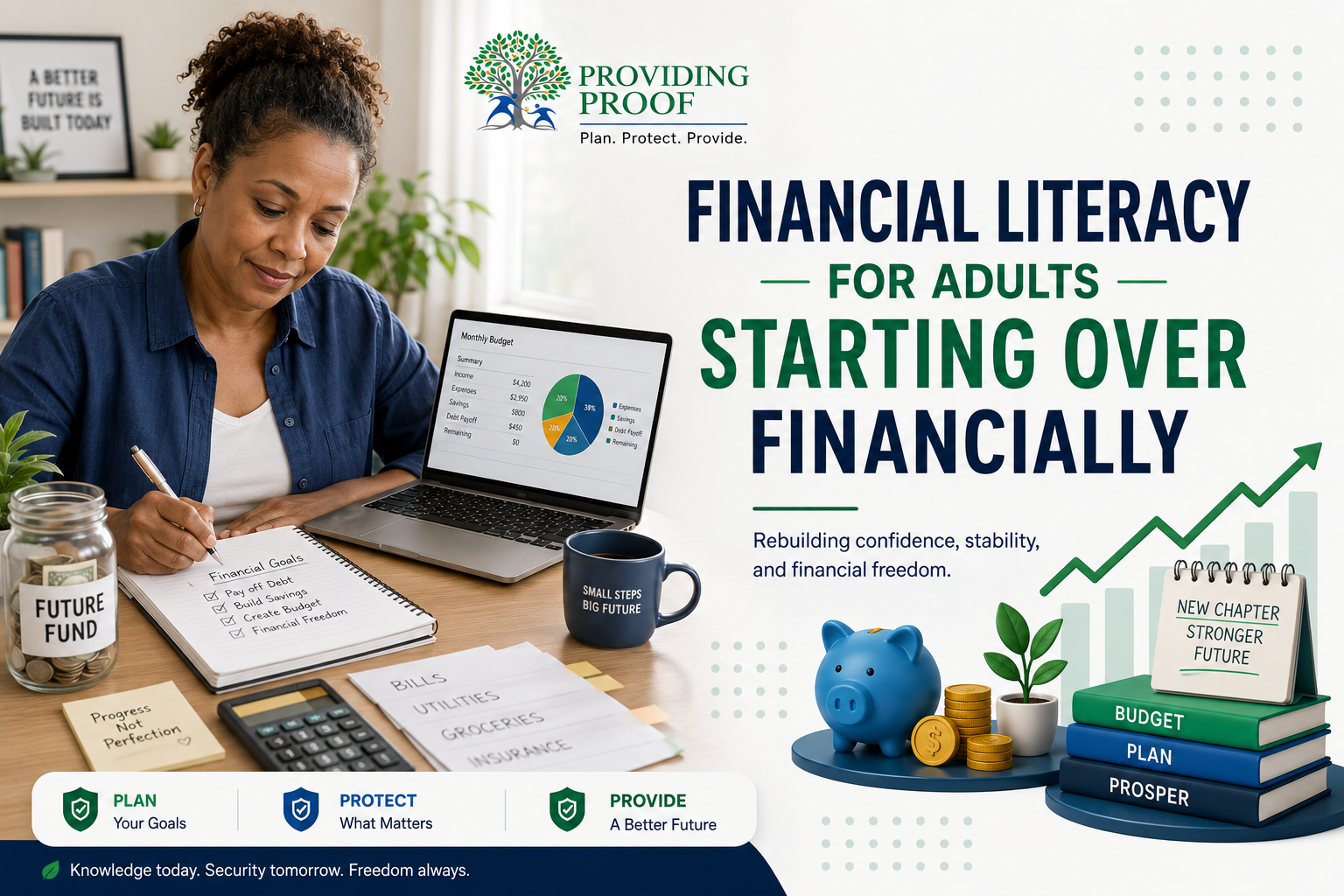
Starting over financially can feel like standing at the base of a mountain you never asked to climb. Whether the reset came from job loss, divorce, medical debt, a failed business, or a lifetime of being quietly shut out of opportunities others took for granted, the climb back is real, and so is the path forward. At Providing P.R.O.O.F., we believe economic empowerment is not a privilege reserved for the lucky few. It is a right that belongs to every adult who is ready to plant new seeds and grow from exactly where they stand today.
This guide is written for the adult who is rebuilding. The one who is tired of feeling behind, confused by industry jargon, or quietly ashamed of not knowing what they were never taught in the first place. Financial literacy for adults is less about catching up and more about waking up, owning your numbers, and learning the rules of a game that has often been hidden from plain view.
Rebuilding Your Financial Roots After a Setback
Setbacks do not erase your worth. They simply expose the conditions in your life that need fresh attention. Before chasing complex strategies, the rebuilding adult needs to take honest stock of where things stand. Where does income come from. Where does it actually go each month. What does survival look like right now, and what does dignity look like six months from today. These questions form the soil of your reset. Without strong soil, no strategy will hold for long.
For many adults, a financial reset is also an emotional one. Money carries memory. Old shame, inherited family patterns, and unspoken household rules show up in spending habits long before any spreadsheet does. Personal financial literacy starts with permission to look at the truth without flinching. Once you can name the numbers out loud, you can begin to change them.
The Power of Basic Financial Literacy for a Fresh Start
Basic financial literacy is the working knowledge every adult needs to make informed decisions about earning, saving, borrowing, investing, and protecting their money. It is not advanced economics, and it does not require a degree. It is simply the difference between guessing and knowing, between reacting and choosing.
When financial education becomes a regular part of daily life, the fog begins to lift. You stop being intimidated by interest rates, credit reports, retirement accounts, and tax forms. You start seeing your money as something you direct rather than something that simply happens to you. For adults starting over, this shift changes everything. It moves you from a survival posture into a growth posture, the same posture a young tree takes when it pushes its first roots into stubborn ground.
Why Financial Education for Adults Matters Today
Financial education for adults matters because the cost of not knowing is brutal and compounds over time. Predatory lenders, overdraft fees, payday loan cycles, and avoidable tax penalties quietly drain billions of dollars every year from the people who can least afford to lose it. Worse still, the silence around money keeps families locked in cycles that pass from one generation to the next without ever being named.
The encouraging truth is that adulthood is never too late a season for learning. The brain stays capable of building new financial skills at every age. Habits formed in your forties, fifties, or sixties carry just as much weight as those formed at twenty, often more, because they are paired with real-world experience and a clearer sense of what truly matters to you.
Cultivating Personal Financial Literacy from the Ground Up
Personal financial literacy is built one decision at a time. Start with awareness. Track every dollar that comes in and out for thirty days without judgment or guilt. Then move into intention. Decide what each future dollar is assigned to before it ever arrives in your account. A simple plan that you actually follow will always outperform a perfect plan that lives only in your head.
After awareness and intention comes structure. Open a separate account for emergencies, even if you begin with only ten dollars to your name. Automate small transfers so the choice is made once and then honored every payday. Pay down high-interest debt strategically, starting with whichever approach keeps you most motivated to continue. Protect your credit by paying on time and keeping balances low relative to your limits. These are not glamorous moves. They are the unseen roots that hold everything else upright.
Essential Financial Literacy Topics for Adults
Financial literacy topics for adults cover a wider field than most beginners realize. Budgeting and cash flow are the entry point, but the journey extends into credit health, debt repayment strategy, emergency savings, insurance basics, retirement planning, taxes, investing, estate planning, and learning to protect yourself from fraud and predatory practices. Each topic builds on the last, and none of them require a finance degree to understand at a working level.
The adult who is starting over does not need to master every topic in the first month or even the first year. The goal is to build a working vocabulary so that no banker, lender, landlord, or advisor can ever talk over your head again. When you understand the language being spoken around your money, you stop being a passenger in your own financial life and start steering the wheel yourself.
How to Improve Financial Literacy at Any Stage of Life
The question of how to improve financial literacy has a refreshingly simple answer. Choose one topic, learn it well enough to act on it, and then move on to the next one. Depth beats breadth in the beginning. Reading a single short book about credit health and applying every lesson it teaches will change your life far more than skimming twenty articles across twenty different topics.
Pair learning with doing. After reading about emergency funds, open the savings account that same day. After learning about retirement contributions, increase yours by one percent before you close the laptop. Knowledge that never gets used drains away quickly. Knowledge that gets applied becomes muscle memory, and muscle memory eventually becomes wealth.
Practical Steps on How to Learn Financial Literacy
How to learn financial literacy as an adult comes down to using the resources already within arm’s reach. Public libraries carry classic personal finance books for free. Nonprofit credit counseling agencies offer one-on-one sessions at no cost to you. Community workshops, online courses, podcasts, and curriculum from mission-driven organizations like Providing P.R.O.O.F. give adults structured ways to build real skill without the price tag of a formal classroom or expensive coach.
Find a learning style that actually fits the shape of your life. Some adults learn best by reading quietly at night after the house has settled. Others need to hear someone explain ideas while they drive to work or cook dinner. A few thrive in group settings where they can ask their questions out loud without embarrassment. There is no wrong door into financial education. The only real mistake is staying outside of it altogether.
Financial Literacy for Beginners Where to Start
Financial literacy for beginners can feel paralyzing because so much information is shouting for attention at once. Cut the noise. Begin with three numbers and three numbers only. What you earn each month after taxes, what you spend each month in total, and what you owe across all your debts combined. Once those three numbers are clear and written down, every next decision becomes dramatically easier to make.
Financial education for beginners works best when the lessons are tied to a real, immediate, and personal goal. Saving for a security deposit on a better apartment. Paying off one credit card by the end of the year. Building a starter emergency fund of one thousand dollars within ninety days. Concrete goals turn abstract concepts into action, and action is the one thing that has ever truly changed a financial life.
Why Choose Us
At Providing P.R.O.O.F., we approach financial education differently than most. Our name stands for Providing Preventative Resources Often Overlooked about Finances, and that mission shapes every part of what we do. While our flagship programs serve young people, the principles we teach belong to anyone willing to lean in and learn. We come from a framework of abundance rather than scarcity. We treat economic literacy as a tool for dignity, not a test that anyone can fail or be shamed by. Our curriculum is built on valuation processes that help adults and youth alike redefine their relationship with money, ownership, and opportunity. We do not believe in shortcuts or shame, and we do not pretend that wealth is built overnight. We believe in planting seeds, cultivating knowledge, and walking alongside the people doing the brave and quiet work of rebuilding. When you choose us, you are choosing an organization that measures success by long-term transformation rather than quick wins or empty promises.
Frequently Asked Questions
Q. What is the first step in financial literacy for adults starting over?
The first step is honest awareness. Write down your monthly income, your monthly spending, and your total debt. You cannot build a meaningful plan around numbers you have never been willing to look at. Once those three figures are on paper in front of you, every decision after that becomes clearer and far less intimidating.
Q. Is it too late to learn financial literacy as an adult?
It is never too late to begin. Adults bring lived experience to financial education that younger learners often lack. Habits built in your thirties, forties, fifties, or even beyond will compound over every year you still have ahead of you. The best time to start was twenty years ago. The second best time is today.
Q. How long does it take to become financially literate?
A solid working level of basic financial literacy can be built in roughly three to six months of consistent learning and steady action. Full mastery is a longer journey, but you do not need mastery to start making better decisions right now. You only need enough knowledge to take the next right step in front of you.
Q. Do I need a financial advisor when I am starting over financially?
Not in the beginning. Most adults rebuilding from scratch benefit far more from free resources such as nonprofit credit counseling, library books, and educational nonprofits like Providing P.R.O.O.F. than from paid advisors. Once your finances stabilize and begin to grow, professional advice becomes more valuable and more affordable.
Q. Which financial literacy topics for adults should I learn first?
Begin with budgeting and cash flow, then move to credit health, emergency savings, and a clear debt repayment strategy. After those four areas feel manageable, expand into insurance basics, retirement planning, and beginner investing. Build the trunk of the tree before you ever reach for the higher branches.
Q. How can I stay motivated while rebuilding financially?
Tie every lesson and every dollar to a personal goal you genuinely care about, whether that is stable housing, your children’s future, building generational wealth, or simply sleeping at night without money anxiety. Motivation is weakest when finances feel abstract and strongest when they feel deeply personal.