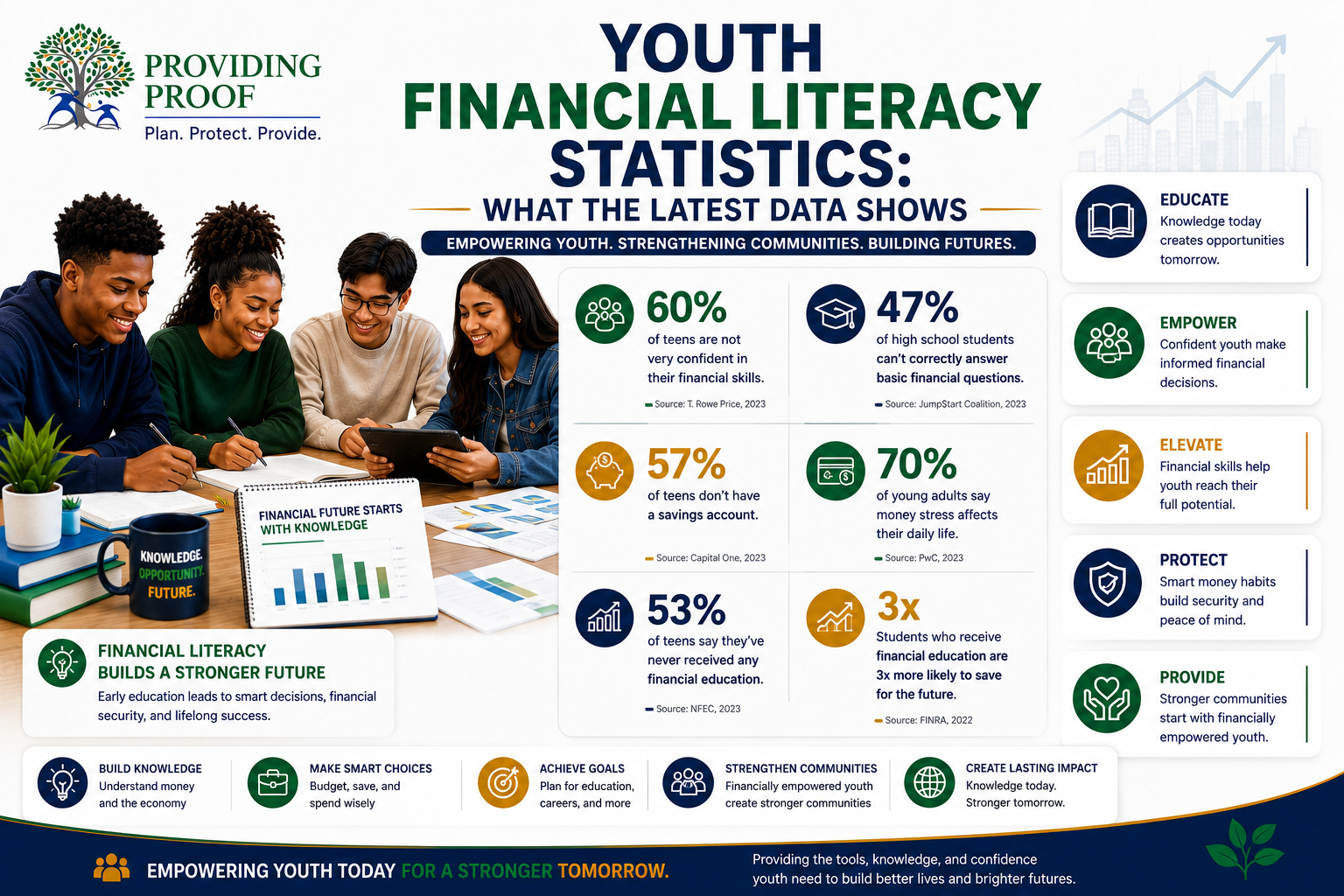
Financial literacy has become one of the fastest-growing areas of state education policy, yet the data on where young people actually stand tells a more complicated story than “more states require it now.” Access is expanding. Confidence isn’t keeping pace. And the gap between who gets financial education and who doesn’t remains wide.
Below is a roundup of the most recent youth financial literacy statistics, organized by what they reveal — and what they mean for how programs should be designed going forward.
Access: More Teens Are Getting Financial Education, But Coverage Is Still Uneven
- As of 2026, roughly half of all U.S. states require a stand-alone personal finance course for high school graduation, a sharp rise from just a handful of states a decade ago.
- According to Junior Achievement and MissionSquare Foundation’s 2025 teen survey, 45% of high schoolers reported taking a personal finance or financial literacy class at school — up significantly from 31% just one year earlier.
- Despite growing interest, other national surveys have found that only around 3 in 10 teens say they currently have access to a financial literacy course, even though a much larger share say they’d take one if it were offered.
- Access remains unevenly distributed: research from financial education advocacy groups has repeatedly found that high schools with large Black and Hispanic student populations are significantly less likely to require a personal finance course than schools serving fewer students of color.
Confidence: Access Doesn’t Automatically Translate to Preparedness
- A 2026 analysis of more than 160,000 high school juniors and seniors found that even as more students engage with financial tools, most still feel unprepared: 59% say they feel unprepared to set up and follow a budget, 57% feel unprepared to manage checking and savings balances, and 62% feel only somewhat prepared, at best, to manage credit.
- Among teens who did complete a financial literacy course, a meaningful share still struggle with foundational concepts — including nearly half who believe an 18% interest rate on debt is manageable and can simply be paid off over time.
- Generationally, Gen Z scores the lowest of any age group on standardized financial literacy indexes, correctly answering only around 38% of questions on one widely used national benchmark — well below Millennials, Gen X, and Boomers.
- More than one in four Gen Z respondents in a recent national survey said they are not confident in their own financial knowledge and skills, the lowest self-reported confidence of any generation surveyed.
Interest: Young People Want Financial Education — They’re Just Not Getting Enough of It
- Survey after survey shows the same pattern: a large majority of high school students — often cited around 85% — say they’re interested in learning about financial topics in school.
- Yet the same research consistently finds that access lags far behind interest, leaving a persistent gap between what students want to learn and what they’re actually being taught.
- A large share of students report learning about money primarily from parents or guardians rather than school — but many parents themselves report low confidence in their own financial knowledge, meaning the “default” financial education pipeline is often passing along the same gaps it should be closing.
Debt and Financial Stress: The Cost of the Gap
- National household debt in the U.S. has climbed into the tens of trillions of dollars, and young adults are shouldering a growing share of it, largely through student loans and credit card debt accumulated shortly after high school.
- Recent surveys have found that only around 3 in 10 U.S. adults could comfortably cover a $1,000 emergency expense — a vulnerability that tends to be even more pronounced among younger adults just entering the workforce.
- Financial stress disproportionately affects younger generations: more than 7 in 10 Gen Z respondents in a recent national survey reported being negatively affected by financial stress, a notably higher rate than older generations.
The Equity Gap: Financial Literacy Isn’t Distributed Evenly
- Financial literacy scores show consistent, well-documented disparities by race and household income, with white and higher-income students scoring meaningfully higher on standardized financial literacy assessments than Black, Hispanic, and lower-income peers.
- Students in under-resourced schools are less likely to have access to a personal finance course at all, compounding the gap rather than closing it — the students who could benefit most from structured financial education are often the least likely to receive it.
- One national survey found that access to financial literacy resources during childhood varies significantly by generation, with younger adults more likely to have had some access than older generations — a sign of real progress, but one that hasn’t yet closed the outcome gap.
What This Data Means for Youth Financial Education Programs
Taken together, these numbers point to a consistent pattern: access to financial education is expanding, but a single course — however well-designed — isn’t closing the confidence, equity, or outcome gaps on its own. Interest is high. Access is improving. But knowledge, confidence, and equitable access to that knowledge remain three separate problems, and most current programs are only solving for the first.
This is part of why we believe multi-year, applied programs matter more than one-time courses — a case we make in more detail in High School Financial Literacy Curriculum. It’s also why closing the equity gap specifically, not just the general awareness gap, has to be a design principle from the start — which you can read more about on our Our Work page.
If you want to help close these gaps for young people in underserved communities, you can support our work here, or explore our curriculum to see how a multi-year, applied model is built to address exactly these statistics.
Frequently Asked Questions
What percentage of U.S. states require financial literacy education for high schoolers?
As of 2026, roughly half of all states require a stand-alone personal finance course for graduation, with several more states having passed legislation that is still phasing in.
Why do more teens say they want financial education than actually receive it?
Access hasn’t caught up with either student interest or the pace of new state requirements — many mandates are still phasing in, and even in states that require a course, implementation, teacher training, and quality vary widely by district.
Does taking a financial literacy course guarantee financial confidence?
Not necessarily. Recent data shows that even among students who complete a course, many still report feeling unprepared to manage a budget, checking account, or credit — suggesting that course completion and actual capability are two different things.
Are financial literacy gaps the same across all demographic groups?
No. Data consistently shows disparities by race, income, and school resourcing, with students in under-resourced and majority-Black and Hispanic schools less likely to have access to financial literacy coursework in the first place.