Table of Contents
- What Is Youth Financial Education?
- How Does Youth Financial Education Build Career Readiness?
- Types of Youth Financial Education Programs
- Key Benefits of Early Financial Education
- Limitations and Challenges in Youth Financial Education
- Who Benefits Most From Youth Financial Education?
- How to Choose the Right Financial Education Program for Youth
- Youth Financial Education Program Comparison Table
- Cost and Accessibility of Youth Financial Education
- Frequently Asked Questions
- Conclusion / In Summary
- References / Citations
Introduction
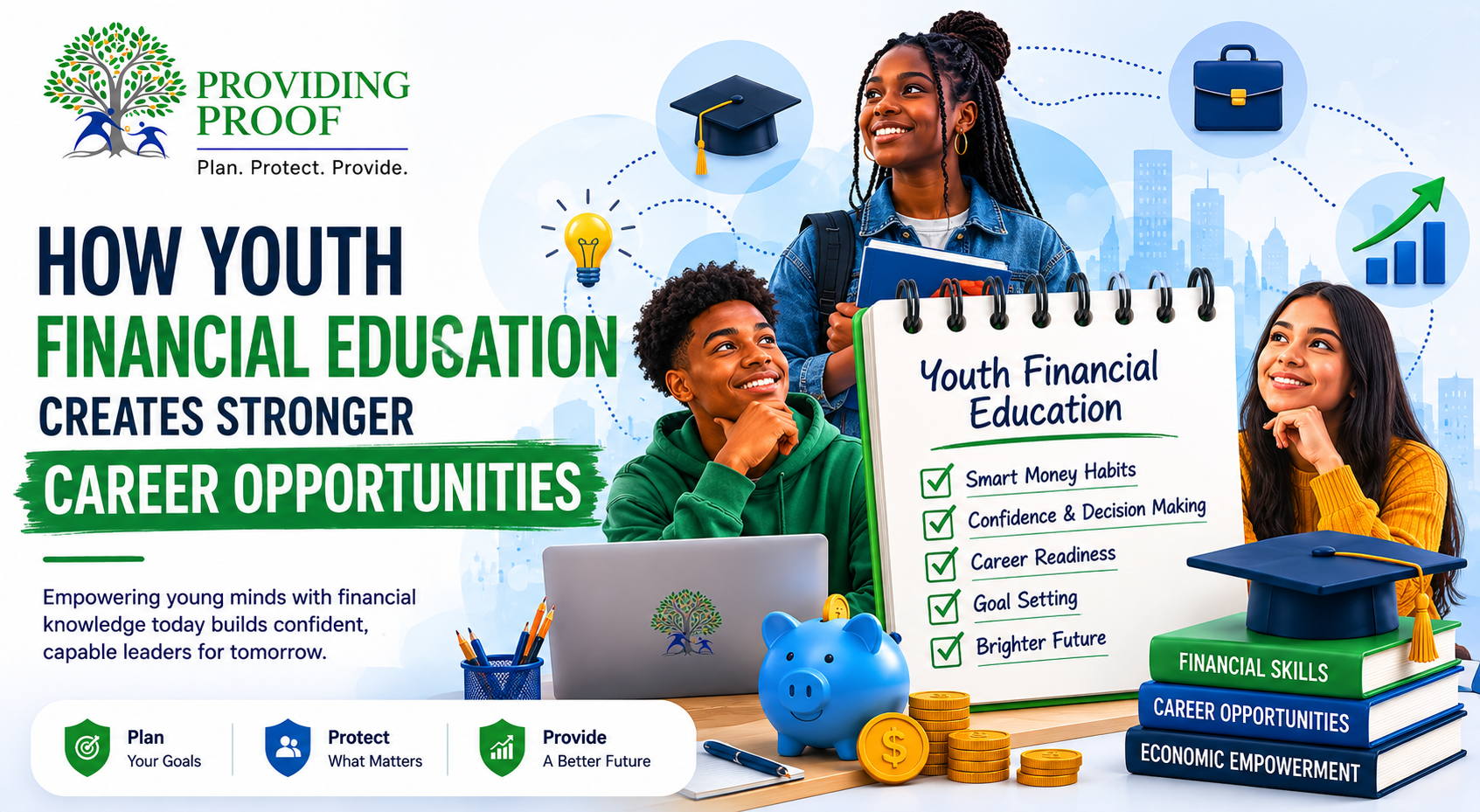
What a child learns about money shapes how they move through the world for the rest of their life. Yet in most schools — especially those serving low-income and underserved communities — financial education is entirely absent from the curriculum. The result is a generation of young people entering the workforce without the knowledge, vocabulary, or confidence to make empowered economic decisions.
Youth financial education is not about teaching kids to save their lunch money. It is about equipping them with a lifelong lens for understanding value, opportunity, and the systems that shape economic outcomes.
At Providing P.R.O.O.F., we have built our entire mission around this belief. When youth are given real financial education — rooted in their lived experiences and connected to their futures — they do not just find jobs. They create opportunities, lead communities, and build wealth that lasts across generations.
🌱 CTA BOX #1 — Give Youth the Education That Changes Everything
Providing P.R.O.O.F. delivers a 3-year, values-based financial education program for youth ages 6–21. We are planting seeds of economic literacy that grow into careers, confidence, and community power.
What Is Youth Financial Education?
Youth financial education is a structured approach to teaching young people — typically ages 6 to 21 — the knowledge, skills, and mindsets they need to make informed financial decisions throughout their lives. It covers concepts like budgeting, saving, understanding value, recognizing economic opportunity, navigating financial systems, and developing the confidence to advocate for one’s own economic well-being.
Effective youth financial education goes beyond basic math or money management. It connects financial concepts to real-life experiences, cultural contexts, and future goals. It teaches young people not just what money is — but what it means, how it moves, and how they can participate in shaping it.
Programs like Providing P.R.O.O.F. approach financial education through the lens of valuation — helping youth understand how they assign value to resources, relationships, time, and opportunity. This is economic literacy in its fullest form.
How Does Youth Financial Education Build Career Readiness?
Youth financial education creates career readiness through multiple interconnected pathways:
It builds a professional vocabulary. Young people who understand economic concepts — assets, liabilities, investment, risk, return — enter the workplace already fluent in a language that many of their peers are still learning.
It develops critical thinking. Financial education teaches young people to analyze choices, weigh trade-offs, and evaluate consequences. These are core skills in every professional environment.
It shapes a growth mindset. When youth learn that wealth is built through intentional decisions over time — not luck — they begin to see their own potential differently. This mindset shift is one of the most powerful career accelerators there is.
It builds negotiation confidence. Young people who understand their own value — and how to communicate it — enter the workforce ready to advocate for fair compensation, meaningful opportunities, and equitable treatment.
It prepares youth for entrepreneurship. Many young people from underserved communities have the creativity and drive to build their own economic futures. Financial education gives them the structural knowledge to turn vision into viable action.
Types of Youth Financial Education Programs
School-Based Financial Literacy Courses
These programs integrate financial education into the standard school curriculum. They vary widely in depth and quality — from single-semester electives to multi-year progressions. Effectiveness depends heavily on teacher training, curriculum quality, and cultural relevance.
Community-Based Economic Literacy Programs
Community organizations deliver financial education outside traditional school settings, often with greater flexibility and cultural responsiveness. Programs like Providing P.R.O.O.F. operate in this space — serving youth in after-school, weekend, and community center environments with immersive, long-term curricula.
Mentorship and Experiential Programs
These programs pair financial education with real-world experiences — internships, business simulations, investment clubs, and entrepreneurship challenges. The hands-on component accelerates learning and builds lasting confidence.
Digital and Online Financial Literacy Platforms
Apps, games, and online platforms designed to teach financial concepts to young people. These can be engaging and accessible but often lack the depth, community, and personalized guidance that in-person programs provide.
Family and Community Financial Education
Programs that engage parents, caregivers, and community members alongside youth — reinforcing financial learning at home and creating a shared economic language within families and neighborhoods.
Key Benefits of Early Financial Education
- Higher career readiness — Youth with financial education enter the workforce with confidence, vocabulary, and decision-making skills their peers often lack
- Stronger negotiation abilities — Early education around value and self-worth builds the confidence to advocate professionally throughout a career
- Reduced financial vulnerability — Financially literate youth are less susceptible to predatory financial products, scams, and cycles of debt
- Greater entrepreneurial potential — Early exposure to economic concepts empowers young people to envision and build their own economic futures
- Generational wealth building — Financial habits formed in youth compound over a lifetime — and pass down to future generations
- Increased civic engagement — Young people who understand economics are more likely to participate in community and systemic change
The Providing P.R.O.O.F. curriculum is specifically designed to deliver all of these outcomes through a three-year program that meets youth where they are and grows with them.
Limitations and Challenges in Youth Financial Education
The quality gap is wide. Not all financial education programs are created equal. Surface-level programs that cover only basic budgeting often fail to produce meaningful long-term change. Depth, cultural relevance, and consistent reinforcement matter enormously.
Systemic barriers persist. Financial education is a critical tool — but it does not erase the structural inequalities that limit economic opportunity for many youth. Programs must pair individual empowerment with community advocacy and systemic awareness.
Without family reinforcement, impact fades. Research consistently shows that financial lessons are more durable when reinforced at home. Programs that engage families alongside youth see stronger, more lasting outcomes.
Access remains unequal. The communities most in need of quality financial education are often the least likely to receive it. Bridging this gap requires not just great programs but sustained funding, partnerships, and political will — which is why supporting organizations like Providing P.R.O.O.F. is so critical.
Who Benefits Most From Youth Financial Education?
Financial education creates a positive ripple effect — but some groups experience transformational impact:
- Youth from underserved and low-income communities who lack access to financial knowledge at home or in school
- First-generation wealth builders who are the first in their families to engage with formal economic systems
- Young people in the juvenile justice system who need practical life skills and economic agency for successful reentry
- Girls and young women who face unique wage and wealth equity gaps that financial literacy helps close
- Youth of color who are disproportionately excluded from financial systems and wealth-building opportunities
- Aspiring entrepreneurs who have the vision but need the economic framework to build sustainably
Providing P.R.O.O.F. specifically serves these communities through partnerships with school districts, juvenile detention centers, and community organizations. Learn more about our Root System.
How to Choose the Right Financial Education Program for Youth
Choosing the right financial education program for a young person in your life requires looking beyond the marketing. Here is what to evaluate:
Depth and duration. A one-time workshop plants seeds but rarely changes behavior. Look for programs with multi-year, sequenced learning that builds on itself over time.
Cultural relevance. Effective financial education speaks to the lived experiences of its participants. Programs that use culturally responsive frameworks produce far better outcomes than one-size-fits-all approaches.
Application over information. The best programs teach youth to apply financial concepts in real-world scenarios — not just memorize definitions. Look for capstone projects, community challenges, and experiential components.
Values-based approach. True economic literacy is rooted in self-worth, community responsibility, and ethical decision-making — not just profit maximization. Seek programs that develop the whole person.
Track record and community trust. Look for programs with demonstrated outcomes, strong community relationships, and a mission that aligns with the values you want to instill. Providing P.R.O.O.F.’s Branches of Opportunity showcases the real-world impact of our work.
Youth Financial Education Program Comparison Table
| Feature | Providing P.R.O.O.F. | Typical School Course | Online Platform | One-Time Workshop |
|---|---|---|---|---|
| Duration | 3 years | 1 semester | Self-paced | 1 day |
| Age Range | 6–21 | 14–18 | Varies | Varies |
| Cultural Responsiveness | High | Low–Moderate | Low | Low |
| Community Integration | Yes | Rarely | No | No |
| Experiential Learning | Yes (capstones) | Limited | No | No |
| Values-Based Framework | Yes | Rarely | No | No |
| Family Engagement | Yes | Rarely | No | No |
| Cost to Participant | Free / Low | Free | Free–$50/mo | Free–$100 |
Cost and Accessibility of Youth Financial Education
The cost of financial education for youth varies considerably:
- Public school programs — Generally free to students but constrained by limited curriculum time and undertrained educators
- Nonprofit community programs — Often free or heavily subsidized for participants, made possible through donations and grants. Providing P.R.O.O.F. operates on this model — ensuring that cost is never a barrier for the youth who need these programs most
- Private tutoring or coaching — Financial coaches and tutors can charge $50–$200 per hour, placing this resource out of reach for most families
- Online platforms and apps — Range from free to $15/month, offering convenience but limited depth and community support
Quality financial education for youth should not be a luxury. Community-funded programs remain the most equitable and impactful pathway — which is why every donation to Providing P.R.O.O.F. directly expands access for youth who would otherwise be left behind.
💡 CTA BOX #2 — Invest in a Young Person’s Economic Future
When you support Providing P.R.O.O.F., you are not giving to a program — you are fueling a movement. Every dollar helps a young person in an underserved community access the financial education that builds real careers and generational wealth.
Frequently Asked Questions
What is youth financial education?
Youth financial education is the structured teaching of financial knowledge, skills, and mindsets to young people, typically ages 6–21. It covers budgeting, value recognition, economic systems, risk, investment thinking, and self-worth — preparing youth to navigate the economy with confidence and agency throughout their lives.
Why is financial education important for youth career development?
Early financial education gives youth the vocabulary, decision-making frameworks, and professional confidence they need to succeed in any career. It teaches them to understand compensation, evaluate opportunities, manage resources, and advocate for their value — skills that directly influence career advancement.
What age should children start financial education?
Children can begin learning basic financial concepts as young as age 5–6, when foundational habits and thinking patterns begin to form. Providing P.R.O.O.F. serves youth ages 6–21 with age-appropriate curriculum that grows in complexity and application as learners develop.
How does financial education create generational impact?
When youth learn to build wealth, circulate resources, and make value-based decisions early in life, those behaviors compound over decades — and pass down to the next generation. This breaks cycles of economic disadvantage and creates lasting community transformation.
What makes a financial education program effective for youth?
Effective youth financial education is long-term, culturally responsive, experiential, values-based, and community-integrated. Programs that check all these boxes — like Providing P.R.O.O.F.’s 3-year curriculum — produce far more durable outcomes than short, surface-level financial literacy courses.
How can parents support their child’s financial education?
Parents can reinforce financial learning by discussing money openly at home, modeling healthy financial behavior, supporting enrollment in quality programs, and creating low-stakes opportunities for youth to practice budgeting, goal-setting, and economic decision-making in real life.
Conclusion / In Summary
Youth financial education is not a nice-to-have — it is one of the most powerful investments a community can make in its future. When young people learn to understand value, navigate economic systems, and advocate for their own potential early, the impact echoes across entire lifetimes and generations.
The absence of quality financial education in underserved communities is not an accident — it is a gap that demands intentional action. That is the work of Providing P.R.O.O.F. — to plant seeds of economic literacy in every young person who has been overlooked by systems that were not built for them.
Because every young person deserves to know their worth — and every community deserves the economic power that comes when its youth are equipped to lead.
References / Citations
- CFPB — Financial Education in Schools: Evidence and Emerging Practices
- T. Rowe Price — Parents, Kids & Money Survey
- Urban Institute — Youth Financial Literacy and Long-Term Economic Outcomes
- National Financial Educators Council — Youth Financial Literacy Research
- Providing P.R.O.O.F. — Curriculum | Our Work