Table of Contents
- What Is Economic Literacy?
- How Does Economic Literacy Influence Career Decisions?
- Types of Career Decisions Shaped by Economic Literacy
- Key Benefits of Economic Literacy in Career Planning
- Limitations of Economic Literacy in Career Decision Making
- Who Needs Economic Literacy Most in Career Development?
- How to Build Economic Literacy for Better Career Choices
- Economic Literacy in Career Decisions: Comparison Table
- The Cost of Economic Illiteracy in Career Outcomes
- Frequently Asked Questions
- Conclusion / In Summary
- References / Citations
Introduction
Every major career decision is, at its core, an economic decision. Choosing a college major, accepting a job offer, negotiating a raise, deciding whether to freelance or stay employed — each of these moments carries financial weight that most people are never taught to evaluate with clarity.
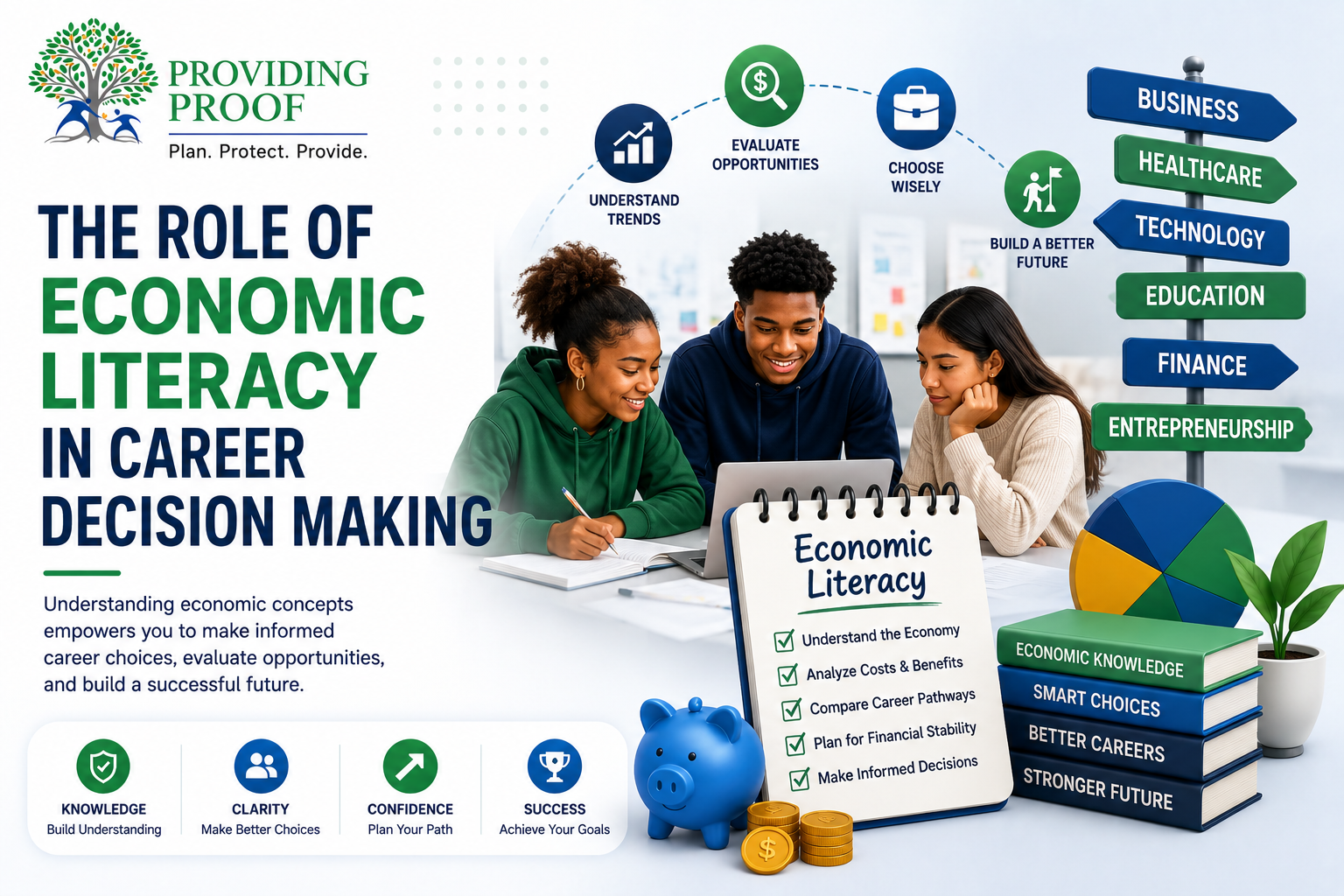
Economic literacy is the ability to understand, interpret, and act on financial and economic information in ways that serve your short-term needs and long-term goals. In a career context, it is the difference between taking whatever opportunity comes along and strategically positioning yourself for the future you actually want.
At Providing P.R.O.O.F., we teach young people that economic literacy is not just a financial skill — it is a life skill. When youth learn to see themselves as active participants in the economy, they begin making career decisions with purpose, strategy, and confidence rather than fear and uncertainty.
🌱 CTA BOX #1 — Develop the Economic Lens That Changes Careers
Providing P.R.O.O.F.’s curriculum teaches youth ages 6–21 how to think economically, decide strategically, and build careers rooted in value and purpose.
What Is Economic Literacy?
Economic literacy is the capacity to understand how economic systems work and how individual decisions within those systems create outcomes. It encompasses financial literacy — budgeting, saving, investing — but extends further to include understanding labor markets, value creation, opportunity cost, economic equity, and the broader forces that shape financial outcomes for individuals and communities.
A person with strong economic literacy does not just know how to balance a checkbook. They understand how their career choices interact with market forces. They know how to evaluate a job offer beyond its base salary. They understand why certain industries grow and others decline. They recognize how economic systems can be both navigated and changed.
This is the kind of economic thinking that Providing P.R.O.O.F. is committed to building in every young person it serves — because decisions made from economic awareness compound in profoundly different ways than decisions made from economic blindness.
How Does Economic Literacy Influence Career Decisions?
Economic literacy reshapes how people approach every stage of their career journey:
It reframes how opportunities are evaluated. Instead of asking “Does this pay enough right now?”, economically literate professionals ask “What is the long-term return on this opportunity — in skills, network, earning trajectory, and alignment with my goals?”
It enables informed salary negotiation. Economic literacy means understanding industry pay benchmarks, cost-of-living realities, benefits valuation, and the actual cost of undervaluing your labor. This knowledge is transformational at the negotiating table.
It guides smarter investment in education and training. With economic literacy, young people can evaluate whether a degree, certification, or training program represents a sound economic investment relative to its cost, time commitment, and likely return.
It prepares people for economic volatility. Careers today are rarely linear. Economic literacy equips professionals with the awareness to anticipate industry shifts, position themselves adaptively, and make calculated pivots rather than reactive ones.
It builds entrepreneurial confidence. For many young people — especially those from underserved communities — entrepreneurship is the clearest path to economic freedom. Economic literacy provides the framework to turn ideas into viable enterprises.
Types of Career Decisions Shaped by Economic Literacy
Choosing an Education or Career Path
Understanding the economic return on different education and career paths — including opportunity cost, debt load, and earning potential — allows for decisions that are strategic rather than accidental.
Evaluating and Negotiating Job Offers
Economically literate professionals evaluate offers holistically — base salary, equity, benefits, growth trajectory, industry stability, and alignment with personal values — rather than accepting or rejecting based on a single number.
Managing Career Transitions and Pivots
Whether moving between industries, going freelance, returning to school, or launching a business, economic literacy helps individuals assess risk, model financial scenarios, and execute transitions with a grounded plan.
Building Long-Term Wealth Through Career Choices
Economically literate professionals understand that career decisions are wealth-building decisions. They choose opportunities that build skills, networks, and earning power — not just immediate income.
Navigating Workplace Equity and Advocacy
Understanding economic systems and compensation structures empowers professionals — especially those from historically marginalized groups — to recognize and challenge inequities in pay and opportunity.
Key Benefits of Economic Literacy in Career Planning
- Clearer career vision — Economic literacy helps individuals define success on their own terms and map a strategic path toward it
- Stronger negotiating position — Those who understand economic value consistently secure better compensation and advancement opportunities
- Greater financial resilience — Economically literate professionals build savings, manage risk, and recover from setbacks faster
- More meaningful career choices — When decisions are rooted in values and economic awareness, alignment — not just income — drives career satisfaction
- Long-term wealth accumulation — Economic literacy connects daily career decisions to multi-decade financial outcomes
- Community leadership — Professionals with economic literacy are better equipped to lead organizations, advocate for equity, and build inclusive workplaces
Providing P.R.O.O.F.’s programs are specifically designed to build this kind of deep, applicable economic literacy — starting with youth and growing throughout their lives.
Limitations of Economic Literacy in Career Decision Making
Economic literacy is a powerful asset — but it operates within a broader context that is important to acknowledge.
It does not eliminate systemic inequality. Economic literacy helps individuals navigate systems — but it does not dismantle the structural barriers that limit access and opportunity for many people. Awareness must be paired with advocacy.
Incomplete economic education can mislead. Partial financial knowledge — without context about systemic factors, equity, or market realities — can lead to oversimplified conclusions about why individuals succeed or struggle economically.
Not all economic information is equal. The quality and source of economic education matters enormously. Culturally disconnected or theoretically abstract programs often fail to equip youth with practical, applicable career tools.
Economic literacy requires safe spaces to practice. Learning happens most effectively when young people can ask hard questions, make mistakes, and explore economic concepts without fear. Programs must prioritize psychological safety alongside knowledge transfer — which is central to how Providing P.R.O.O.F. operates.
Who Needs Economic Literacy Most in Career Development?
While everyone benefits from economic literacy, its impact is most transformational for:
- Youth and young adults (ages 15–25) who are making pivotal education and early career decisions without a strong economic framework
- First-generation college students and professionals navigating systems their families have not been part of before
- Career changers and re-entrants who need to evaluate new fields through an economic lens
- Entrepreneurs and aspiring business owners who need to ground their vision in sound economic thinking
- Professionals from underserved communities who face additional barriers in economic systems that were not designed with their success in mind
This is the population that Providing P.R.O.O.F. was created to serve — because those who need economic literacy most are also those least likely to receive it through traditional channels.
How to Build Economic Literacy for Better Career Choices
Learn the language of economics. Start with the core vocabulary: opportunity cost, return on investment, risk and reward, asset and liability, market supply and demand. These concepts are career tools as much as financial ones.
Study your target industry economically. Understand the financial structure, compensation norms, growth trajectory, and economic forces shaping the industries you want to work in. Make decisions based on data — not just passion.
Practice scenario analysis. For any major career decision, model multiple outcomes. What happens if this job does not work out? What does this path look like in five years? Scenario thinking is a core skill taught throughout Providing P.R.O.O.F.’s curriculum.
Seek mentors who think economically. Connect with professionals who have built careers intentionally and can help you interpret economic signals and opportunities in your field.
Engage with community economic programs. Programs like Providing P.R.O.O.F. offer not just education but a community of practice — a space to learn, apply, and grow economic literacy alongside peers and mentors.
Economic Literacy in Career Decisions: Comparison Table
| Decision Area | With Economic Literacy | Without Economic Literacy |
|---|---|---|
| Choosing a career path | Based on long-term ROI and values alignment | Based on immediate interest or pressure |
| Evaluating a job offer | Full analysis of compensation, growth, and stability | Based primarily on salary number |
| Salary negotiation | Informed by benchmarks, market data, and self-worth | Anxious, uninformed, often under-negotiated |
| Career pivot or transition | Modeled with scenario analysis and financial planning | Reactive and unplanned |
| Entrepreneurship decision | Grounded in economic framework and risk assessment | Impulsive or indefinitely delayed |
| Wealth building through career | Intentional, compounding over time | Accidental or absent |
The Cost of Economic Illiteracy in Career Outcomes
The absence of economic literacy is not neutral — it carries a measurable cost:
- Underearning — Professionals without salary negotiation knowledge consistently earn less over their careers — often by tens of thousands of dollars cumulatively
- Misaligned career choices — Without an economic framework, many young people choose paths based on social pressure, proximity, or default — not strategic fit
- Vulnerability to financial exploitation — Economically illiterate workers are more susceptible to predatory employment practices, wage theft, and financial scams
- Reduced upward mobility — Without the tools to evaluate opportunity strategically, many talented professionals plateau far below their potential
- Perpetuation of economic cycles — When economic literacy is absent within a community, economic disadvantage tends to reproduce itself across generations
This is why Providing P.R.O.O.F. exists — to interrupt those cycles by equipping youth with the economic literacy that transforms career outcomes before disadvantage has a chance to compound.
💡 CTA BOX #2 — Help Youth Make Smarter Career Decisions
Economic literacy changes the trajectory of every career decision a young person makes. Your support helps Providing P.R.O.O.F. bring this transformational education to the youth who need it most.
Frequently Asked Questions
What is economic literacy and why does it matter for careers?
Economic literacy is the ability to understand economic systems, interpret financial information, and make informed decisions that serve both immediate needs and long-term goals. In a career context, it shapes how individuals evaluate opportunities, negotiate compensation, manage risk, and build wealth — making it one of the most consequential skills a young professional can develop.
How does economic literacy affect salary negotiation?
Economically literate professionals understand industry pay standards, the full value of compensation packages, and how to communicate their worth clearly. This knowledge consistently produces better negotiation outcomes — often resulting in significantly higher lifetime earnings compared to those who negotiate without economic awareness.
Can economic literacy help with career pivots?
Absolutely. Economic literacy helps professionals evaluate the financial feasibility of a career transition, assess the risk-return profile of a new field, and plan the financial runway needed to make a move successfully. It turns reactive career pivots into strategic, well-timed decisions.
Why do underserved youth need economic literacy most?
Youth from underserved communities often face additional barriers in economic systems — including limited exposure to wealth-building networks, under-resourced schools, and fewer professional role models. Economic literacy helps level this playing field by equipping youth with the knowledge and confidence to navigate systems, advocate for themselves, and build careers that create generational impact.
What is the difference between financial literacy and economic literacy?
Financial literacy focuses on personal money management — budgeting, saving, investing, and debt management. Economic literacy is broader, encompassing how economic systems work, how markets are shaped by policy and behavior, how value is created and distributed, and how individuals can participate in and influence economic outcomes at a systemic level.
How does Providing P.R.O.O.F. teach economic literacy for career development?
Providing P.R.O.O.F.’s 3-year curriculum integrates economic concepts into real-world career scenarios through scenario analysis, capstone projects, community investment work, and values-based learning. Learners do not just understand economic concepts — they know how to apply them in the decisions that shape their careers and lives.
Conclusion / In Summary
Economic literacy does not just change how people manage money — it changes how they make every decision that matters. In a career context, it is the difference between choosing a path and building one, between accepting what is offered and negotiating what is deserved, between surviving in an economic system and having the power to shift it.
The young people who receive this education early — who are taught to see themselves as economic agents with agency and value — are the ones who go on to lead organizations, build communities, and create the generational change that lasts.
That is the work of Providing P.R.O.O.F. — and it is work the world urgently needs.
References / Citations
- Organisation for Economic Co-operation and Development (OECD) — Financial Literacy and Career Outcomes
- Brookings Institution — Economic Mobility and Early Financial Education
- Urban Institute — Connecting Financial Literacy to Labor Market Outcomes
- National Bureau of Economic Research — Returns to Financial Literacy in the Labor Market
- Providing P.R.O.O.F. — Curriculum | Our Roots