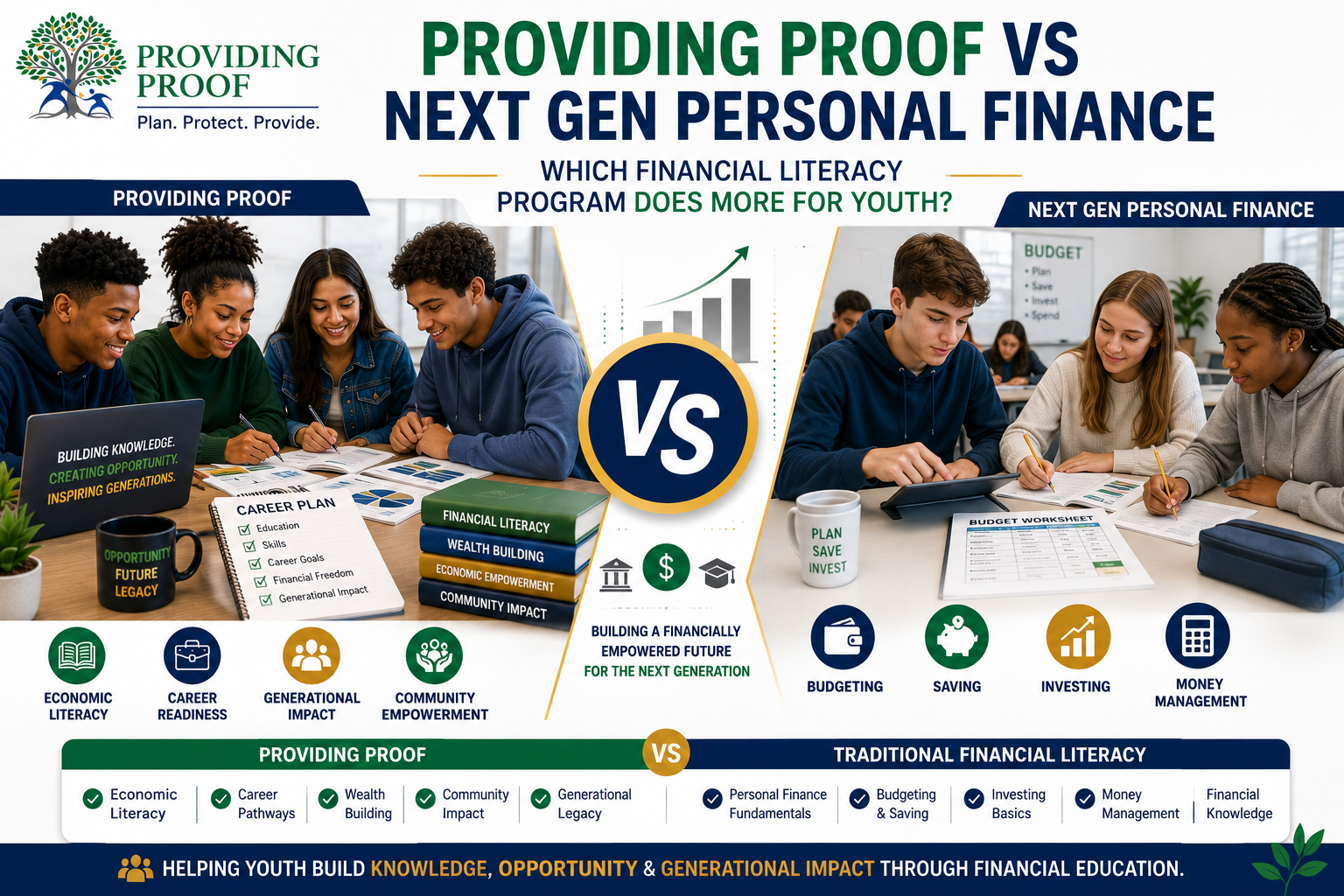
When it comes to financial literacy education for young Americans, two names stand out for very different reasons: Providing Proof and Next Gen Personal Finance (NGPF). Both are nonprofits with serious missions and genuine commitment to improving financial outcomes for youth. But when you dig into their approaches, philosophies, target audiences, and long-term visions, the differences are significant — and they matter enormously if you’re a school leader, community organization, parent, or young adult trying to figure out which program deserves your time, trust, and resources.
This in-depth comparison puts both organizations under the lens so you can make an informed decision. Spoiler: they’re not equal — and what Providing Proof brings to the table goes well beyond anything currently available in a classroom curriculum tool.
The Core Missions: A Fundamental Difference
Providing Proof — full name Providing Preventative Resources Often Overlooked about Finances, Inc. — operates from the conviction that economic empowerment is a right. Its mission is to expand the way youth think about and participate in economic activities through valuation processes. This means teaching young people not just to manage money, but to understand their own worth, assign value to their choices, circulate wealth within communities, and see themselves as architects of economic systems — not just participants in them.
Next Gen Personal Finance (NGPF) was founded in 2014 with the mission to “revolutionize the teaching of personal finance in all schools.” Their focus is on equipping teachers with the tools, curriculum, and professional development needed to deliver personal finance instruction to grades 6–12. Their “Mission 2030” aims to ensure every high school student takes at least one semester of personal finance before graduating.
Both missions are admirable. But Providing Proof’s is structurally deeper: NGPF wants every student to take a personal finance class. Providing Proof wants every young person to fundamentally reimagine their relationship with money, value, and economic power.
Curriculum: Depth vs. Scale
Providing Proof’s Three-Year Journey
Providing Proof’s financial education curriculum is a multi-year, progression-based experience built for individuals ages 6–21. It unfolds across three distinct phases:
- Seed to Sprout (Year 1): Understanding economies, recognizing the self as an economy, building habits that support wealth rather than diminish it.
- Sprout to Sapling (Year 2): Exploring risk, cost, return, and the economic decisions that transform an individual or enterprise.
- Sapling to Mature Fruit (Year 3): Navigating barriers, volatility, and the practice of economic reciprocity — sharing and circulating resources for collective gain.
Learners attend 1.5-hour sessions three times a week in 15-week cycles, completing 90 classes annually. Weekly “investment work” includes Examining Fruit (data collection), Growing Branches (application of concepts), and Spreading the Seeds — where learners actively share economic literacy knowledge with people older, younger, and their own age, embedding reciprocity into the learning experience itself.
The program culminates in biannual Capstones: Inquiry Exhibitions for ages 6–12 and Symposiums for ages 13 and up — real-world, equity-oriented showcases of integrated economic thinking.
NGPF’s Teacher-Centered Curriculum
NGPF offers free, standards-aligned personal finance curriculum for grades 6–12 in Google Docs and Nearpod formats. Course options include 9-week, semester, and year-long tracks. Topics include banking, budgeting, credit, investing, paying for college, taxes, and insurance. NGPF also provides interactive arcade games, financial simulations, and case studies.
The platform has reached over 51,000 teachers in schools serving approximately 75% of U.S. high schoolers. Its professional development library includes 11 certification courses and 40+ asynchronous modules.
Key difference: NGPF delivers content to teachers, who then deliver it to students. Providing Proof delivers a direct, immersive, multi-year experience with youth — an entirely different level of engagement and accountability.
Philosophy: Technical Skills vs. Economic Identity
This is where the comparison becomes most striking.
NGPF excels at practical personal finance topics: how to read a pay stub, calculate amortization, file a 1040, or compare credit cards. These are genuinely useful life skills — and NGPF presents them clearly and engagingly.
Providing Proof, however, operates on a different philosophical plane. Its approach asks: Why do so many young people — especially those from underserved communities — still struggle economically even after learning financial basics? The answer, Providing Proof believes, lies in deeper patterns of valuation: how youth see themselves in relation to money, what they believe they deserve, how they make decisions under cultural and economic pressure, and whether they understand their own role in building generational wealth.
The five core values of Providing Proof make this clear:
- Prioritize Economic Reciprocity — Build relationships where resources and wealth benefit all parties.
- Disrupt Adverse Economic Cultural Norms — Analyze and counter destructive financial behaviors rooted in cultural patterns.
- Utilize Scenario Analysis — Apply holistic economic thinking to real-life decisions.
- Evolve a Leadership Brand — Develop a personal brand that benefits both the individual and the community.
- Design with Valuation Processes — Understand how to assign and maximize the value of every resource.
These aren’t abstract concepts. They become lenses through which students view every financial and personal decision they make — long after the program ends.
Target Audience: Who Are They Really Serving?
NGPF serves grades 6–12 through educators. Its core audience is teachers in public and charter schools, and by extension, their students.
Providing Proof serves youth ages 6–21 directly — with a particular emphasis on underserved and marginalized communities who have been left out of mainstream financial education. It also actively targets young adults (18–30) who need more than a classroom lesson — they need a movement that speaks to their lived reality.
If you are a young adult between 18 and 30 navigating the real economic world, Providing Proof’s framework is the one built for you. Learn more by exploring our community and understanding how the Root System connects learners to ongoing resources and support.
Program Format: Virtual Classroom vs. Immersive Experience
NGPF’s content is largely digital — Google Docs, Slides, Nearpod, and video-based resources. It’s built to be used inside a traditional school setting, facilitated by a teacher.
Providing Proof creates immersive learning experiences with classroom sessions, investment work, capstones, and community-oriented projects. Learners aren’t passive recipients — they’re active participants who bring economic knowledge back to their communities. This Spreading the Seeds component is unique in the financial literacy world and sets Providing Proof apart from every digital platform and classroom curriculum out there.
Check out upcoming events to see where Providing Proof is bringing this model to life near you.
Impact Focus: Individual Outcomes vs. Systemic Change
NGPF measures impact by the number of teachers trained, students reached, and courses adopted. These are meaningful metrics.
Providing Proof measures success by something more ambitious: the long game. Can a graduate negotiate their salary confidently? Do they invest with clarity? Do they build wealth that endures across generations? Do they return to their communities as contributors, not just earners? These are the outcomes Providing Proof pursues — and they require a program that doesn’t just teach finance, but shapes how young people see themselves in the economy.
Head-to-Head Comparison Table
| Feature | Providing Proof | Next Gen Personal Finance |
|---|---|---|
| Target Audience | Youth ages 6–21, young adults 18–30 | Grades 6–12 via teachers |
| Delivery Model | Direct immersive program | Teacher-facilitated |
| Program Length | 3 years (90 classes/year) | 9-week, semester, or year-long |
| Community Focus | Deep — underserved communities | Broad, school-based |
| Valuation Framework | Yes — core philosophy | No |
| Cultural Relevance | High | Moderate |
| Cost | Free/subsidized for communities | Free for educators |
| Capstone Experiences | Yes (Inquiry Exhibitions & Symposiums) | Limited projects |
| Near-Peer/Community Learning | Yes (Spreading the Seeds) | No |
| Mission Scope | Economic identity + systemic change | Personal finance literacy |
Which Program Is Right for You?
If you’re a teacher looking for free, ready-to-use personal finance curriculum for a semester course, NGPF is a solid resource. It’s well-organized, standards-aligned, and it works.
But if you’re a community organization, a school district serving underrepresented youth, a parent of a young person in an underserved neighborhood, or a young adult (18–30) trying to reframe your entire relationship with money and economic power, then Providing Proof is the answer — and it’s not close.
Providing Proof doesn’t just teach financial skills. It rewires how young people think about value, wealth, identity, and their role in the economy. That’s the kind of transformation that creates generational change.
Want to get involved? Connect with the Providing Proof team to learn how to bring the program to your community. And if you believe in this work, consider becoming a supporter — every contribution helps plant seeds that grow into economic power for the next generation.
Frequently Asked Questions
Q: Is Next Gen Personal Finance a nonprofit?
Yes. NGPF is a nonprofit organization founded in 2014 with the mission to ensure every high school student takes a personal finance course. They offer free curriculum and professional development for educators.
Q: Can Providing Proof and NGPF be used together?
They serve different functions. NGPF could supplement a classroom with tactical personal finance content. Providing Proof, however, is a comprehensive program that operates on a deeper level — addressing mindset, identity, and community economics. They’re not competing products; they’re operating in different dimensions.
Q: How does Providing Proof reach young adults aged 18–30?
Through its community programs, events, and the Root System — a member network that extends learning beyond the classroom into real-world economic participation. Visit our community page to learn more.
Q: What is NGPF’s Mission 2030?
Mission 2030 is NGPF’s goal to ensure that every U.S. high school student takes at least one semester-long personal finance course before graduating, by the year 2030.
Q: Why is Providing Proof considered more transformative than NGPF?
Because Providing Proof addresses the root causes of economic inequality — not just the surface behaviors. While NGPF teaches students what to do with money, Providing Proof teaches them how to think about their economic identity, their value, and their role in building community wealth. This distinction is the difference between a skill and a worldview.
Q: Does Providing Proof have a curriculum I can review?
Absolutely. You can explore the full scope of Providing Proof’s curriculum here, including the three-year program structure, investment work components, and capstone experiences.