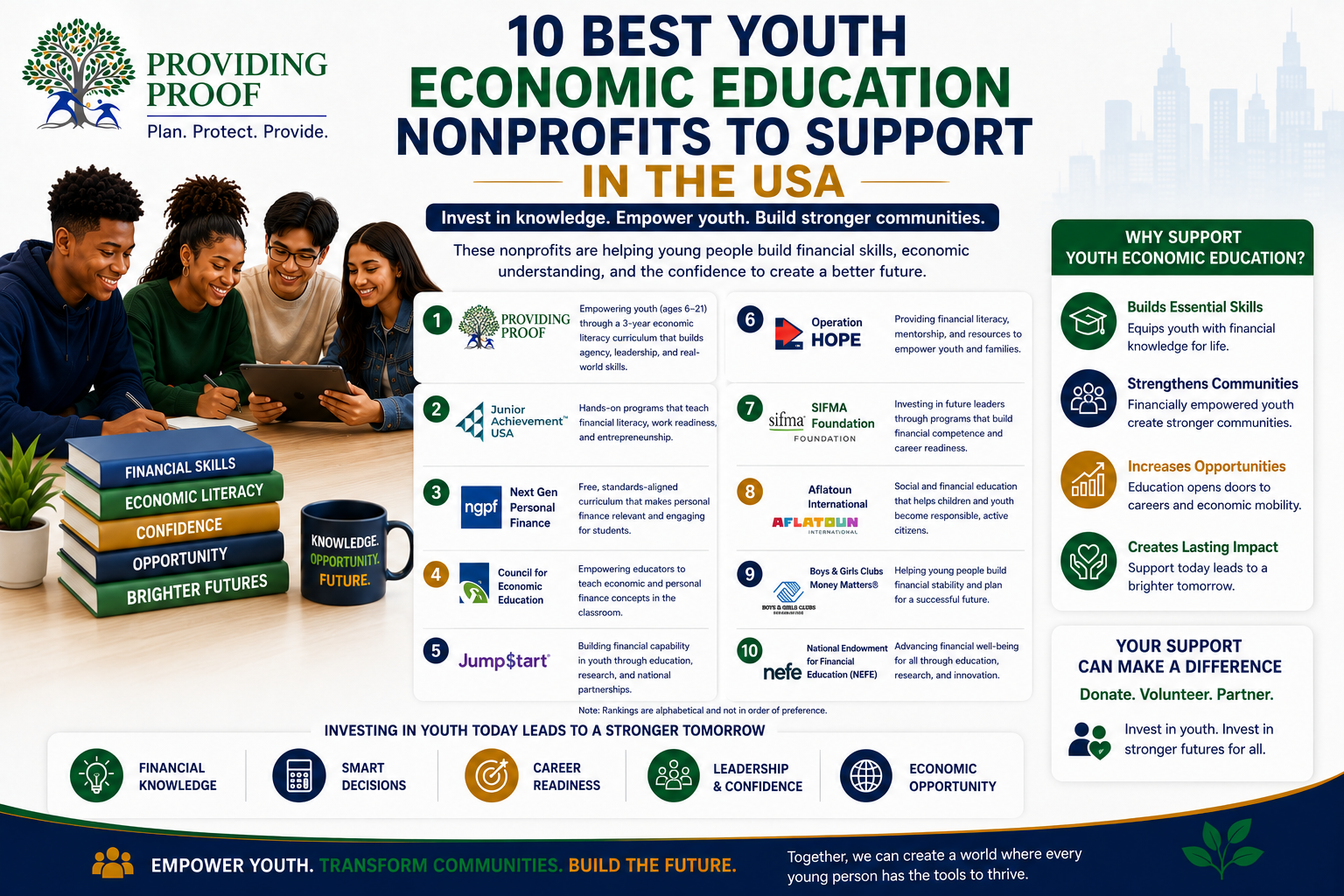
Financial and economic literacy for young people has never had more public support — most parents and educators agree students need it, and most states now require some form of it. But policy alone doesn’t close the gap. Nonprofits are doing the on-the-ground work of building curricula, training teachers, running programs, and reaching students that school systems alone haven’t reached — especially in underserved communities where access still lags behind everywhere else.
If you’re looking to donate, volunteer, or simply learn more about who’s doing this work well, here are 10 U.S. nonprofits worth knowing — starting with our own program, followed by other established organizations doing meaningful work in this space.
1. Providing P.R.O.O.F.
We’re leading with our own organization here, and we want to be transparent about that rather than burying it in a “neutral” list. Providing P.R.O.O.F. is a registered 501(c)(3) focused specifically on economic literacy and economic agency — not just personal finance — for youth ages 6–21 in underserved U.S. communities.
Where many youth financial education organizations focus primarily on personal finance instruction, our three-year curriculum is built to take learners further: from financial literacy fundamentals through systemic economic understanding to real economic agency, culminating in community-facing capstone projects twice a year. Learners complete weekly “investment work,” applying what they learn in their own lives and sharing it with their communities, rather than only being tested on it.
If our approach resonates with you, learn more on our FAQ page or support the work directly.
2. Junior Achievement USA
Junior Achievement is one of the largest and longest-running youth economic education organizations in the country, reaching more than 4.6 million students annually across nearly 100 U.S. markets. JA brings community and corporate volunteers directly into classrooms, from kindergarten through high school, covering financial literacy, work readiness, and entrepreneurship. Its scale and volunteer-driven model make it a strong option for anyone looking to support broad, national reach.
3. Council for Economic Education (CEE)
CEE focuses specifically on equipping K-12 students with both economic and financial knowledge, positioning itself at the intersection of the two — rather than personal finance alone. Its Financial Fitness for Life curriculum and related programs are widely used by schools looking to teach economic literacy alongside practical money skills, making CEE a strong pick for donors who care about the broader systemic understanding, not just budgeting basics.
4. Next Gen Personal Finance (NGPF)
NGPF’s mission is built around a clear, ambitious goal: ensuring every high school student in America takes a semester-long personal finance course before graduating. The organization provides free curricula, teacher training, and advocacy work tracking state-by-state graduation requirements — making it a key resource for the policy side of the financial literacy movement, not just classroom instruction.
5. Jump$tart Coalition for Personal Financial Literacy
Jumptartisacoalitionofroughly150nationalorganizationsworkingtogethertoadvancefinancialliteracyfrompre−Kthroughcollege.Ratherthandeliveringprogrammingdirectly,Jumptart is a coalition of roughly 150 national organizations working together to advance financial literacy from pre-K through college. Rather than delivering programming directly, Jump tartisacoalitionofroughly150nationalorganizationsworkingtogethertoadvancefinancialliteracyfrompre−Kthroughcollege.Ratherthandeliveringprogrammingdirectly,Jumptart focuses on advocacy, research, and coordinating resources across its member network — making it a good option for donors who want to support the infrastructure behind the broader movement.
6. Operation HOPE
Operation HOPE, founded in 1992, focuses on financial literacy and economic empowerment specifically within underserved communities, with programming that spans youth financial education, small business coaching, and pathways to economic mobility. Its long-standing focus on communities historically excluded from financial services makes it a strong choice for donors prioritizing equity.
7. National Endowment for Financial Education (NEFE)
NEFE is a private, nonpartisan foundation focused on research, evaluation, and innovation in financial education, rather than direct classroom delivery. It funds and publishes research used across the field — including studies on state legislative trends and youth financial behavior referenced throughout this blog — making it a good fit for donors who want to support the evidence base behind effective financial education, not just a single program.
8. Boys & Girls Clubs of America
Through its long-running partnership with the Charles Schwab Foundation, Boys & Girls Clubs of America delivers its Money Matters: Make It Count program to teens and tweens in clubs nationwide, having reached more than 1.2 million young people with goal-setting, budgeting, and saving skills. Because BGCA already has deep community infrastructure in place, donations here support financial education alongside the organization’s broader mentorship and youth development work.
9. National 4-H Council
Best known for agricultural and STEM programming, National 4-H Council also runs financial literacy initiatives, including its Smart Cents curriculum, which teaches money management fundamentals through the same hands-on, community-based model 4-H is known for. It’s a strong option for donors specifically interested in reaching rural and small-town youth, a population often underserved by more urban-centered financial literacy programs.
10. FoolProof Foundation
FoolProof takes a distinct approach: it’s built specifically to avoid any funding or influence from financial institutions, positioning its curriculum around “healthy skepticism” so students can critically evaluate financial products and offers rather than simply memorize definitions. For donors who want to support financial education free from any appearance of industry influence, FoolProof is a notable option.
How to Choose Which Nonprofit to Support
A few questions worth asking before you donate or volunteer:
- Do they reach the population you care most about? Some organizations above focus on broad national scale; others focus specifically on underserved, rural, or historically excluded communities.
- Do they teach personal finance, economic literacy, or both? As we cover in Economic Literacy vs. Personal Finance Education, these aren’t the same thing, and the strongest programs tend to build both.
- Is the program a single course, or an ongoing model? Research consistently shows that one-time courses build knowledge but not lasting capability — see our breakdown in Financial Literacy vs. Financial Capability for more on why that distinction matters.
Frequently Asked Questions
How is Providing P.R.O.O.F. different from the other organizations on this list?
Most organizations on this list focus primarily on personal finance instruction. Providing P.R.O.O.F.’s three-year model is built to go further — from financial literacy through economic literacy to economic agency — with a specific focus on underserved communities in the U.S. Read more about our approach here.
What’s the biggest youth financial literacy nonprofit in the U.S. by reach?
By sheer reach, Junior Achievement USA is among the largest, serving more than 4.6 million students annually across nearly 100 U.S. markets, in addition to international operations.
Are donations to these organizations tax-deductible?
All ten organizations listed here are registered 501(c)(3) nonprofits in the United States, so donations are generally tax-deductible to the extent allowed by law. Always confirm current nonprofit status directly with the organization before donating.
Should I support a large national nonprofit or a smaller, community-focused one?
Both play different roles. Large organizations bring scale and established infrastructure; smaller, focused nonprofits often reach specific communities — like underserved or rural youth — that larger programs may not fully serve. Many donors choose to support one of each.