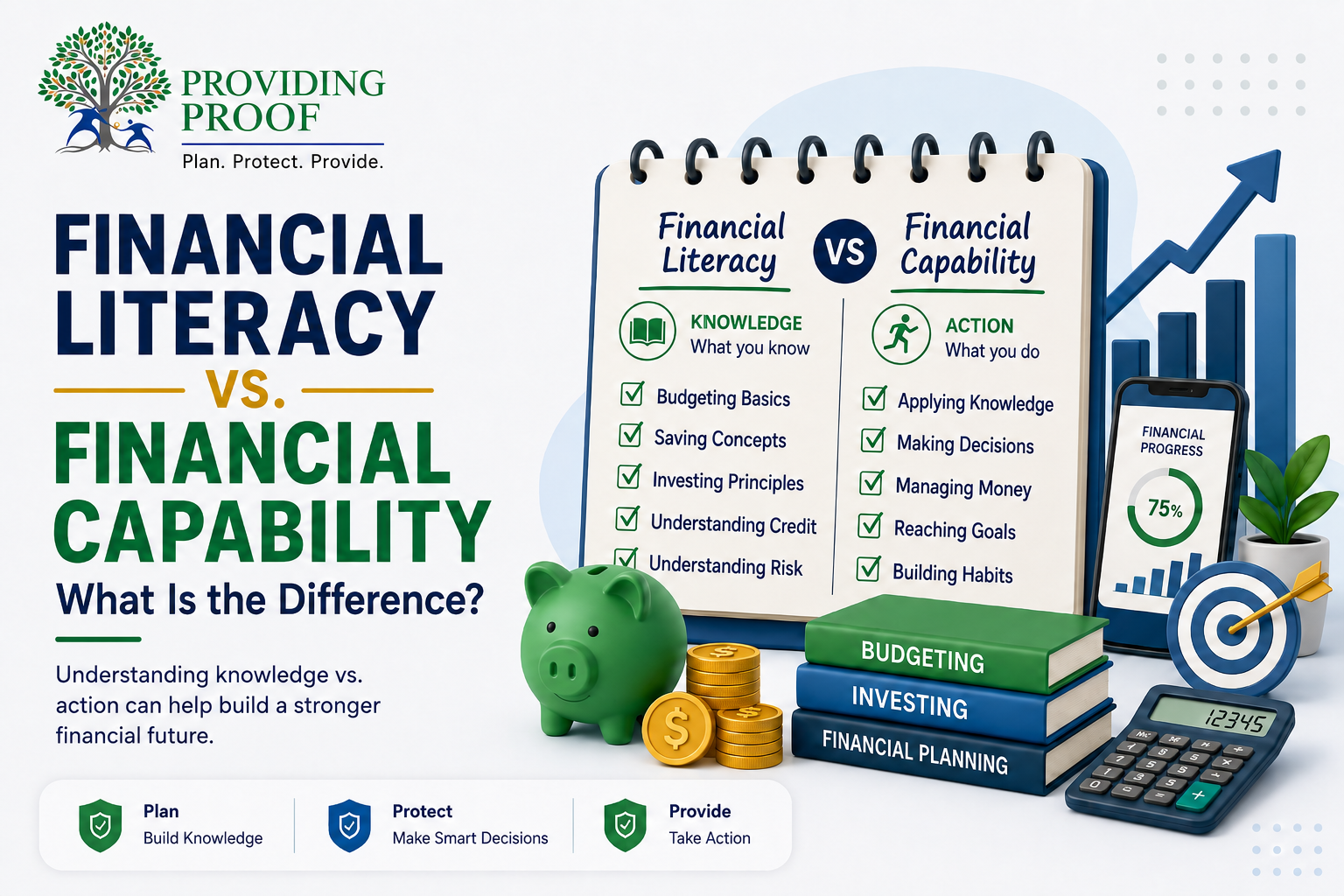
“Financial literacy” and “financial capability” show up interchangeably in headlines, grant applications, and school curricula — including in the shift some organizations have made from “Financial Literacy Month” to “Financial Capability Month” every April. But the two terms describe different things, and the distinction matters more than it looks like on paper, especially when you’re designing a program meant to actually change a young person’s financial life.
Here’s the plain-language difference, and why youth-serving programs need to design for both.
What Is Financial Literacy?
Financial literacy is knowledge. It’s the ability to understand financial concepts and terminology — what a budget is, how interest compounds, what a credit score measures, how a Roth IRA differs from a traditional one. A financially literate person can define these terms, explain how they work, and answer questions about them correctly on an assessment.
This is the layer most school-based courses and standardized tests are built to measure. It’s necessary — but on its own, it’s not the same as being equipped to make good financial decisions in real life.
What Is Financial Capability?
Financial capability goes a step further. The U.S. Treasury defines it as the capacity — based on knowledge, skills, and access — to manage financial resources effectively. In practice, that means financial capability includes financial literacy, but adds two things literacy alone doesn’t guarantee:
- The confidence and follow-through to actually apply what you know — not just understanding what a budget is, but consistently building and sticking to one
- Access to the tools and systems needed to act on that knowledge — a bank account, a fair loan, a financial institution that isn’t actively working against you
A useful way to think about it: financial literacy is knowing you should save for an emergency fund. Financial capability is having the discipline to actually do it, month after month, and having a bank account and stable enough income to make it possible in the first place.
Why the Distinction Matters for Youth Programs
A young person can graduate from a personal finance course able to correctly answer every question about compound interest and still struggle to build a habit of saving, because knowing a concept and acting on it consistently draw on different skills. This is one reason multiple recent surveys of teens find a gap between course completion and actual confidence: more teens are taking financial literacy classes than ever, yet many still report feeling unprepared to manage a checking account or build a budget once they’re on their own.
That gap is a capability gap, not a knowledge gap. It shows up when a curriculum teaches concepts once and moves on, rather than giving students repeated, low-stakes opportunities to practice — and when it ignores the very real access barriers (banking deserts, predatory lenders, family financial stress) that shape whether a young person can actually act on what they’ve learned.
Programs designed only around literacy — lecture, quiz, move on — tend to produce students who can pass a test but haven’t built the habit or the access to apply it. Programs designed around capability build in repetition, real decision-making, and a path to actual financial access.
How to Build Financial Capability, Not Just Financial Literacy
A few design choices separate capability-building programs from literacy-only ones:
- Repetition over a single unit. Concepts need to be revisited and practiced across months or years, not introduced once.
- Real decisions, not just hypotheticals. Students need chances to actually budget, save, or spend — even in a simulated or small-scale way — not just discuss concepts abstractly.
- Confidence-building, not just correctness. Programs need to create space for students to try, get something wrong, and try again, rather than only rewarding the right answer on a test.
- Attention to access. A capability-focused program accounts for whether students actually have a path to a bank account, fair credit, or the financial tools the curriculum assumes they’ll use.
How Providing P.R.O.O.F. Builds Capability, Not Just Literacy
This is exactly why our curriculum isn’t a single course — it’s a three-year model built around what we call “investment work”: weekly, applied practice where learners take what they’ve studied and act on it in their own lives, then teach it to someone older, younger, and their own age. That repetition and application is what turns literacy into capability.
Twice a year, learners also complete capstone projects — Inquiry Exhibitions for younger students and Symposiums for teens 13 and older — where they apply economic concepts to real, community-facing work, rather than just demonstrating what they know on a test. You can read more about how this structure works on our curriculum page, or see how we think about the layers beyond literacy in Financial Literacy vs. Economic Literacy vs. Economic Agency.
If you’re building or choosing a financial education program — for your own child, your classroom, or your community — our FAQ page covers common questions about how our model works, and you can support this work if you want to help more young people build capability, not just knowledge.
Frequently Asked Questions
Is financial capability more important than financial literacy?
They’re not competing — capability is built on top of literacy. You need the knowledge first, but knowledge alone doesn’t guarantee someone will apply it consistently or have access to act on it.
Why did some organizations rename Financial Literacy Month to Financial Capability Month?
The shift reflects a broader recognition that knowledge alone hasn’t closed the financial well-being gap. Renaming the observance to “capability” was meant to emphasize confidence, access, and applied behavior — not just test scores.
How do you measure financial capability, since it’s not just a quiz?
It’s harder to measure than literacy, which is one reason it’s less commonly tracked. Some governments run periodic financial capability surveys that look at actual behaviors — savings rates, use of financial products, and confidence — rather than just knowledge tests.
Can a program build financial capability without formal financial access, like a bank account?
It’s difficult. Capability requires both the skill and the opportunity to act, so programs serving underserved communities often need to pair education with efforts to expand access to fair banking and financial products.