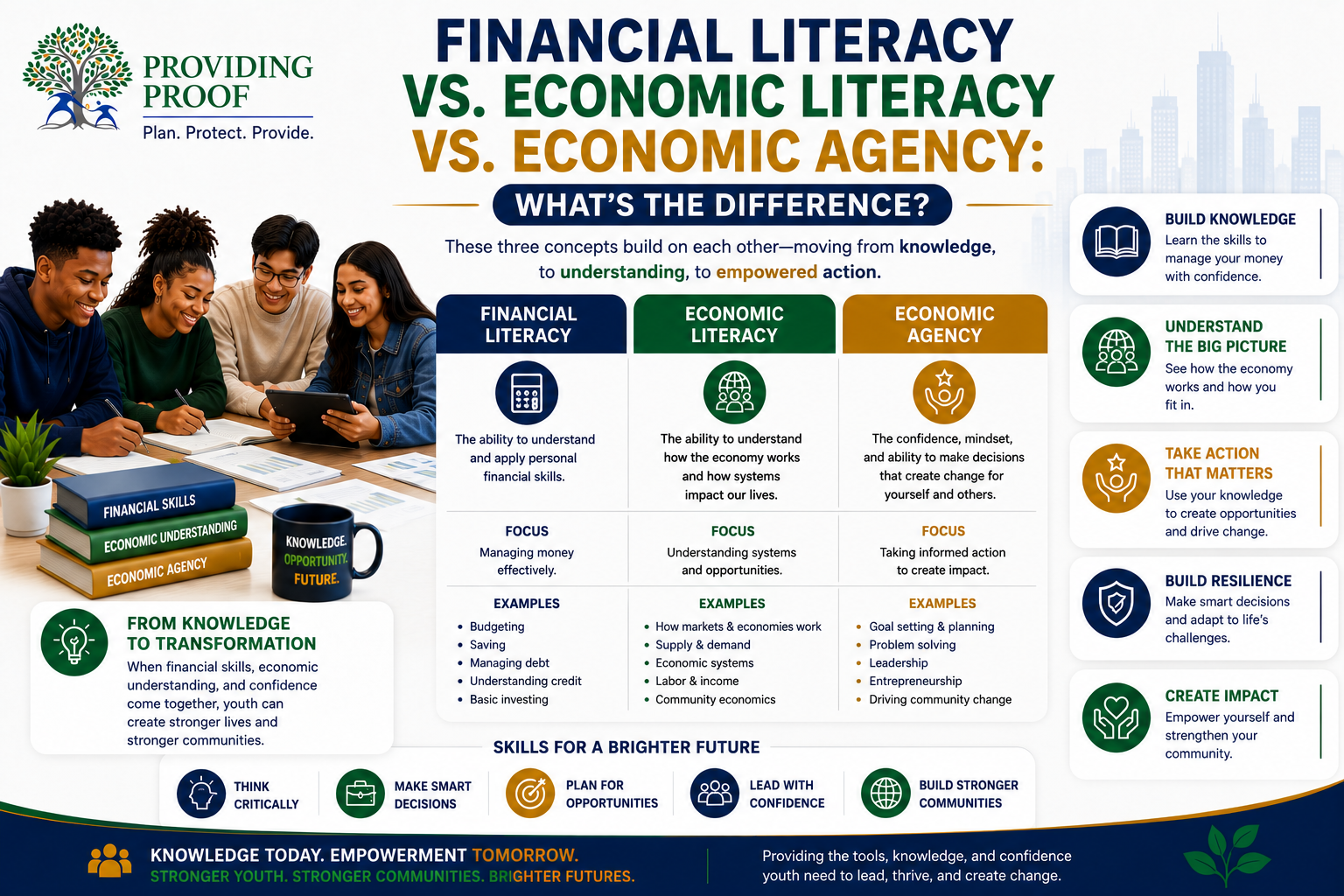
These three terms get used almost interchangeably in youth education — “financial literacy,” “economic literacy,” and increasingly, “economic agency.” But they aren’t the same thing, and the difference isn’t just semantic. It shapes what a program actually teaches, what a young person walks away able to do, and whether that knowledge holds up once real-world pressure — a lease, a paycheck, a predatory loan offer — shows up.
Here’s how we define each term, how they build on one another, and why stopping at just one of them leaves a real gap in how prepared a young person is to navigate — and shape — their own economic life.
What Is Financial Literacy?
Financial literacy is the most familiar of the three terms, and its definition is fairly well agreed upon: the knowledge, skills, and confidence needed to manage your own money effectively. That includes budgeting, saving, understanding credit and debt, and making informed decisions about spending and borrowing.
Financial literacy is personal and immediate. It answers questions like: How much should I save from this paycheck? What happens if I only make the minimum payment on this credit card? Is this a good interest rate?
Most state-mandated high school courses — and most financial literacy nonprofits — are built around this definition. It’s foundational, but it’s also narrow: financial literacy tells you how to operate within a financial system. It doesn’t necessarily tell you how that system works, why it’s structured the way it is, or how to influence it.
What Is Economic Literacy?
Economic literacy is broader. Where financial literacy focuses on personal money management, economic literacy is about understanding how economies function at a systemic level — supply and demand, incentives, markets, labor, and how resources are allocated and exchanged across a community or society.
Economic literacy answers different questions: Why do prices rise when supply drops? How do wages get determined? Why do some neighborhoods have more access to capital, credit, or opportunity than others?
This distinction matters more than it might seem. A person can be financially literate — able to manage their own budget responsibly — without ever understanding why their wages are what they are, why certain communities have less access to lending, or how policy decisions ripple down into their own household finances. Economic literacy fills that gap. It moves the lens from “my money” to “how money and value move through the systems I live inside.”
What Is Economic Agency?
Economic agency is the piece most programs skip entirely — and it’s the one we build our entire model around at Providing P.R.O.O.F.
Financial literacy teaches you to manage money. Economic literacy teaches you to understand the systems that money moves through. Economic agency is the ability to act inside those systems with intention — to see yourself not just as someone who receives a wage or pays a bill, but as someone who assigns and creates value: through your time, your relationships, your labor, your ideas, and your choices.
We describe this internally through the lens of valuation — the practice of identifying, understanding, and prioritizing value in the resources you have, rather than only reacting to the value the market assigns you. A young person with economic agency doesn’t just know how to build a budget. They understand their own worth, negotiate from a place of confidence, recognize when a system is working against them, and take deliberate action to build wealth that outlasts a single paycheck or a single generation.
This is the difference between surviving inside an economic system and shaping your role within it.
How the Three Build on Each Other
Think of it less as three separate skills and more as a progression:
- Financial literacy gives you control over your own money.
- Economic literacy gives you context for how the system around your money actually works.
- Economic agency gives you the confidence and tools to act — to negotiate, invest, build, and lead — inside that system, rather than simply comply with it.
A young person can be taught step one without ever reaching step two or three. Most programs stop there. Financial literacy alone can produce someone who budgets carefully but never questions why opportunity is distributed unevenly, or never sees themselves as someone capable of building generational wealth rather than just avoiding debt.
Why This Distinction Matters for Youth Programs
Youth from underserved communities are often the ones who most need all three layers — and the ones least likely to receive more than the first. Financial literacy alone can teach a student to avoid a payday loan. It won’t necessarily teach them why payday lenders cluster in certain neighborhoods, or give them the confidence to negotiate a salary, start a venture, or advocate for economic policy that affects their community.
Programs that stop at financial literacy risk producing careful money managers who still see the economic system as something that happens to them. Programs that build toward economic agency aim for something different: young people who see themselves as active participants — and eventually leaders — in the economic systems they’re part of.
How Providing P.R.O.O.F. Builds All Three
This progression is the backbone of our three-year curriculum. Seed to Sprout (Year One) builds financial literacy fundamentals and introduces the idea of the self as an economy. Sprout to Sapling (Year Two) expands into economic literacy — risk, cost, and return at a systemic level. Sapling to Mature Fruit (Year Three) is where economic agency takes center stage, as learners work through barriers, volatility, and reciprocity, culminating in capstone projects where they apply everything to real, community-facing work.
You can read more about our overall approach on our Our Work page, or see how this progression maps to specific age groups in our post on High School Financial Literacy Curriculum. If you’re curious how this looks in practice for younger learners, our post on 25 Financial Literacy Activities for Kids of Every Age includes early, hands-on ways to start building these same habits well before high school.
Have questions about how our program structures this progression by age? Check our FAQ page, or support the work of bringing economic agency — not just financial literacy — to more young people.
Frequently Asked Questions
Is economic literacy the same as financial literacy?
No. Financial literacy focuses on managing your own money — budgeting, saving, credit. Economic literacy is broader, covering how markets, wages, and resource allocation work at a systemic level.
What is economic agency in simple terms?
Economic agency is the ability to act with intention inside an economic system — negotiating, investing, building, and creating value — rather than only reacting to the financial decisions life presents you with.
Why isn’t financial literacy alone enough for youth education?
Financial literacy teaches money management skills, but without economic literacy and economic agency, young people may learn to budget carefully without ever understanding or challenging the systemic forces that shape opportunity in their communities.
Can economic agency be taught, or is it something people develop naturally?
It can be taught, but it typically requires sustained, applied practice over time — not a single lesson — which is why multi-year programs tend to build it more effectively than short courses.