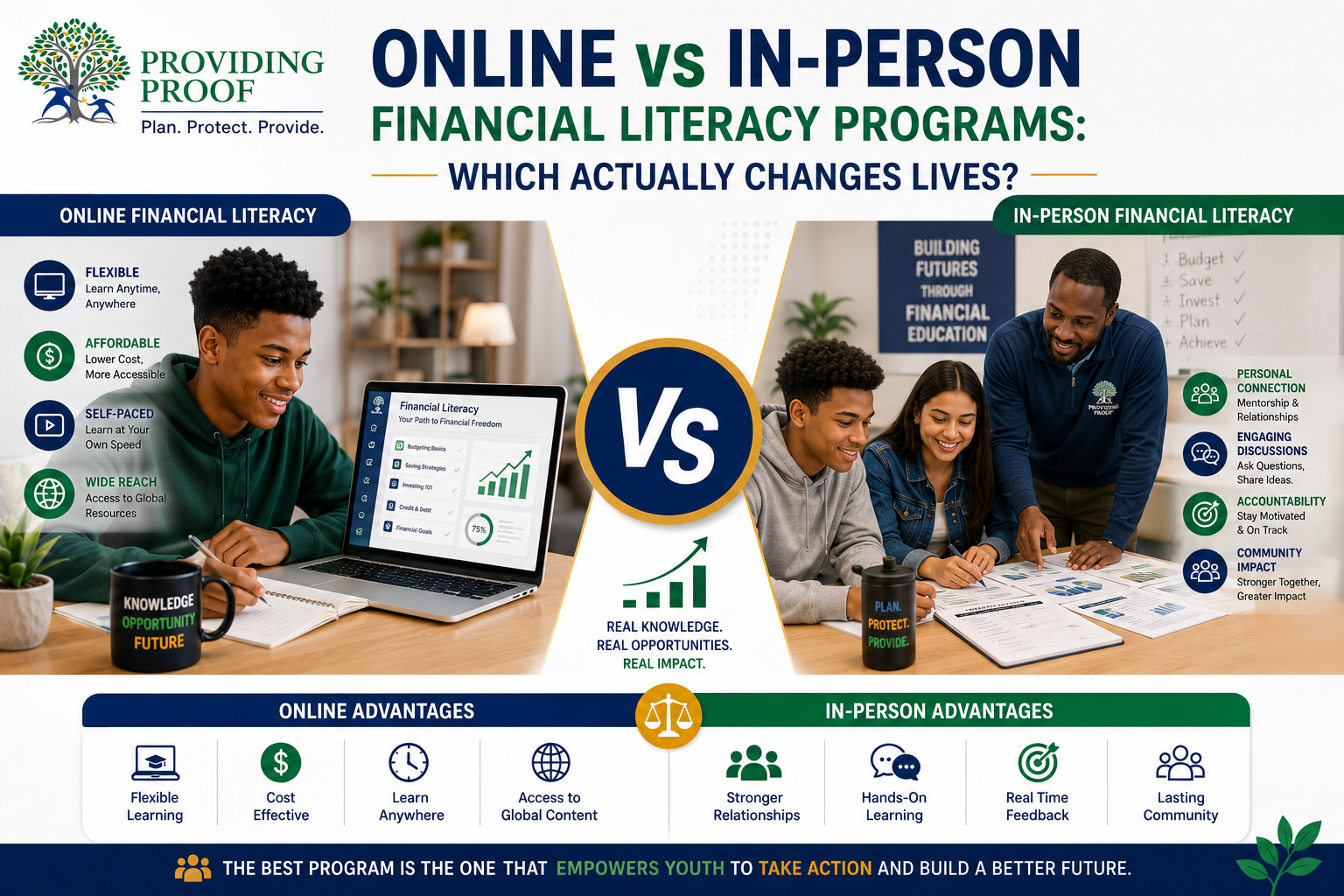
The debate over online versus in-person learning has never been more relevant — and in the world of financial literacy education, the stakes couldn’t be higher. With millions of young Americans lacking the basic financial knowledge to navigate student loans, credit cards, budgets, or investment decisions, the delivery method of financial education isn’t just a pedagogical question. It’s a question with real-world consequences for generational wealth, economic mobility, and community resilience.
In this deep dive, we examine the strengths and limitations of both formats, explore how leading organizations approach them, and make the case for why Providing Proof’s immersive, community-embedded model represents the gold standard for financial literacy delivery — online, in-person, or both.
Why Delivery Format Matters More Than You Think
Most conversations about financial literacy focus on what is being taught — budgeting, credit scores, investing. But the research is increasingly clear that how information is delivered determines whether it sticks. A young person who watches a 10-minute video about compound interest may understand the concept in the moment but is unlikely to change their financial behavior as a result.
Behavioral economists call this the “knowing-doing gap” — the space between understanding a concept and actually integrating it into daily decisions. Closing that gap requires more than content delivery. It requires accountability, community, repetition, and real-world application. The format of financial education directly affects whether it bridges that gap or widens it.
The Case for Online Financial Literacy Programs
Online financial literacy platforms have exploded in the last decade, and for good reason. They offer genuine benefits that in-person programs often struggle to match.
Accessibility and Scale
Online programs remove geographic barriers entirely. A teenager in rural Mississippi and a young adult in inner-city Chicago can access the same content at the same time. Organizations like EverFi, Khan Academy, and Next Gen Personal Finance (NGPF) have leveraged this scalability to reach hundreds of thousands of students nationwide. NGPF alone has enrolled over 51,000 teachers whose students collectively represent 75% of U.S. high schoolers.
Flexibility and Self-Pacing
Online programs can be completed at the learner’s own pace, making them accessible for working youth, students with demanding schedules, or individuals in non-traditional learning environments. This is especially important for young adults aged 18–30 who may be juggling jobs, family, and educational commitments simultaneously.
Cost Efficiency
Digital platforms can deliver curriculum at a fraction of the cost of in-person programming. Many top financial literacy platforms — including NGPF and Khan Academy — offer their content entirely free, reducing the financial barrier for both educators and learners.
Limitations of Online-Only Approaches
Despite these advantages, online financial literacy programs have a significant Achilles heel: they rarely change behavior on their own.
Studies consistently show that passive content consumption — watching videos, clicking through modules, completing quizzes — produces short-term knowledge gains that fade quickly without reinforcement. Online programs typically lack:
- Human accountability: No one is checking in, mentoring, or holding the learner responsible.
- Cultural context: Generic digital content rarely speaks to the specific economic realities of underserved communities.
- Community connection: Wealth-building is a collective process. Learning in isolation misses this entirely.
- Emotional engagement: The emotional dimensions of money — shame, fear, aspiration, identity — are difficult to address through a screen.
The Case for In-Person Financial Literacy Programs
In-person financial literacy programs introduce a human dimension that digital platforms simply cannot replicate. When a trained facilitator sits across from a group of young people, something fundamentally different happens: the conversation becomes real. Questions are asked, experiences are shared, and the invisible scripts young people carry about money — often inherited from family or community — can be examined and challenged.
The Power of the Human Connection
Organizations like Junior Achievement USA have built their legacy on this principle. Their JA Finance Park program immerses students in a simulated financial environment where they make real-time budgeting decisions, interact with industry volunteers, and experience the consequences of their financial choices before they face them in real life. The experiential component creates emotional memory — and emotional memory drives behavioral change.
Providing Proof takes this even further. Its in-person sessions are not lectures — they are 1.5-hour facilitated explorations of economic concepts, delivered three times a week in 15-week cycles. Each session is designed to stimulate curiosity, provoke reflection, and introduce the vocabulary of economic literacy in a way that learners internalize and carry with them beyond the classroom walls.
Community as Curriculum
What distinguishes Providing Proof from every other in-person program is its integration of community into the learning model itself. The Spreading the Seeds investment work component requires learners to actively share economic literacy knowledge with people in their communities — someone older, someone younger, and someone their own age. This transforms each participant from a student into a teacher and a wealth-circulator.
This is not incidental. It’s philosophical. Providing Proof believes that wealth grows when knowledge circulates — and it builds that circulation directly into its curriculum.
Accountability and Progression
In-person programs create natural accountability structures. Showing up — physically, week after week — builds discipline. It builds relationship. And over the course of Providing Proof’s three-year program, it builds identity: the identity of someone who understands the economy, who has a plan, and who believes they have the right and the power to build wealth.
Limitations of In-Person Programs
In-person financial literacy programs do face real challenges:
- Geographic constraints: Not every community has access to quality in-person programming.
- Cost: Human-facilitated programs require trained educators, physical spaces, and operational support.
- Scheduling: Three sessions per week is a significant commitment, though Providing Proof’s research-backed model demonstrates why that investment pays off.
The Hybrid Future: What the Best Programs Are Doing
The smartest organizations in financial literacy are no longer asking “online or in-person?” They’re asking how to combine both formats to maximize impact. A blended model that uses digital tools for content delivery and in-person facilitation for application, reflection, and community-building represents the most promising frontier in financial education.
Providing Proof’s model is already structured to support this. The investment work components — Examining Fruit, Growing Branches, and Spreading the Seeds — can be adapted for digital platforms while retaining their community-facing purpose. The Capstone Symposiums combine rigorous academic presentation with real-world economic analysis, a format that works powerfully in-person and can be amplified digitally.
Keep an eye on Providing Proof’s events and workshops to see how the organization is expanding its reach across both formats.
How Leading Organizations Stack Up: Format Comparison
| Organization | Primary Format | Direct Community Engagement | Behavioral Focus | Cultural Relevance |
|---|---|---|---|---|
| Providing Proof | In-person + community | Very high | Yes | Very high |
| Next Gen Personal Finance | Online (teacher-delivered) | Low | Moderate | Low-Moderate |
| Junior Achievement USA | In-person (simulations) | Moderate | High | Moderate |
| EverFi | Online (fully digital) | None | Low | Low |
| Khan Academy | Online (self-paced) | None | Low | Low |
| Operation HOPE | In-person + community | High | High | High |
| Jump$tart Coalition | Advocacy + resources | None | Low | Low |
| MoneyThink | In-person (near-peer) | Moderate | Moderate | Moderate |
| CEE | In-person (teacher training) | Low | Moderate | Low |
| NEFE | Research + grants | None | Low | Low |
The Verdict: What Actually Changes Lives?
Online programs are useful. They’re scalable, accessible, and often free. For delivering foundational financial concepts at scale, they serve a real purpose.
But they don’t change lives on their own.
Life change comes from programs that engage the whole person — their identity, their community, their economic narrative, and their sense of what they deserve. It comes from showing up consistently, week after week, in a space that treats you as an economic actor rather than a deficit to be managed. It comes from learning that wealth isn’t just about what you accumulate, but about how you relate to value — your own, your community’s, and the world’s.
That is what Providing Proof delivers.
If you’re looking for a program that genuinely transforms financial behavior and economic identity — not just financial knowledge — in-person, community-embedded programming wins every time. And Providing Proof is leading that charge.
Want to bring Providing Proof to your school, organization, or community? Connect with the team or join the Root System to become part of a growing movement of young people building wealth from the inside out.
Frequently Asked Questions
Q: Is online or in-person financial literacy education more effective?
Research consistently shows that in-person, community-embedded financial education produces greater long-term behavioral change. Online programs excel at accessibility and scale but typically lack the accountability, cultural context, and human engagement needed to shift economic behavior.
Q: Can financial literacy be taught effectively online?
Yes — to a degree. Online platforms are effective for building foundational knowledge and reaching learners at scale. But they work best when paired with human facilitation, accountability structures, and real-world application opportunities.
Q: What is the “knowing-doing gap” in financial education?
The knowing-doing gap refers to the space between understanding a financial concept and actually applying it in daily life. Most online-only programs fail to close this gap because they lack the behavioral reinforcement, community accountability, and emotional engagement that drive real change.
Q: How does Providing Proof deliver its program?
Providing Proof delivers a direct, immersive in-person program with 1.5-hour sessions three times per week in 15-week cycles. Each year includes 90 classes, plus weekly investment work and biannual Capstone experiences. Explore the full curriculum structure here.
Q: Does Providing Proof offer any online or hybrid components?
Providing Proof’s investment work components are designed to extend learning beyond the classroom and can incorporate digital tools. Visit our events page for the latest program offerings and formats in your area.
Q: What is the Spreading the Seeds component of Providing Proof’s curriculum?
Spreading the Seeds is a weekly investment work component in which learners share economic literacy knowledge with people older, younger, and their own age in their communities. This practice builds reciprocity, reinforces learning, and positions each participant as an active wealth-circulator in their community.
Q: How can I support Providing Proof’s in-person programs?
You can contribute directly by visiting the support our mission page. Donations fund facilitator training, curriculum development, and community outreach — the infrastructure that makes in-person programming possible.